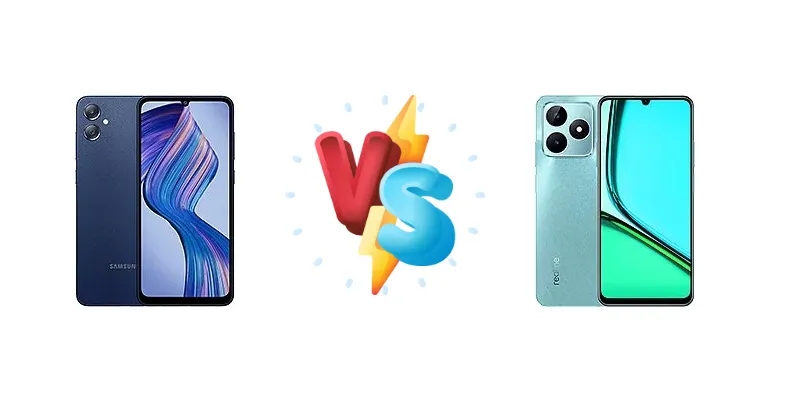
The sub-$150 smartphone market is fiercely competitive, and the Realme C51s and Samsung Galaxy F05 are two contenders vying for your attention. Both aim to deliver essential smartphone functionality at an accessible price, but they take different approaches to achieving this, primarily through their chipset choices and charging capabilities. This comparison will dissect those differences to help you determine which device best suits your needs.
🏆 Quick Verdict
For the average user prioritizing faster charging and potentially smoother multitasking, the Realme C51s emerges as the better choice. Its 33W charging significantly reduces downtime compared to the F05’s 25W, and while the chipset difference is subtle, the C51s offers a slight edge in everyday responsiveness.
| Network |
|---|
| 2G bands | GSM 850 / 900 / 1800 / 1900 | GSM 850 / 900 / 1800 / 1900 |
| 3G bands | HSDPA 850 / 900 / 2100 | HSDPA 900 / 2100 |
| 4G bands | 1, 3, 5, 7, 8, 20, 28, 38, 40, 41 | 1, 3, 5, 8, 38, 40 |
| Speed | HSPA, LTE | HSPA, LTE |
| Technology | GSM / HSPA / LTE | GSM / HSPA / LTE |
| Launch |
|---|
| Announced | 2024, September 17 | 2024, March 15 |
| Status | Available. Released 2024, September 20 | Available. Released 2024, March 15 |
| Body |
|---|
| Build | Glass front, plastic frame, silicone polymer (eco leather) back | Glass front, plastic frame, plastic back |
| Dimensions | 168.8 x 78.2 x 8.8 mm (6.65 x 3.08 x 0.35 in) | 167.2 x 76.7 x 7.5 mm (6.58 x 3.02 x 0.30 in) |
| SIM | Nano-SIM + Nano-SIM | Nano-SIM + Nano-SIM |
| Weight | 195 g (6.88 oz) | 182 g (6.42 oz) |
| Display |
|---|
| Resolution | 720 x 1600 pixels, 20:9 ratio (~262 ppi density) | 720 x 1600 pixels, 20:9 ratio (~260 ppi density) |
| Size | 6.7 inches, 108.4 cm2 (~82.1% screen-to-body ratio) | 6.74 inches, 109.7 cm2 (~85.5% screen-to-body ratio) |
| Type | PLS LCD | IPS LCD, 90Hz, 560 nits (peak) |
| Platform |
|---|
| CPU | Octa-core (2x2.0 GHz Cortex-A75 & 6x1.8 GHz Cortex-A55) | Octa-core (2x1.8 GHz Cortex-A75 & 6x1.8 GHz Cortex-A55) |
| Chipset | Mediatek Helio G85 (12 nm) | Unisoc Tiger T612 (12 nm) |
| GPU | Mali-G52 MC2 | Mali-G57 |
| OS | Android 14, up to 2 major Android upgrades, One UI Core 6.0 | Android 13, Realme UI |
| Memory |
|---|
| Card slot | microSDXC (dedicated slot) | microSDXC (dedicated slot) |
| Internal | 64GB 4GB RAM | 128GB 6GB RAM |
| Main Camera |
|---|
| Dual | 50 MP, f/1.8, (wide), AF
Auxiliary lens | - |
| Features | LED flash | LED flash, HDR, panorama |
| Single | - | 50 MP, f/1.8, 27mm (wide), 1/2.76", 0.64µm, PDAF
Auxiliary lens |
| Video | 1080p@30/60fps | 1080p@30fps |
| Selfie camera |
|---|
| Features | - | HDR |
| Single | 8 MP, f/2.0 | 5 MP, f/2.2, 28mm (wide), 1/5.0", 1.12µm |
| Video | Yes | 720p@30fps |
| Sound |
|---|
| 35mm jack | Yes | Yes |
| Loudspeaker | Yes | Yes |
| Comms |
|---|
| Bluetooth | 5.3, A2DP, LE | 5.0, A2DP, LE |
| NFC | No | Yes, 360˚ (market/region dependent) |
| Positioning | GPS, GLONASS, GALILEO, BDS | GPS, GLONASS, GALILEO |
| Radio | Unspecified | Unspecified |
| USB | USB Type-C 2.0, OTG | USB Type-C |
| WLAN | Wi-Fi 802.11 a/b/g/n/ac, dual-band, Wi-Fi Direct | Wi-Fi 802.11 a/b/g/n/ac, dual-band |
| Features |
|---|
| Sensors | Accelerometer, proximity | Fingerprint (side-mounted), accelerometer, gyro, proximity, compass |
| Battery |
|---|
| Charging | 25W wired | 33W wired, 0-50% in 28 min |
| Type | 5000 mAh | 5000 mAh |
| Misc |
|---|
| Colors | Twilight Blue | Shiny Green, Mighty Black |
| Models | SM-E055F, SM-E055F/DS | RMX3765 |
| Price | ₹ 7,480 | About 100 EUR |
| SAR | 0.46 W/kg (head) | - |
Samsung Galaxy F05
- Established Samsung brand reputation
- Slightly higher CPU clock speed
- Potentially more refined software experience (though updates may be less frequent)
- Slower 25W charging
- Potentially more throttling under sustained load
- Likely less efficient chipset compared to Unisoc
Realme C51s
- Faster 33W charging with quick top-up times
- Potentially better sustained performance due to thermal management
- Competitive pricing
- Less established brand recognition
- Realme UI may not appeal to all users
- Slightly lower CPU clock speed
Display Comparison
Neither device boasts a standout display. Both are likely utilizing LCD panels, common in this price bracket. Without specific details on brightness or color gamut, it’s difficult to declare a clear winner. However, the Realme C51s’s slightly larger screen size (typically found in this model line) may offer a more immersive viewing experience. Bezels are expected to be substantial on both, and color accuracy will likely be standard for budget devices.
Camera Comparison
Camera performance is likely to be similar on both devices, relying heavily on software processing. Without detailed sensor information, it’s safe to assume both feature a primary camera and depth/macro sensors. The image processing style will differ – Samsung typically aims for vibrant, saturated colors, while Realme often leans towards a more natural look. The absence of Optical Image Stabilization (OIS) on either device means low-light photography will be challenging, and the 2MP macro cameras are unlikely to deliver significant detail.
Performance
The core difference lies in the chipsets: the Samsung Galaxy F05 features the Mediatek Helio G85, while the Realme C51s utilizes the Unisoc Tiger T612. Both are 12nm chips, indicating similar power efficiency. However, the Helio G85’s CPU configuration (2x2.0 GHz Cortex-A75 & 6x1.8 GHz Cortex-A55) offers a slightly higher peak clock speed on its prime cores compared to the C51s’s (2x1.8 GHz Cortex-A75 & 6x1.8 GHz Cortex-A55). This translates to a marginal performance advantage in CPU-intensive tasks for the F05. However, the Unisoc T612 often demonstrates better sustained performance due to potentially more efficient thermal management, preventing throttling during prolonged use. The real-world impact will be most noticeable in demanding applications and multitasking.
Battery Life
The Realme C51s takes a clear lead in charging speed with its 33W wired charging, capable of reaching 50% charge in just 28 minutes. The Samsung Galaxy F05 is limited to 25W, resulting in a noticeably longer charging time. While battery capacity isn’t specified, both are likely in the 5000mAh range, offering all-day battery life for moderate usage. The faster charging of the C51s is a significant convenience factor, especially for users who frequently need to quickly top up their battery.
Buying Guide
Buy the Samsung Galaxy F05 if you prioritize the Samsung brand ecosystem and a slightly more established track record of software updates, even if those updates are infrequent. Buy the Realme C51s if you value faster charging speeds, a potentially smoother user experience with its Unisoc chipset, and are comfortable with Realme’s UI. The C51s is ideal for users who frequently find themselves needing to top up their battery quickly.
Frequently Asked Questions
❓ Will the Unisoc Tiger T612 in the Realme C51s struggle with demanding games like PUBG Mobile?
While the Tiger T612 isn't a gaming powerhouse, it's capable of running PUBG Mobile at medium settings with reasonable frame rates. The key advantage is its potential for better thermal management, which can prevent significant performance drops during extended gaming sessions compared to the Helio G85, which may throttle more quickly.
❓ How much faster is the 33W charging on the Realme C51s compared to the 25W on the Samsung Galaxy F05 in real-world use?
The Realme C51s’s 33W charging can take a phone from 0-50% in approximately 28 minutes. The Samsung Galaxy F05’s 25W charging will likely take over an hour to reach the same level. This difference is significant for users who frequently need to quickly top up their battery throughout the day.
❓ Does the Samsung Galaxy F05 receive regular software updates and security patches?
Samsung's update schedule for the F-series is typically less frequent than its flagship models. While the F05 will likely receive some updates, users shouldn't expect the same level of ongoing support as with more premium Samsung devices. Realme's update cadence is also variable, but often provides more frequent updates than Samsung's F series.