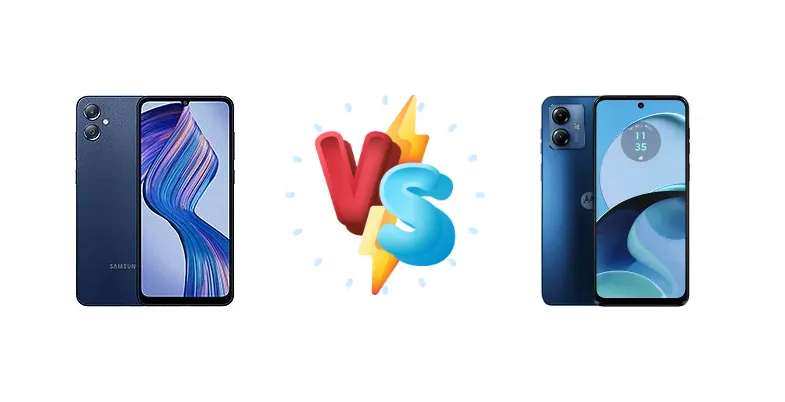
The sub-$150 smartphone market is fiercely competitive. Both the Samsung Galaxy F05 and Motorola Moto G14 aim to deliver essential features at an accessible price point. While appearing similar on paper, key differences in chipset and charging capabilities dictate which phone is better suited for specific user needs. This comparison dissects those differences to provide a definitive recommendation.
🏆 Quick Verdict
For users prioritizing consistent performance and faster charging, the Samsung Galaxy F05 emerges as the better choice. While the Moto G14 offers a slightly more modern design and potentially wider availability, the F05’s Helio G85 chipset provides a more reliable experience for everyday tasks and light gaming.
| Network |
|---|
| 2G bands | GSM 850 / 900 / 1800 / 1900 | GSM 850 / 900 / 1800 / 1900 |
| 3G bands | HSDPA 850 / 900 / 2100 | HSDPA 850 / 900 / 1900 / 2100 |
| 4G bands | 1, 3, 5, 7, 8, 20, 28, 38, 40, 41 | 1, 2, 3, 5, 7, 8, 20, 28, 38, 40, 41 |
| Speed | HSPA, LTE | HSPA, LTE |
| Technology | GSM / HSPA / LTE | GSM / HSPA / LTE |
| Launch |
|---|
| Announced | 2024, September 17 | 2023, August 01 |
| Status | Available. Released 2024, September 20 | Available. Released 2023, August 08 |
| Body |
|---|
| Build | Glass front, plastic frame, silicone polymer (eco leather) back | Glass front (Panda glass), plastic frame, plastic back |
| Dimensions | 168.8 x 78.2 x 8.8 mm (6.65 x 3.08 x 0.35 in) | 161.5 x 73.8 x 8 mm (6.36 x 2.91 x 0.31 in) |
| SIM | Nano-SIM + Nano-SIM | Nano-SIM + Nano-SIM |
| Weight | 195 g (6.88 oz) | 177 g (6.24 oz) |
| Display |
|---|
| Protection | - | Panda glass |
| Resolution | 720 x 1600 pixels, 20:9 ratio (~262 ppi density) | 1080 x 2400 pixels, 20:9 ratio (~405 ppi density) |
| Size | 6.7 inches, 108.4 cm2 (~82.1% screen-to-body ratio) | 6.5 inches, 102.0 cm2 (~85.6% screen-to-body ratio) |
| Type | PLS LCD | IPS LCD |
| Platform |
|---|
| CPU | Octa-core (2x2.0 GHz Cortex-A75 & 6x1.8 GHz Cortex-A55) | Octa-core (2x2.0 GHz Cortex-A75 & 6x1.8 GHz Cortex-A55) |
| Chipset | Mediatek Helio G85 (12 nm) | Unisoc Tiger T616 (12 nm) |
| GPU | Mali-G52 MC2 | Mali-G57 MP1 |
| OS | Android 14, up to 2 major Android upgrades, One UI Core 6.0 | Android 13, planned upgrade to Android 14 |
| Memory |
|---|
| Card slot | microSDXC (dedicated slot) | microSDXC (dedicated slot) |
| Internal | 64GB 4GB RAM | 128GB 4GB RAM, 256GB 8GB RAM |
| Main Camera |
|---|
| Dual | 50 MP, f/1.8, (wide), AF
Auxiliary lens | 50 MP, f/1.8, (wide), 0.64µm, PDAF
2 MP (macro) |
| Features | LED flash | LED flash, HDR, panorama |
| Video | 1080p@30/60fps | 1080p@30fps |
| Selfie camera |
|---|
| Single | 8 MP, f/2.0 | 8 MP, f/2.0, (wide), 1/4.0", 1.12µm |
| Video | Yes | 1080p@30fps |
| Sound |
|---|
| 35mm jack | Yes | Yes |
| Loudspeaker | Yes | Yes, with stereo speakers |
| Comms |
|---|
| Bluetooth | 5.3, A2DP, LE | 5.0, A2DP, LE |
| NFC | No | Yes (market/region dependent) |
| Positioning | GPS, GLONASS, GALILEO, BDS | GPS, GLONASS, GALILEO |
| Radio | Unspecified | FM radio |
| USB | USB Type-C 2.0, OTG | USB Type-C 2.0 |
| WLAN | Wi-Fi 802.11 a/b/g/n/ac, dual-band, Wi-Fi Direct | Wi-Fi 802.11 a/b/g/n/ac, dual-band |
| Features |
|---|
| Sensors | Accelerometer, proximity | Fingerprint (side-mounted), accelerometer, gyro, proximity, compass (market/region dependent) |
| Battery |
|---|
| Charging | 25W wired | 15W wired
20W wired (India) |
| Type | 5000 mAh | Li-Po 5000 mAh |
| Misc |
|---|
| Colors | Twilight Blue | Steel Gray, Sky Blue, Butter Cream, Pale Lilac |
| Models | SM-E055F, SM-E055F/DS | PAYF0010IN |
| Price | ₹ 7,480 | $ 190.00 / £ 89.99 / € 149.90 |
| SAR | 0.46 W/kg (head) | - |
Samsung Galaxy F05
- Faster 25W charging for quicker top-ups.
- Helio G85 chipset offers slightly better GPU performance.
- Samsung’s established software and support ecosystem.
- Potential for more bloatware compared to Motorola.
- Battery capacity is currently unknown.
Motorola Moto G14
- Cleaner Android experience with minimal bloatware.
- Potentially more modern design aesthetic.
- 20W charging available in India offers a moderate improvement.
- Slower 15W charging (outside of India).
- Unisoc Tiger T616 chipset may offer slightly lower performance.
Display Comparison
Neither Samsung nor Motorola provide detailed display specifications beyond resolution. However, both phones likely utilize LCD panels given their price point. The absence of high refresh rates is expected. The real difference lies in calibration and brightness, which are currently unknown. Without nits data, it's difficult to assess outdoor visibility. Bezels are likely comparable, reflecting the budget nature of both devices.
Camera Comparison
Camera performance is a significant unknown without sample images. Both phones likely feature a primary camera alongside depth and macro sensors. The primary sensor resolution is not specified, but the inclusion of a 2MP macro lens on both devices suggests limited utility. Image processing will heavily influence the final result, with Samsung typically favoring more saturated colors and Motorola aiming for a more natural look. Without OIS (Optical Image Stabilization) on either device, low-light photography will be challenging.
Performance
Both the Samsung Galaxy F05 and Motorola Moto G14 are equipped with octa-core CPUs featuring the same core configuration: 2x2.0 GHz Cortex-A75 and 6x1.8 GHz Cortex-A55. However, the chipset differs – the F05 uses the Mediatek Helio G85, while the G14 utilizes the Unisoc Tiger T616. While the CPU architecture is identical, the Helio G85 generally demonstrates slightly better GPU performance, making it marginally better for gaming. Both phones will likely pair this with 4GB or 6GB of RAM, impacting multitasking capabilities. Thermal management is a concern for both, but the Helio G85 has a more established track record, suggesting potentially more optimized power delivery.
Battery Life
Battery capacity is not specified for either device. However, the charging speed is a key differentiator. The Samsung Galaxy F05 supports 25W wired charging, enabling significantly faster top-ups compared to the Motorola Moto G14’s standard 15W charging (20W in India). This means the F05 will reach 100% charge in a shorter timeframe, a crucial advantage for users who frequently need to recharge their phones. Even with a similar battery capacity, the faster charging of the F05 provides a more convenient user experience.
Buying Guide
Buy the Samsung Galaxy F05 if you need a phone that consistently delivers smooth performance for daily tasks, benefits from faster 25W charging, and you value Samsung’s established software ecosystem. Buy the Motorola Moto G14 if you prefer a cleaner Android experience with minimal bloatware, and if the 20W charging (available in India) is sufficient for your usage patterns, and you prioritize a potentially more modern aesthetic.
Frequently Asked Questions
❓ Will the Unisoc Tiger T616 in the Moto G14 struggle with demanding apps like PUBG Mobile?
While the Tiger T616 can handle PUBG Mobile, you'll likely need to lower graphics settings to achieve a consistently smooth frame rate. The Helio G85 in the Galaxy F05 offers a slight advantage in GPU performance, potentially allowing for higher settings without significant frame drops.
❓ How long will it take to fully charge the Samsung Galaxy F05 with the 25W charger?
Based on typical 25W charging speeds, the Samsung Galaxy F05 should fully charge from 0% to 100% in approximately 1 hour and 30 minutes, assuming a battery capacity around 5000mAh. This is considerably faster than the Moto G14’s 15W charging.
❓ Is the 2MP macro camera on either phone worth using?
Generally, 2MP macro cameras on budget phones offer limited image quality. They often lack detail and struggle in low-light conditions. While they can be fun to experiment with, don't expect professional-level macro photography from either device.
❓ Does the Motorola Moto G14 receive regular software updates?
Motorola has improved its software update commitment in recent years, but updates are typically less frequent than those offered by Samsung. Expect at least one major Android update and a few security patches, but don't anticipate the same level of long-term support as a Samsung device.