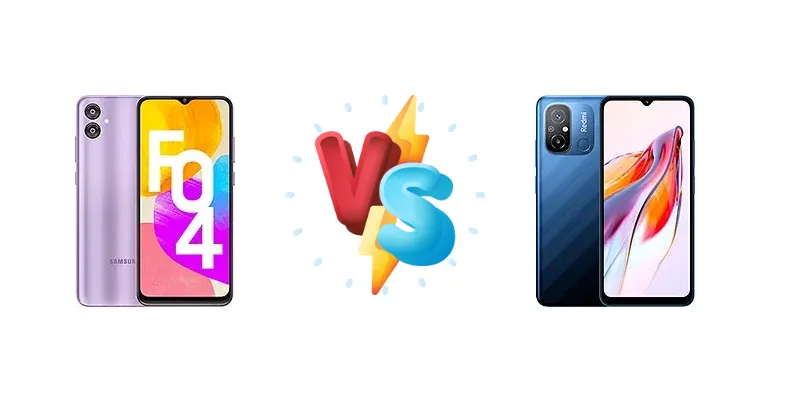
Looking for an affordable smartphone that doesn't completely compromise on features? The Samsung Galaxy F04 and Xiaomi Redmi 12C are two strong contenders in the budget phone arena. But which one reigns supreme? Let's dive into a detailed comparison to help you make the right choice.
🏆 Quick Verdict
The Xiaomi Redmi 12C edges out the Samsung Galaxy F04 thanks to its superior Helio G85 chipset, offering noticeably better performance for gaming and everyday tasks. While both are budget options, the Redmi 12C provides a more compelling overall experience.
| Network |
|---|
| 2G bands | GSM 850 / 900 / 1800 / 1900 | GSM 850 / 900 / 1800 / 1900 |
| 3G bands | HSDPA 850 / 900 / 2100 | HSDPA 850 / 900 / 2100 |
| 4G bands | 1, 3, 5, 7, 8, 20, 28, 38, 40, 41 | 1, 3, 5, 7, 8, 20, 28, 38, 40, 41 - International |
| Speed | HSPA, LTE | HSPA, LTE |
| Technology | GSM / HSPA / LTE | GSM / CDMA / HSPA / EVDO / LTE |
| | - | CDMA2000 1xEV-DO |
| Launch |
|---|
| Announced | 2023, January 04 | 2022, December 31 |
| Status | Available. Released 2023, January 12 | Available. Released 2023, January 01 |
| Body |
|---|
| Build | Glass front, plastic back, plastic frame | - |
| Dimensions | 164.2 x 75.9 x 9.1 mm (6.46 x 2.99 x 0.36 in) | 168.8 x 76.4 x 8.8 mm (6.65 x 3.01 x 0.35 in) |
| SIM | Nano-SIM + Nano-SIM | Nano-SIM + Nano-SIM |
| Weight | 188 g (6.63 oz) | 192 g (6.77 oz) |
| Display |
|---|
| Resolution | 720 x 1600 pixels, 20:9 ratio (~270 ppi density) | 720 x 1650 pixels (~268 ppi density) |
| Size | 6.5 inches, 102.0 cm2 (~81.8% screen-to-body ratio) | 6.71 inches, 106.5 cm2 (~82.6% screen-to-body ratio) |
| Type | PLS LCD | IPS LCD, 500 nits (typ) |
| Platform |
|---|
| CPU | Octa-core (4x2.35 GHz Cortex-A53 & 4x1.8 GHz Cortex-A53) | Octa-core (2x2.0 GHz Cortex-A75 & 6x1.8 GHz Cortex-A55) |
| Chipset | Mediatek MT6765 Helio P35 (12 nm) | Mediatek MT6769Z Helio G85 (12 nm) |
| GPU | PowerVR GE8320 | Mali-G52 MC2 |
| OS | Android 12, One UI | Android 12, MIUI 13 |
| Memory |
|---|
| Card slot | microSDXC (dedicated slot) | microSDXC (dedicated slot) |
| Internal | 64GB 4GB RAM | 32GB 2GB RAM, 32GB 3GB RAM, 32GB 4GB RAM, 64GB 3GB RAM, 64GB 4GB RAM, 128GB 3GB RAM, 128GB 4GB RAM, 128GB 6GB RAM |
| | - | eMMC 5.1 |
| Main Camera |
|---|
| Dual | 13 MP, f/2.2, (wide), AF
Auxiliary lens | 50 MP, (wide), PDAF
0.08 MP (depth) |
| Features | LED flash | LED flash, HDR |
| Single | - | 50 MP, f/1.8, (wide), 1/2.76", PDAF
Auxiliary lens |
| Video | 1080p@30fps | 1080p@30fps |
| Selfie camera |
|---|
| Single | 5 MP, f/2.2 | 5 MP, f/2.2, (wide) |
| Video | Yes | 1080p@30fps |
| Sound |
|---|
| 3.5mm jack | Yes | Yes |
| 35mm jack | Yes | Yes |
| Loudspeaker | Yes | Yes |
| Comms |
|---|
| Bluetooth | 5.0, A2DP, LE | 5.1, A2DP, LE |
| NFC | No | Yes (market/region dependent) |
| Positioning | GPS, GLONASS, GALILEO, BDS | GPS, GLONASS, BDS, GALILEO |
| Radio | Unspecified | FM radio |
| USB | USB Type-C 2.0 | microUSB 2.0 |
| WLAN | Wi-Fi 802.11 b/g/n, Wi-Fi Direct | Wi-Fi 802.11 a/b/g/n/ac, dual-band, Wi-Fi Direct |
| Features |
|---|
| Sensors | Accelerometer, proximity | Fingerprint (rear-mounted), accelerometer |
| | - | Virtual proximity sensing |
| Battery |
|---|
| Charging | 15W wired | 10W wired |
| Type | Li-Po 5000 mAh | Li-Po 5000 mAh |
| Misc |
|---|
| Colors | Jade Purple, Opal Green | Graphite Gray, Ocean Blue, Mint Green, Lavender Purple |
| Models | SM-E045F, SM-E045F/DS | 22120RN86G, 22120RN86I, 22126RN91Y, 2212ARNC4L |
| Price | About 90 EUR | £ 132.99 / € 107.41 |
| SAR | 0.38 W/kg (head) | 1.08 W/kg (head) 0.64 W/kg (body) |
| SAR EU | - | 0.98 W/kg (head) 0.99 W/kg (body) |
Samsung Galaxy F04
- Trusted Samsung brand
- Simple and user-friendly interface
- Decent battery life
- Sufficient storage options
- Underpowered chipset
- Mediocre display quality
- Basic camera performance
- Slower charging speed
Xiaomi Redmi 12C
- Better performance thanks to Helio G85
- Improved camera quality
- Slightly better display
- Faster charging (relatively)
- Good value for money
- Xiaomi's MIUI can be a bit cluttered
- Build quality feels slightly less premium
- May receive fewer software updates compared to Samsung
Display Comparison
Both phones feature large 6.5-inch HD+ displays, offering decent viewing angles for media consumption. However, the Redmi 12C often has slightly better color accuracy and brightness, making it a bit more enjoyable to use outdoors. The F04's display is adequate but lacks the vibrancy of the Redmi 12C.
Camera Comparison
The Galaxy F04 typically features a dual-camera setup (13MP main + 2MP depth) while the Redmi 12C boasts a 50MP main camera. While megapixels aren't everything, the Redmi 12C generally captures more detailed photos, especially in good lighting conditions. Low-light performance is comparable on both devices, but the Redmi 12C's processing tends to be slightly better. Both phones have basic selfie cameras.
Performance
This is where the Redmi 12C truly shines. The Helio G85 chipset is significantly more powerful than the Helio P35 in the Galaxy F04. Expect smoother multitasking, faster app loading times, and a better gaming experience on the Redmi 12C. The F04 can feel sluggish at times, especially with demanding apps.
Battery Life
Both phones offer large 5000mAh batteries, promising all-day battery life. However, the Redmi 12C's more efficient chipset allows it to stretch that battery life a bit further, especially with heavy usage. The F04's battery life is still good, but not quite as impressive.
Buying Guide
Who should buy the Samsung Galaxy F04? Users prioritizing a trusted brand and a simple, user-friendly experience. Who should buy the Xiaomi Redmi 12C? Those seeking better performance and a slightly more feature-rich experience within a similar price range.
Frequently Asked Questions
❓ Which phone is better for gaming?
The Xiaomi Redmi 12C is significantly better for gaming due to its more powerful Helio G85 chipset. The Galaxy F04 struggles with more demanding games.
❓ Does the Samsung Galaxy F04 get more software updates?
Samsung generally provides more consistent software updates and security patches compared to Xiaomi, although both brands have improved in recent years.