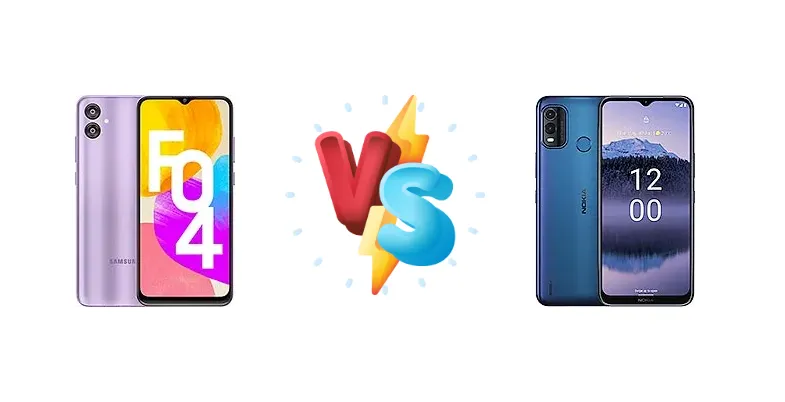
The Samsung Galaxy F04 and Nokia G11 Plus represent the fiercely competitive sub-$150 smartphone market. Both aim to deliver essential functionality at an accessible price, but they take different approaches to achieving this. The F04 leverages MediaTek’s Helio P35, while the G11 Plus opts for Unisoc’s T606. This comparison dissects these choices, revealing which device offers the best balance of performance, battery life, and overall value.
🏆 Quick Verdict
For the average user prioritizing consistent, if not blazing-fast, performance and a slightly faster charging experience, the Samsung Galaxy F04 emerges as the better choice. While the Nokia G11 Plus offers a more modern CPU architecture, the Helio P35’s higher clock speeds translate to a more responsive user experience in everyday tasks.
| Network |
|---|
| 2G bands | GSM 850 / 900 / 1800 / 1900 | GSM 850 / 900 / 1800 / 1900 |
| 3G bands | HSDPA 850 / 900 / 2100 | HSDPA 850 / 900 / 2100 - International |
| 4G bands | 1, 3, 5, 7, 8, 20, 28, 38, 40, 41 | 1, 3, 5, 7, 8, 20, 28, 38, 40, 41 - International |
| Speed | HSPA, LTE | HSPA 42.2/5.76 Mbps, LTE Cat4 150/50 Mbps |
| Technology | GSM / HSPA / LTE | GSM / HSPA / LTE |
| | - | 1, 3, 5, 8, 40, 41 - India |
| Launch |
|---|
| Announced | 2023, January 04 | 2022, June 29 |
| Status | Available. Released 2023, January 12 | Available. Released 2022, July 20 |
| Body |
|---|
| Build | Glass front, plastic back, plastic frame | Glass front, plastic frame, plastic back |
| Dimensions | 164.2 x 75.9 x 9.1 mm (6.46 x 2.99 x 0.36 in) | 164.8 x 75.9 x 8.6 mm (6.49 x 2.99 x 0.34 in) |
| SIM | Nano-SIM + Nano-SIM | · Nano-SIM· Nano-SIM + Nano-SIM |
| Weight | 188 g (6.63 oz) | 192 g (6.77 oz) |
| | - | Splash protection |
| Display |
|---|
| Resolution | 720 x 1600 pixels, 20:9 ratio (~270 ppi density) | 720 x 1600 pixels, 20:9 ratio (~269 ppi density) |
| Size | 6.5 inches, 102.0 cm2 (~81.8% screen-to-body ratio) | 6.52 inches, 102.6 cm2 (~82.1% screen-to-body ratio) |
| Type | PLS LCD | IPS LCD, 90Hz, 400 nits (typ) |
| Platform |
|---|
| CPU | Octa-core (4x2.35 GHz Cortex-A53 & 4x1.8 GHz Cortex-A53) | Octa-core (2x1.6 GHz Cortex-A75 & 6x1.6 GHz Cortex-A55) |
| Chipset | Mediatek MT6765 Helio P35 (12 nm) | Unisoc T606 (12 nm) |
| GPU | PowerVR GE8320 | Mali-G57 MP1 |
| OS | Android 12, One UI | Android 12, upgradable to Android 13 |
| Memory |
|---|
| Card slot | microSDXC (dedicated slot) | microSDXC (dedicated slot) |
| Internal | 64GB 4GB RAM | 32GB 3GB RAM, 64GB 3GB RAM, 64GB 4GB RAM, 128GB 3GB RAM |
| | - | eMMC 5.1 |
| Main Camera |
|---|
| Dual | 13 MP, f/2.2, (wide), AF
Auxiliary lens | 50 MP, f/1.8, (wide), 1/2.67", PDAF
Auxiliary lens |
| Features | LED flash | LED flash |
| Single | - | 8 MP, f/2.0, (wide), 1/4.0" |
| Video | 1080p@30fps | 1080p@30fps |
| Selfie camera |
|---|
| Single | 5 MP, f/2.2 | 8 MP, f/2.0, (wide), 1/4.0" |
| Video | Yes | 1080p@30fps |
| Sound |
|---|
| 3.5mm jack | Yes | Yes |
| 35mm jack | Yes | Yes |
| Loudspeaker | Yes | Yes |
| Comms |
|---|
| Bluetooth | 5.0, A2DP, LE | 5.0, A2DP, LE |
| NFC | No | No |
| Positioning | GPS, GLONASS, GALILEO, BDS | GPS |
| Radio | Unspecified | FM radio |
| USB | USB Type-C 2.0 | USB Type-C 2.0, OTG |
| WLAN | Wi-Fi 802.11 b/g/n, Wi-Fi Direct | Wi-Fi 802.11 a/b/g/n/ac, dual-band, Wi-Fi Direct |
| Features |
|---|
| Sensors | Accelerometer, proximity | Fingerprint (rear-mounted), accelerometer, proximity |
| Battery |
|---|
| Charging | 15W wired | 10W wired |
| Type | Li-Po 5000 mAh | Li-Ion 5000 mAh |
| Misc |
|---|
| Colors | Jade Purple, Opal Green | Lake Blue, Charcoal Grey |
| Models | SM-E045F, SM-E045F/DS | - |
| Price | About 90 EUR | About 130 EUR |
| SAR | 0.38 W/kg (head) | - |
Samsung Galaxy F04
- Faster 15W charging
- Higher CPU clock speeds for snappier performance
- Potentially more responsive user experience
- Older CPU architecture
- Likely less frequent software updates
Nokia G11 Plus
- More modern CPU architecture (Cortex-A75)
- Potential for better long-term software support (Nokia's promise)
- Clean Android experience
- Slower 10W charging
- Lower CPU clock speeds may result in occasional lag
- Performance may not match the F04 in everyday tasks
Display Comparison
Neither Samsung nor Nokia provide detailed display specifications for these models. Given their price point, both likely utilize LCD panels with 720p+ resolution. The absence of information regarding peak brightness or color gamut suggests neither device will excel in outdoor visibility or color accuracy. Bezels are expected to be substantial on both, contributing to a less immersive viewing experience. The focus here is clearly on affordability, not display quality.
Camera Comparison
Detailed camera specifications are scarce. Both phones likely feature a primary camera around the 13MP mark, accompanied by lower-resolution depth or macro sensors. Image quality will be heavily reliant on software processing, and neither device is expected to deliver exceptional results. The aperture of the main sensor will be a key determinant of low-light performance, but this information is unavailable. The 2MP macro cameras found on both devices are largely marketing filler and offer limited practical utility. Expect similar camera performance from both, with neither excelling in any particular area.
Performance
The core difference lies in the chipsets. The Samsung Galaxy F04’s MediaTek Helio P35 features an octa-core configuration with four Cortex-A53 cores clocked at 2.35 GHz and another four at 1.8 GHz. The Nokia G11 Plus utilizes the Unisoc T606, also an octa-core chip, but with a more modern split: two Cortex-A75 cores at 1.6 GHz and six Cortex-A55 cores at 1.6 GHz. While the Unisoc T606’s A75 cores offer superior individual performance compared to the Helio P35’s A53 cores, the lower clock speeds and the greater number of less powerful A55 cores mean the F04 will likely feel snappier in many everyday tasks. The Helio P35’s higher clock speeds provide a noticeable advantage in responsiveness. Both devices will struggle with graphically intensive games, but the F04 may maintain a slightly more stable framerate due to its higher CPU clock.
Battery Life
Battery capacity is not explicitly stated for either device, but both likely house around a 5000mAh battery, typical for this price segment. However, the charging speeds differ significantly. The Samsung Galaxy F04 supports 15W wired charging, while the Nokia G11 Plus is limited to 10W. This translates to a noticeably faster 0-100% charge time on the F04. While both phones should easily last a full day with moderate usage, the faster charging on the F04 provides a convenience advantage, especially for users who frequently need to top up their battery.
Buying Guide
Buy the Samsung Galaxy F04 if you need a phone that feels consistently responsive for daily tasks like browsing, social media, and messaging, and if you value a slightly quicker charging cycle. Buy the Nokia G11 Plus if you prioritize a more modern CPU architecture and potentially better long-term software support, understanding that you might experience occasional slowdowns in demanding applications.
Frequently Asked Questions
❓ Will the Unisoc T606 in the Nokia G11 Plus struggle with multitasking compared to the Helio P35?
While the Unisoc T606 has a more modern architecture, the Helio P35’s higher clock speeds give it an edge in handling multiple apps simultaneously. The T606’s A75 cores are powerful, but the overall system performance is likely to feel less fluid when switching between apps or running demanding applications concurrently.
❓ How long will it take to fully charge each phone from 0%?
With 15W charging, the Samsung Galaxy F04 should fully charge in approximately 2.5 to 3 hours. The Nokia G11 Plus, limited to 10W, will likely take around 3.5 to 4 hours to reach 100%. This difference is significant for users who prioritize quick top-ups.
❓ Is the Nokia G11 Plus guaranteed to receive more Android updates than the Samsung Galaxy F04?
Nokia has a stated commitment to providing regular software updates and security patches for its devices. Samsung’s update policy for the Galaxy F series is less consistent. While no guarantees exist, the Nokia G11 Plus is *likely* to receive more frequent and longer-term software support.