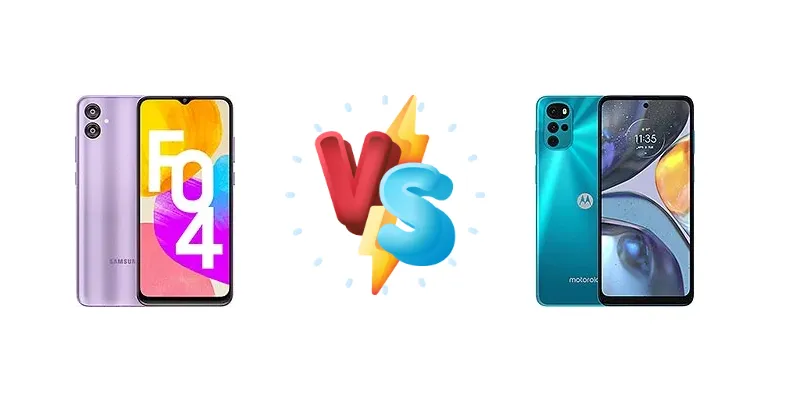
The Samsung Galaxy F04 and Motorola Moto G22 represent the fiercely competitive sub-$150 smartphone market. Both devices aim to deliver essential smartphone functionality at an accessible price point, but they achieve this with slightly different approaches to chipset selection and charging capabilities. This comparison dissects their key specifications to determine which device offers the most compelling package for budget-conscious consumers.
🏆 Quick Verdict
For most users, the Motorola Moto G22 emerges as the slightly better choice. While both phones utilize the Mediatek Helio series, the G37’s marginally higher CPU clock speed and, crucially, its 20W (in India) or 15W (Global) charging support provide a tangible advantage in everyday use and convenience, offsetting the F04’s brand recognition.
| Network |
|---|
| 2G bands | GSM 850 / 900 / 1800 / 1900 | GSM 850 / 900 / 1800 / 1900 |
| 3G bands | HSDPA 850 / 900 / 2100 | HSDPA 850 / 900 / 1900 / 2100 |
| 4G bands | 1, 3, 5, 7, 8, 20, 28, 38, 40, 41 | 1, 3, 5, 7, 8, 20, 38, 40, 41 |
| Speed | HSPA, LTE | HSPA 42.2/5.76 Mbps, LTE Cat4 150/50 Mbps |
| Technology | GSM / HSPA / LTE | GSM / HSPA / LTE |
| Launch |
|---|
| Announced | 2023, January 04 | 2022, March 04 |
| Status | Available. Released 2023, January 12 | Available. Released 2022, March 04 |
| Body |
|---|
| Build | Glass front, plastic back, plastic frame | Glass front, plastic frame, plastic back |
| Dimensions | 164.2 x 75.9 x 9.1 mm (6.46 x 2.99 x 0.36 in) | 164 x 75 x 8.5 mm (6.46 x 2.95 x 0.33 in) |
| SIM | Nano-SIM + Nano-SIM | · Nano-SIM· Nano-SIM + Nano-SIM |
| Weight | 188 g (6.63 oz) | 185 g (6.53 oz) |
| | - | Water-repellent design |
| Display |
|---|
| Resolution | 720 x 1600 pixels, 20:9 ratio (~270 ppi density) | 720 x 1600 pixels, 20:9 ratio (~268 ppi density) |
| Size | 6.5 inches, 102.0 cm2 (~81.8% screen-to-body ratio) | 6.5 inches, 103.5 cm2 (~84.2% screen-to-body ratio) |
| Type | PLS LCD | IPS LCD, 90Hz |
| Platform |
|---|
| CPU | Octa-core (4x2.35 GHz Cortex-A53 & 4x1.8 GHz Cortex-A53) | Octa-core (4x2.3 GHz Cortex-A53 & 4x1.8 GHz Cortex-A53) |
| Chipset | Mediatek MT6765 Helio P35 (12 nm) | Mediatek MT6765V/CB Helio G37 (12 nm) |
| GPU | PowerVR GE8320 | PowerVR GE8320 |
| OS | Android 12, One UI | Android 12 |
| Memory |
|---|
| Card slot | microSDXC (dedicated slot) | microSDXC (dedicated slot) |
| Internal | 64GB 4GB RAM | 64GB 4GB RAM, 128GB 4GB RAM |
| Main Camera |
|---|
| Dual | 13 MP, f/2.2, (wide), AF
Auxiliary lens | - |
| Features | LED flash | LED flash, HDR, panorama |
| Quad | - | 50 MP, f/1.8, (wide), 0.64µm, PDAF
8 MP, f/2.2, 118˚ (ultrawide), 1/4.0", 1.12µm
2 MP (macro)
Auxiliary lens |
| Video | 1080p@30fps | 1080p@30fps |
| Selfie camera |
|---|
| Features | - | HDR |
| Single | 5 MP, f/2.2 | 16 MP, f/2.5, (wide), 1.0µm |
| Video | Yes | 1080p@30fps |
| Sound |
|---|
| 3.5mm jack | Yes | Yes |
| 35mm jack | Yes | Yes |
| Loudspeaker | Yes | Yes |
| Comms |
|---|
| Bluetooth | 5.0, A2DP, LE | 5.0, A2DP, LE |
| NFC | No | Yes (market/region dependent) |
| Positioning | GPS, GLONASS, GALILEO, BDS | GPS, GLONASS, GALILEO |
| Radio | Unspecified | Unspecified |
| USB | USB Type-C 2.0 | USB Type-C 2.0 |
| WLAN | Wi-Fi 802.11 b/g/n, Wi-Fi Direct | Wi-Fi 802.11 a/b/g/n/ac, dual-band, Wi-Fi Direct |
| Features |
|---|
| Sensors | Accelerometer, proximity | Fingerprint (side-mounted), accelerometer, gyro, proximity, compass |
| Battery |
|---|
| Charging | 15W wired | 20W wired (India)
15W wired (Global) |
| Type | Li-Po 5000 mAh | Li-Po 5000 mAh |
| Misc |
|---|
| Colors | Jade Purple, Opal Green | Pearl White, Iceberg Blue, Cosmic Black, Mint Green |
| Models | SM-E045F, SM-E045F/DS | XT2231-1, XT2231-2, XT2231-5 |
| Price | About 90 EUR | About 120 EUR |
| SAR | 0.38 W/kg (head) | - |
Samsung Galaxy F04
- Established Samsung brand reputation
- Predictable One UI software experience
- Potentially more conservative camera processing
- Slower 15W charging
- Slightly less powerful chipset (Helio P35)
Motorola Moto G22
- Faster charging (up to 20W)
- Slightly more capable Helio G37 chipset
- Potentially more vibrant camera output
- Motorola’s software update track record is less consistent
- Brand perception may be lower than Samsung
Display Comparison
Neither device boasts a standout display. Both likely utilize LCD panels, a common cost-saving measure in this segment. Detailed display specs (resolution, brightness, color gamut) are unavailable, but we can infer similar performance. Bezels are likely to be noticeable on both, and color accuracy will be adequate for basic consumption, but not ideal for color-critical work. The lack of high refresh rates is expected at this price point.
Camera Comparison
Camera performance will be heavily reliant on software processing. Both phones likely feature a primary camera alongside depth and macro sensors (the latter often being of limited utility). Without specific sensor size or aperture information, it’s difficult to definitively declare a winner. However, Motorola’s image processing algorithms often prioritize brighter, more saturated images, which may appeal to casual users. The F04’s camera is likely to be more conservatively tuned. The presence of OIS (Optical Image Stabilization) is highly unlikely on either device.
Performance
The core difference lies in the chipsets. The Samsung Galaxy F04 features the Mediatek Helio P35, while the Motorola Moto G22 uses the Helio G37. Both are 12nm chips with an octa-core configuration (4x2.35/2.3 GHz Cortex-A53 & 4x1.8 GHz Cortex-A53). The G37’s slightly higher peak CPU clock speed (2.3 GHz vs 2.35 GHz) is a minor advantage, but the 'G' designation suggests a greater focus on gaming performance, potentially offering a small GPU boost. However, both chips are entry-level and will struggle with demanding tasks. RAM configurations are likely similar, further minimizing the performance gap. Thermal management will be passive on both, meaning sustained performance will be limited by heat.
Battery Life
Battery capacity is not specified, but both phones likely house around a 5000mAh battery, standard for this price range. The key differentiator is charging speed. The Motorola Moto G22 supports 20W wired charging in India, and 15W globally, while the Samsung Galaxy F04 is limited to 15W. This translates to significantly faster top-up times for the G22, especially in regions where the 20W charger is included. A 20W charger can potentially reduce 0-100% charging time by 30-45 minutes compared to the F04’s 15W charging.
Buying Guide
Buy the Samsung Galaxy F04 if you prioritize brand familiarity and a consistently predictable software experience, even if it means sacrificing some charging speed. Buy the Motorola Moto G22 if you value faster charging – a significant benefit for users who frequently find themselves needing a quick power boost – and a slightly more capable processor for light multitasking and gaming.
Frequently Asked Questions
❓ Will the Motorola Moto G22 overheat during prolonged gaming sessions?
The Helio G37 is an entry-level chipset, and both phones utilize passive cooling. Expect some thermal throttling during extended gaming, leading to reduced performance. The G37’s gaming focus *may* allow for slightly longer sustained performance than the P35, but don’t expect flagship-level gaming capabilities.
❓ Is the 2MP macro camera on either phone worth using?
Generally, 2MP macro cameras on budget phones offer limited image quality. They often lack detail and sharpness. While they can be fun to experiment with, don’t expect professional-looking macro shots. The primary camera will deliver far superior results in most scenarios.
❓ Does the Motorola Moto G22 support fast charging with any standard charger?
The Moto G22 supports up to 20W charging (in India) or 15W (Global) with a compatible charger. It's crucial to use a Power Delivery (PD) or Quick Charge (QC) compliant charger to achieve these speeds. The included charger may be a standard 5W or 10W unit, resulting in significantly slower charging times.
❓ How does Samsung's One UI compare to Motorola's My UX in terms of software updates?
Samsung generally provides more consistent and longer-term software updates for its devices, including security patches. Motorola’s update track record is less predictable, and their devices often receive fewer major Android version upgrades. If timely software updates are a priority, the Galaxy F04 has an edge.