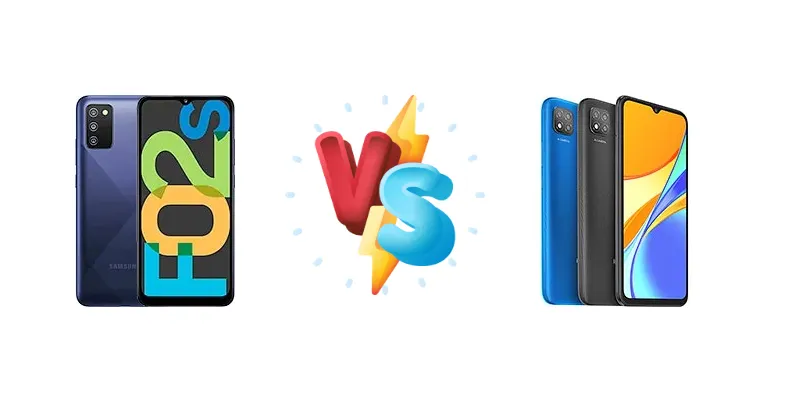
The Samsung Galaxy F02s and Xiaomi Redmi 9C NFC represent the fiercely competitive sub-$150 smartphone market. Both aim to deliver essential smartphone functionality at an accessible price point, but they take different approaches to achieving this. This comparison dissects their core components to reveal which device offers the best value for budget-conscious consumers.
🏆 Quick Verdict
For the average user prioritizing responsiveness and occasional multitasking, the Xiaomi Redmi 9C NFC is the better choice. Its MediaTek Helio G35 chipset, built on a more efficient 12nm process, delivers noticeably faster CPU performance than the Samsung Galaxy F02s’ Snapdragon 450, despite the slower charging.
| Network |
|---|
| 2G bands | GSM 850 / 900 / 1800 / 1900 | GSM 850 / 900 / 1800 / 1900 |
| 3G bands | HSDPA 850 / 900 / 2100 | HSDPA 850 / 900 / 1700(AWS) / 1900 / 2100 |
| 4G bands | 1, 3, 5, 7, 8, 20, 28, 38, 40, 41 | 1, 2, 3, 4, 5, 7, 8, 20, 38, 40 |
| Speed | HSPA 42.2/5.76 Mbps, LTE Cat4 150/50 Mbps | HSPA, LTE |
| Technology | GSM / HSPA / LTE | GSM / HSPA / LTE |
| Launch |
|---|
| Announced | 2021, April 05 | 2020, August 27. Released 2020, August 27 |
| Status | Available. Released 2021, April 09 | Discontinued |
| Body |
|---|
| Build | Glass front, plastic back, plastic frame | - |
| Dimensions | 164.2 x 75.9 x 9.1 mm (6.46 x 2.99 x 0.36 in) | 164.9 x 77.1 x 9 mm (6.49 x 3.04 x 0.35 in) |
| SIM | Nano-SIM + Nano-SIM | Nano-SIM + Nano-SIM |
| Weight | 196 g (6.91 oz) | 196 g (6.91 oz) |
| Display |
|---|
| Resolution | 720 x 1600 pixels, 20:9 ratio (~270 ppi density) | 720 x 1600 pixels, 20:9 ratio (~269 ppi density) |
| Size | 6.5 inches, 102.0 cm2 (~81.8% screen-to-body ratio) | 6.53 inches, 102.9 cm2 (~81.0% screen-to-body ratio) |
| Type | PLS LCD | IPS LCD, 400 nits (typ) |
| Platform |
|---|
| CPU | Octa-core 1.8 GHz Cortex-A53 | Octa-core (4x2.3 GHz Cortex-A53 & 4x1.8 GHz Cortex-A53) |
| Chipset | Qualcomm SDM450 Snapdragon 450 (14 nm) | Mediatek MT6765G Helio G35 (12 nm) |
| GPU | Adreno 506 | PowerVR GE8320 |
| OS | Android 10 | Android 10, MIUI 12 |
| Memory |
|---|
| Card slot | microSDXC (dedicated slot) | microSDXC (dedicated slot) |
| Internal | 32GB 3GB RAM, 64GB 4GB RAM | 32GB 2GB RAM, 32GB 3GB RAM, 64GB 2GB RAM, 64GB 3GB RAM, 128GB 3GB RAM, 128GB 4GB RAM |
| | eMMC 5.1 | eMMC 5.1 |
| Main Camera |
|---|
| Dual | - | 13 MP, f/2.2, 28mm (wide), 1.0µm, PDAF
2 MP (macro) |
| Features | LED flash | LED flash, HDR |
| Single | 5 MP, f/2.2 | - |
| Triple | 13 MP, f/2.2, (wide), AF
2 MP (macro)
Auxiliary lens | - |
| Video | 1080p@30fps | 1080p@30fps |
| Selfie camera |
|---|
| Features | - | HDR |
| Single | 5 MP, f/2.2 | 5 MP, f/2.2, (wide), 1.12µm |
| Video | - | 1080p@30fps |
| Sound |
|---|
| 3.5mm jack | Yes | Yes |
| 35mm jack | Yes | Yes |
| Loudspeaker | Yes | Yes |
| Comms |
|---|
| Bluetooth | 4.2, A2DP | 5.0, A2DP, LE |
| NFC | No | Yes |
| Positioning | GPS, GLONASS, GALILEO, BDS | GPS, GLONASS, BDS |
| Radio | FM radio | FM radio |
| USB | USB Type-C 2.0, OTG | microUSB 2.0, OTG |
| WLAN | Wi-Fi 802.11 b/g/n, Wi-Fi Direct | Wi-Fi 802.11 b/g/n, Wi-Fi Direct |
| Features |
|---|
| Sensors | Accelerometer, proximity | Fingerprint (rear-mounted), accelerometer, proximity |
| Battery |
|---|
| Charging | 15W wired | 10W wired |
| Type | Li-Po 5000 mAh | Li-Po 5000 mAh |
| Misc |
|---|
| Colors | Ceramic Blue, Ceramic White, Ceramic Black | Midnight Gray, Sunshine Yellow, Twilight Blue |
| Models | SM-E025F, SM-E025F/DS | M2006C3MNG |
| Price | About 100 EUR | About 100 EUR |
| SAR | 0.52 W/kg (head) | 0.57 W/kg (head) 0.90 W/kg (body) |
| SAR EU | - | 0.37 W/kg (head) 1.14 W/kg (body) |
Samsung Galaxy F02s
- Faster 15W charging
- Established Samsung brand reputation
- Potentially better software update frequency (though limited)
- Less powerful Snapdragon 450 chipset
- Larger 14nm process node leads to lower efficiency
- Lacks NFC functionality
Xiaomi Redmi 9C NFC
- More powerful MediaTek Helio G35 chipset
- More efficient 12nm process node
- Integrated NFC for contactless payments
- Generally more responsive user experience
- Slower 10W charging
- Xiaomi’s MIUI software can be polarizing
Display Comparison
Neither device boasts a standout display. Both likely utilize LCD panels, typical for this price bracket. The absence of detailed display specs necessitates focusing on performance. The real-world impact of display quality will be minimal for the intended user base, with both likely offering adequate, but not exceptional, viewing experiences.
Camera Comparison
Both phones likely feature basic camera setups focused on affordability. Without detailed sensor information, it’s difficult to make a definitive judgment. However, the emphasis should be on the primary sensor. The Redmi 9C NFC’s image processing, while not flagship-level, is generally considered more refined than Samsung’s budget offerings. The presence of NFC on the Redmi 9C NFC is a feature absent on the F02s, offering contactless payment and data transfer capabilities.
Performance
The core difference lies in the chipsets. The Xiaomi Redmi 9C NFC’s MediaTek Helio G35 (12nm) has a distinct advantage over the Samsung Galaxy F02s’ Qualcomm Snapdragon 450 (14nm). While both are octa-core CPUs utilizing Cortex-A53 cores, the Redmi 9C NFC’s CPU configuration – 4x2.3 GHz & 4x1.8 GHz – provides a higher peak clock speed compared to the F02s’ uniform 1.8 GHz. This translates to snappier app launches and smoother multitasking. The 12nm process node of the Helio G35 also contributes to better power efficiency, potentially offsetting the smaller battery in real-world usage. The Snapdragon 450, while reliable, feels dated in comparison.
Battery Life
The Redmi 9C NFC charges at 10W, slower than the Galaxy F02s’ 15W. However, the more efficient Helio G35 chipset and potentially optimized software could mitigate the impact of the slower charging speed. The actual battery life will depend heavily on usage patterns, but the Redmi 9C NFC’s chipset efficiency gives it a fighting chance despite potentially having a similar or slightly smaller battery capacity.
Buying Guide
Buy the Samsung Galaxy F02s if you prioritize a brand with established software support and are primarily focused on basic tasks like calls, messaging, and light social media use. Buy the Xiaomi Redmi 9C NFC if you need a phone that feels more responsive for everyday tasks, benefits from NFC for mobile payments, and occasionally engages in light gaming or multitasking.
Frequently Asked Questions
❓ Will the Redmi 9C NFC struggle with popular apps like WhatsApp and Facebook?
The Helio G35 in the Redmi 9C NFC is capable of running these apps smoothly for most users. While it won't offer a high-end experience, it provides a noticeable improvement over the Snapdragon 450 in the F02s, resulting in faster loading times and less lag when switching between apps.
❓ Is the NFC on the Redmi 9C NFC useful for everyday life?
Yes, the NFC functionality allows for contactless payments via Google Pay or other NFC-enabled payment services. It also simplifies pairing with other NFC-enabled devices, such as Bluetooth speakers or headphones, making it a convenient feature for many users.
❓ How long will it take to fully charge each phone?
The Samsung Galaxy F02s with its 15W charging will likely take around 2.5-3 hours for a full charge. The Xiaomi Redmi 9C NFC, with its 10W charging, will likely take around 3.5-4 hours. However, the Helio G35's efficiency might mean you don't *need* to fully charge it as often.