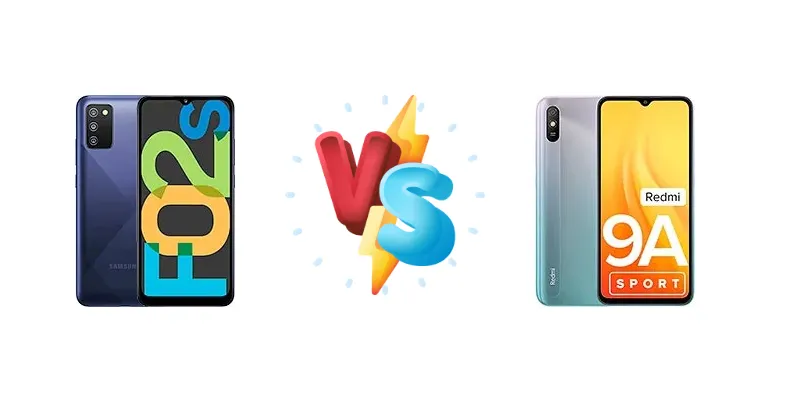
The Samsung Galaxy F02s and Xiaomi Redmi 9A Sport represent the extreme end of the budget smartphone spectrum. Both aim to deliver essential smartphone functionality at the lowest possible price, but they take different approaches to achieving this. The key differentiator lies in their chipsets: Qualcomm’s Snapdragon 450 versus MediaTek’s Helio G25. This comparison will dissect these differences and determine which device offers the best value for users prioritizing performance and efficiency.
🏆 Quick Verdict
For the average user, the Xiaomi Redmi 9A Sport emerges as the slightly better choice. While the Galaxy F02s benefits from Qualcomm’s established optimization, the Helio G25’s more modern 12nm process and higher clock speeds translate to a noticeable performance edge in everyday tasks and light gaming, justifying the slightly slower charging.
| Network |
|---|
| 2G bands | GSM 850 / 900 / 1800 / 1900 | GSM 850 / 900 / 1800 / 1900 |
| 3G bands | HSDPA 850 / 900 / 2100 | HSDPA 850 / 900 / 2100 |
| 4G bands | 1, 3, 5, 7, 8, 20, 28, 38, 40, 41 | 1, 3, 5, 8, 40, 41 |
| Speed | HSPA 42.2/5.76 Mbps, LTE Cat4 150/50 Mbps | HSPA, LTE |
| Technology | GSM / HSPA / LTE | GSM / HSPA / LTE |
| Launch |
|---|
| Announced | 2021, April 05 | 2021, September 28 |
| Status | Available. Released 2021, April 09 | Available. Released 2021, September 28 |
| Body |
|---|
| Build | Glass front, plastic back, plastic frame | - |
| Dimensions | 164.2 x 75.9 x 9.1 mm (6.46 x 2.99 x 0.36 in) | 164.9 x 77.1 x 9 mm (6.49 x 3.04 x 0.35 in) |
| SIM | Nano-SIM + Nano-SIM | Nano-SIM + Nano-SIM |
| Weight | 196 g (6.91 oz) | 194 g (6.84 oz) |
| | - | Water-repellent coating |
| Display |
|---|
| Resolution | 720 x 1600 pixels, 20:9 ratio (~270 ppi density) | 720 x 1600 pixels, 20:9 ratio (~269 ppi density) |
| Size | 6.5 inches, 102.0 cm2 (~81.8% screen-to-body ratio) | 6.53 inches, 102.9 cm2 (~81.0% screen-to-body ratio) |
| Type | PLS LCD | IPS LCD, 400 nits (typ) |
| Platform |
|---|
| CPU | Octa-core 1.8 GHz Cortex-A53 | Octa-core (4x2.0 GHz Cortex-A53 & 4x1.5 GHz Cortex-A53) |
| Chipset | Qualcomm SDM450 Snapdragon 450 (14 nm) | Mediatek MT6762G Helio G25 (12 nm) |
| GPU | Adreno 506 | PowerVR GE8320 |
| OS | Android 10 | Android 10, MIUI 12 |
| Memory |
|---|
| Card slot | microSDXC (dedicated slot) | microSDXC (dedicated slot) |
| Internal | 32GB 3GB RAM, 64GB 4GB RAM | 32GB 2GB RAM, 32GB 3GB RAM |
| | eMMC 5.1 | eMMC 5.1 |
| Main Camera |
|---|
| Features | LED flash | LED flash, HDR |
| Single | 5 MP, f/2.2 | 13 MP, f/2.2, 28mm (wide), 1.0µm, PDAF |
| Triple | 13 MP, f/2.2, (wide), AF
2 MP (macro)
Auxiliary lens | - |
| Video | 1080p@30fps | 1080p@30/60fps |
| Selfie camera |
|---|
| Features | - | HDR |
| Single | 5 MP, f/2.2 | 5 MP, f/2.2, (wide), 1.12µm |
| Video | - | 1080p@30fps |
| Sound |
|---|
| 3.5mm jack | Yes | Yes |
| 35mm jack | Yes | Yes |
| Loudspeaker | Yes | Yes |
| Comms |
|---|
| Bluetooth | 4.2, A2DP | 5.0, A2DP, LE |
| NFC | No | No |
| Positioning | GPS, GLONASS, GALILEO, BDS | GPS, GLONASS, BDS |
| Radio | FM radio | FM radio |
| USB | USB Type-C 2.0, OTG | microUSB 2.0, OTG |
| WLAN | Wi-Fi 802.11 b/g/n, Wi-Fi Direct | Wi-Fi 802.11 a/b/g/n, Wi-Fi Direct |
| Features |
|---|
| Sensors | Accelerometer, proximity | Accelerometer, proximity |
| Battery |
|---|
| Charging | 15W wired | 10W wired |
| Type | Li-Po 5000 mAh | Li-Po 5000 mAh |
| Misc |
|---|
| Colors | Ceramic Blue, Ceramic White, Ceramic Black | Carbon Black, Coral Green, Metallic Blue |
| Models | SM-E025F, SM-E025F/DS | - |
| Price | About 100 EUR | About 100 EUR |
| SAR | 0.52 W/kg (head) | - |
Samsung Galaxy F02s
- Faster 15W charging
- Qualcomm’s established software optimization
- Brand recognition and potentially better software support
- Less efficient 14nm Snapdragon 450 chipset
- Lower peak CPU clock speeds
- Potentially slower app loading times
Xiaomi Redmi 9A Sport
- More efficient 12nm MediaTek Helio G25 chipset
- Higher peak CPU clock speeds
- Potentially smoother multitasking
- Better value for money
- Slower 10W charging
- MediaTek chipset may have less software optimization
- Xiaomi’s MIUI can be resource intensive
Display Comparison
Neither device boasts a standout display. Both likely feature LCD panels, typical for this price bracket. The critical difference lies under the hood. While specific display specs are unavailable, the focus here is on the chipset’s ability to drive the display efficiently. The Snapdragon 450, being an older architecture, may require more power to render the same visuals as the Helio G25, potentially impacting battery life. Bezels are expected to be substantial on both devices, reflecting their budget positioning.
Camera Comparison
Camera performance on both devices is expected to be basic. Without detailed sensor information, it’s safe to assume both rely on entry-level sensors. The focus should be on image processing capabilities, which are heavily tied to the chipset. The Helio G25’s image signal processor (ISP) is likely more modern than the Snapdragon 450’s, potentially resulting in slightly better image quality in favorable lighting conditions. However, low-light performance will likely be similar on both, with noticeable noise and limited detail. The presence of a 2MP macro camera on either device is largely a marketing gimmick and shouldn’t be a deciding factor.
Performance
The performance gap is the most significant aspect of this comparison. The Xiaomi Redmi 9A Sport’s MediaTek Helio G25, built on a 12nm process, offers a clear advantage over the Samsung Galaxy F02s’ Qualcomm Snapdragon 450 (14nm). The Helio G25’s octa-core configuration, split between 2.0 GHz and 1.5 GHz Cortex-A53 cores, provides a higher peak clock speed compared to the Snapdragon 450’s uniform 1.8 GHz Cortex-A53 cores. This translates to snappier app launches and smoother multitasking. While both utilize the Cortex-A53 architecture, the 12nm process of the Helio G25 is more efficient, potentially leading to better thermal management and sustained performance. The Snapdragon 450, however, benefits from Qualcomm’s long-standing software optimization, which could mitigate some of the raw performance difference.
Battery Life
The Redmi 9A Sport’s 10W charging is slower than the Galaxy F02s’ 15W charging. However, the Helio G25’s more efficient 12nm process could offset this difference. The Snapdragon 450, while benefiting from faster charging, may consume more power during typical usage, potentially negating the charging speed advantage. Real-world battery life will depend heavily on usage patterns, but the Redmi 9A Sport is likely to offer comparable, if not slightly better, endurance due to its more efficient chipset.
Buying Guide
Buy the Samsung Galaxy F02s if you prioritize brand recognition and a generally stable software experience, even if it means sacrificing some raw processing power. It’s a solid choice for users who primarily need a phone for calls, messaging, and basic social media. Buy the Xiaomi Redmi 9A Sport if you prefer a more responsive user experience and slightly better performance for the price, particularly if you occasionally engage in casual gaming or multitasking. It’s ideal for users who want the most bang for their buck.
Frequently Asked Questions
❓ Will the Redmi 9A Sport struggle with popular apps like WhatsApp and Facebook?
No, the Helio G25 is perfectly capable of handling everyday apps like WhatsApp and Facebook. While it won't offer a flagship-level experience, it provides a smooth and responsive experience for basic social media and communication tasks. The higher clock speeds compared to the Snapdragon 450 contribute to quicker app loading times.
❓ Is the difference in charging speed between the F02s and 9A Sport noticeable in daily use?
The 15W charging on the F02s is faster on paper, but the difference isn't dramatic. A full charge will still take several hours on both devices. The Redmi 9A Sport’s more efficient chipset may mean you don’t need to charge it as frequently, mitigating the slower charging speed.
❓ Can the Redmi 9A Sport handle light gaming like PUBG Mobile or Call of Duty Mobile?
The Redmi 9A Sport can run PUBG Mobile and Call of Duty Mobile, but you’ll need to lower the graphics settings to the lowest possible levels. Expect frame rate drops during intense action. The Helio G25 is designed for basic gaming, but it’s not a dedicated gaming chipset.
❓ Which phone is likely to receive more software updates?
Samsung generally provides more consistent software updates than Xiaomi, particularly for security patches. However, both devices are entry-level models, so long-term software support is not guaranteed. Expect limited updates beyond the initial Android version.