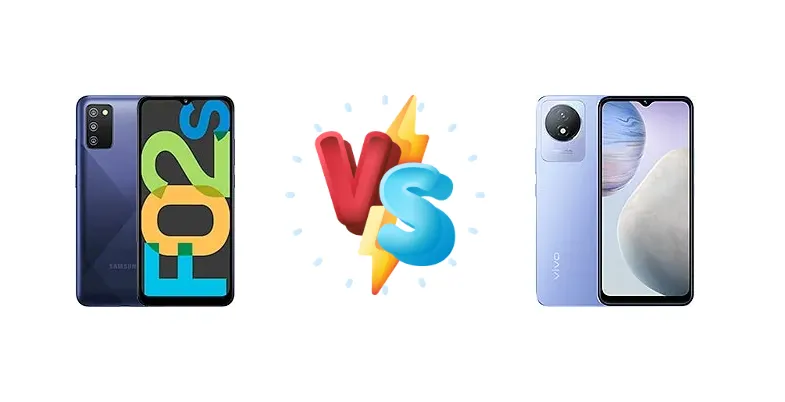
The Samsung Galaxy F02s and vivo Y02 represent the extreme end of the budget smartphone market, targeting first-time smartphone buyers or those needing a reliable secondary device. Both aim to deliver essential functionality at an incredibly low price point, but they achieve this with different chipsets and feature sets. This comparison dissects the key differences to help you determine which device best suits your needs.
🏆 Quick Verdict
For most users, the Samsung Galaxy F02s offers a slightly better overall experience. While the vivo Y02 boasts a newer 12nm process, the Snapdragon 450’s optimized architecture and 15W charging provide a more responsive user experience and quicker top-ups, making it the more practical choice.
| Network |
|---|
| 2G bands | GSM 850 / 900 / 1800 / 1900 | GSM 850 / 900 / 1800 / 1900 |
| 3G bands | HSDPA 850 / 900 / 2100 | HSDPA 850 / 900 / 2100 |
| 4G bands | 1, 3, 5, 7, 8, 20, 28, 38, 40, 41 | 1, 3, 5, 8, 40 |
| Speed | HSPA 42.2/5.76 Mbps, LTE Cat4 150/50 Mbps | HSPA, LTE |
| Technology | GSM / HSPA / LTE | GSM / HSPA / LTE |
| Launch |
|---|
| Announced | 2021, April 05 | 2022, November 29 |
| Status | Available. Released 2021, April 09 | Available. Released 2022, November 29 |
| Body |
|---|
| Build | Glass front, plastic back, plastic frame | Glass front, plastic back, plastic frame |
| Dimensions | 164.2 x 75.9 x 9.1 mm (6.46 x 2.99 x 0.36 in) | 164 x 75.6 x 8.5 mm (6.46 x 2.98 x 0.33 in) |
| SIM | Nano-SIM + Nano-SIM | Nano-SIM + Nano-SIM |
| Weight | 196 g (6.91 oz) | 186 g (6.56 oz) |
| Display |
|---|
| Resolution | 720 x 1600 pixels, 20:9 ratio (~270 ppi density) | 720 x 1600 pixels, 20:9 ratio (~270 ppi density) |
| Size | 6.5 inches, 102.0 cm2 (~81.8% screen-to-body ratio) | 6.51 inches, 102.3 cm2 (~82.5% screen-to-body ratio) |
| Type | PLS LCD | IPS LCD |
| Platform |
|---|
| CPU | Octa-core 1.8 GHz Cortex-A53 | Octa-core 2.0 GHz Cortex-A53 |
| Chipset | Qualcomm SDM450 Snapdragon 450 (14 nm) | Mediatek MT6762 Helio P22 (12 nm) |
| GPU | Adreno 506 | PowerVR GE8320 |
| OS | Android 10 | Android 12 (Go edition), Funtouch 12 |
| Memory |
|---|
| Card slot | microSDXC (dedicated slot) | microSDXC (dedicated slot) |
| Internal | 32GB 3GB RAM, 64GB 4GB RAM | 32GB 2GB RAM, 32GB 3GB RAM |
| | eMMC 5.1 | eMMC 5.1 |
| Main Camera |
|---|
| Features | LED flash | LED flash |
| Single | 5 MP, f/2.2 | 8 MP, f/2.0 |
| Triple | 13 MP, f/2.2, (wide), AF
2 MP (macro)
Auxiliary lens | - |
| Video | 1080p@30fps | 1080p@30fps |
| Selfie camera |
|---|
| Single | 5 MP, f/2.2 | 5 MP, f/2.2 |
| Video | - | Yes |
| Sound |
|---|
| 3.5mm jack | Yes | Yes |
| 35mm jack | Yes | Yes |
| Loudspeaker | Yes | Yes |
| Comms |
|---|
| Bluetooth | 4.2, A2DP | 5.0, A2DP, LE |
| NFC | No | No |
| Positioning | GPS, GLONASS, GALILEO, BDS | GPS, GLONASS, GALILEO, BDS, QZSS |
| Radio | FM radio | FM radio |
| USB | USB Type-C 2.0, OTG | microUSB 2.0, OTG |
| WLAN | Wi-Fi 802.11 b/g/n, Wi-Fi Direct | Wi-Fi 802.11 a/b/g/n/ac, dual-band |
| Features |
|---|
| Sensors | Accelerometer, proximity | Accelerometer, proximity |
| Battery |
|---|
| Charging | 15W wired | 10W wired
5W reverse wired |
| Type | Li-Po 5000 mAh | 5000 mAh |
| Misc |
|---|
| Colors | Ceramic Blue, Ceramic White, Ceramic Black | Cosmic Grey, Orchid Blue |
| Models | SM-E025F, SM-E025F/DS | - |
| Price | About 100 EUR | About 90 EUR |
| SAR | 0.52 W/kg (head) | - |
Samsung Galaxy F02s
- Faster 15W charging
- Optimized Snapdragon 450 chipset for smoother performance
- Established brand reputation for software support
- Older 14nm manufacturing process
- Likely less efficient than the Helio P22 in extremely light usage
vivo Y02
- More modern 12nm manufacturing process
- Slightly higher CPU clock speed
- 5W reverse wired charging
- Slower 10W charging
- Helio P22 may exhibit more noticeable lag in multitasking
Display Comparison
Neither device boasts a standout display. Both likely utilize LCD panels, typical for this price bracket. The focus here isn't on visual fidelity, but on basic usability. Details like peak brightness and color accuracy are unavailable, but we can assume both offer adequate, though not exceptional, viewing experiences. Bezels are likely substantial on both, maximizing screen real estate within a compact form factor.
Camera Comparison
Camera performance on both devices will be limited. Details on sensor sizes and apertures are unavailable, but given the price point, expectations should be tempered. Both likely feature a primary camera alongside basic depth or macro sensors. The focus isn't on image quality, but on providing basic photographic functionality. The 2MP macro sensors commonly found in this segment are unlikely to deliver meaningful results. Image processing will be basic, prioritizing speed over detail.
Performance
The core difference lies in the chipsets. The vivo Y02’s MediaTek Helio P22 (12nm) benefits from a more modern manufacturing process, theoretically offering better power efficiency. However, the Samsung Galaxy F02s utilizes the Qualcomm Snapdragon 450 (14nm), which, despite being older, is a well-optimized architecture. The Y02’s CPU clocks slightly higher at 2.0 GHz versus the F02s’ 1.8 GHz, but both employ Cortex-A53 cores. In real-world usage, the Snapdragon 450’s optimization often translates to smoother multitasking and a more responsive feel, especially when paired with comparable RAM configurations (assumed to be similar in these devices). The Snapdragon’s GPU is also generally more capable for basic gaming.
Battery Life
Battery capacity is not specified, but both devices likely feature batteries in the 3000-4000 mAh range. The key differentiator is charging speed. The Samsung Galaxy F02s supports 15W wired charging, allowing for significantly faster top-ups compared to the vivo Y02’s 10W charging. The Y02 does offer 5W reverse wired charging, a niche feature allowing it to charge other devices, but this is unlikely to be a primary use case for most users. The faster charging of the F02s is a significant advantage for users who need to quickly replenish their battery.
Buying Guide
Buy the Samsung Galaxy F02s if you prioritize consistent performance for everyday tasks like browsing, social media, and light app usage, and value faster charging speeds. Buy the vivo Y02 if you are looking for the absolute lowest price and potentially slightly better efficiency in extremely light usage scenarios, and the inclusion of reverse wired charging is a benefit.
Frequently Asked Questions
❓ Will the vivo Y02 be able to run popular games like PUBG Mobile?
While the Helio P22 can technically run PUBG Mobile, expect to play at the lowest graphics settings and potentially experience frame rate drops. The Snapdragon 450 in the F02s offers a slightly better gaming experience, but neither phone is designed for demanding gaming.
❓ How long will it take to fully charge the Samsung Galaxy F02s with the 15W charger?
Assuming a 4000mAh battery (a common size for this class of phone), a full charge with the 15W charger should take approximately 2.5 to 3 hours. This is significantly faster than the vivo Y02’s 10W charging, which could take upwards of 4 hours.
❓ Is the 5W reverse charging on the vivo Y02 useful for charging accessories like Bluetooth earbuds?
Yes, the 5W reverse charging can be used to top up small accessories like Bluetooth earbuds or a smartwatch, but it's a very slow charging method. It's more of a convenience feature for emergencies than a primary charging solution.
❓ Which phone is likely to receive more software updates?
Samsung generally provides more consistent software updates and security patches for its devices, even at the budget level, compared to vivo. While neither phone is guaranteed long-term support, the F02s is more likely to receive updates.