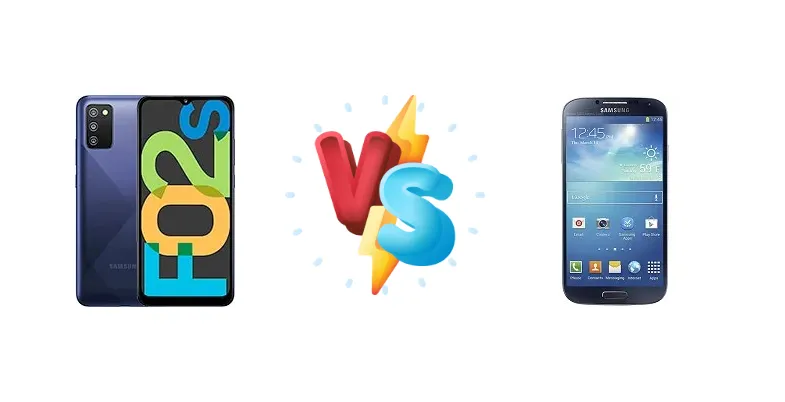
The Samsung Galaxy F02s represents the modern budget smartphone, prioritizing affordability and essential features. Conversely, the Galaxy S4 was a 2013 flagship, boasting cutting-edge technology for its time. This comparison isn't about raw power, but about value, usability, and how these devices stack up in a modern context. We'll dissect their core components to determine which offers the best experience today.
🏆 Quick Verdict
For the average user in 2024, the Samsung Galaxy F02s is the more practical choice. While the Galaxy S4’s Exynos 5410 offers a more complex CPU architecture, the F02s’ Snapdragon 450 provides sufficient performance for everyday tasks with better power efficiency and a lower price point. The S4’s age and potential battery degradation further solidify the F02s as the winner.
| Network |
|---|
| 2G bands | GSM 850 / 900 / 1800 / 1900 | GSM 850 / 900 / 1800 / 1900 |
| 3G bands | HSDPA 850 / 900 / 2100 | HSDPA 850 / 900 / 1900 / 2100 |
| 4G bands | 1, 3, 5, 7, 8, 20, 28, 38, 40, 41 | - |
| EDGE | - | Yes |
| GPRS | - | Yes |
| Speed | HSPA 42.2/5.76 Mbps, LTE Cat4 150/50 Mbps | HSPA 42.2/5.76 Mbps |
| Technology | GSM / HSPA / LTE | GSM / HSPA |
| Launch |
|---|
| Announced | 2021, April 05 | 2013, March. Released 2013, April |
| Status | Available. Released 2021, April 09 | Discontinued |
| Body |
|---|
| Build | Glass front, plastic back, plastic frame | Glass front (Gorilla Glass 3), plastic back, plastic frame |
| Dimensions | 164.2 x 75.9 x 9.1 mm (6.46 x 2.99 x 0.36 in) | 136.6 x 69.8 x 7.9 mm (5.38 x 2.75 x 0.31 in) |
| SIM | Nano-SIM + Nano-SIM | Micro-SIM |
| Weight | 196 g (6.91 oz) | 130 g (4.59 oz) |
| Display |
|---|
| Protection | - | Corning Gorilla Glass 3 |
| Resolution | 720 x 1600 pixels, 20:9 ratio (~270 ppi density) | 1080 x 1920 pixels, 16:9 ratio (~441 ppi density) |
| Size | 6.5 inches, 102.0 cm2 (~81.8% screen-to-body ratio) | 5.0 inches, 68.9 cm2 (~72.3% screen-to-body ratio) |
| Type | PLS LCD | Super AMOLED |
| Platform |
|---|
| CPU | Octa-core 1.8 GHz Cortex-A53 | Octa-core (4x1.6 GHz Cortex-A15 & 4x1.2 GHz Cortex-A7) |
| Chipset | Qualcomm SDM450 Snapdragon 450 (14 nm) | Exynos 5410 Octa (28 nm) |
| GPU | Adreno 506 | PowerVR SGX544MP3 |
| OS | Android 10 | Android 4.2.2 (Jelly Bean), upgradable to 5.0.1 (Lollipop), TouchWiz UI |
| Memory |
|---|
| Call records | - | Yes |
| Card slot | microSDXC (dedicated slot) | microSDXC (dedicated slot) |
| Internal | 32GB 3GB RAM, 64GB 4GB RAM | 16GB 2GB RAM, 32GB 2GB RAM, 64GB 2GB RAM |
| Phonebook | - | 2000 entries |
| | eMMC 5.1 | eMMC 5.0 |
| Main Camera |
|---|
| Features | LED flash | LED flash, HDR |
| Single | 5 MP, f/2.2 | 13 MP, f/2.2, 31mm (standard), 1/3.1", 1.14µm, AF |
| Triple | 13 MP, f/2.2, (wide), AF
2 MP (macro)
Auxiliary lens | - |
| Video | 1080p@30fps | 1080p@30fps |
| Selfie camera |
|---|
| Features | - | Dual video call |
| Single | 5 MP, f/2.2 | 2 MP, f/2.4, 31mm (standard) |
| Video | - | 1080p@30fps |
| Sound |
|---|
| 3.5mm jack | Yes | Yes |
| 35mm jack | Yes | Yes |
| Loudspeaker | Yes | Yes |
| Comms |
|---|
| Bluetooth | 4.2, A2DP | 4.0, A2DP, EDR, LE, aptX |
| Infrared port | - | Yes |
| NFC | No | Yes |
| Positioning | GPS, GLONASS, GALILEO, BDS | GPS, GLONASS |
| Radio | FM radio | No |
| USB | USB Type-C 2.0, OTG | microUSB 2.0 (MHL 2 TV-out), OTG |
| WLAN | Wi-Fi 802.11 b/g/n, Wi-Fi Direct | Wi-Fi 802.11 a/b/g/n/ac, dual-band, Wi-Fi Direct, DLNA, hotspot |
| Features |
|---|
| Games | - | Downloadable |
| Java | - | Yes |
| Messaging | - | SMS(threaded view), MMS, Email, IM |
| Sensors | Accelerometer, proximity | Accelerometer, gyro, proximity, compass, barometer, temperature, humidity, gesture |
| | - | ANT+
S-Voice natural language commands and dictation
Air gestures |
| Battery |
|---|
| Charging | 15W wired | Wireless (Qi) (market dependent) |
| Music play | - | Up to 62 h |
| Stand-by | - | Up to 370 h (3G) |
| Talk time | - | Up to 17 h (3G) |
| Type | Li-Po 5000 mAh | Li-Ion 2600 mAh, removable |
| Misc |
|---|
| Colors | Ceramic Blue, Ceramic White, Ceramic Black | White Frost, Black Mist, Arctic Blue, Black Edition |
| Models | SM-E025F, SM-E025F/DS | GT-I9500, SGH-I337M, SGH-M919, GT-I9507V, SHV-E330L, SPH-L720T, SHV-E300S, SHV-E300L, SHV-E300K, GT-I9507, SGH-M919N |
| Price | About 100 EUR | About 320 EUR |
| SAR | 0.52 W/kg (head) | 0.85 W/kg (head) 1.55 W/kg (body) |
| SAR EU | - | 0.42 W/kg (head) 0.54 W/kg (body) |
| Tests |
|---|
| Audio quality | - |
Noise -95.9dB / Crosstalk -96.4dB |
| Battery life | - |
Endurance rating 65h
|
| Camera | - |
Photo / Video |
| Display | - |
Contrast ratio: Infinite (nominal) / 3.352:1 (sunlight) |
| Loudspeaker | - |
Voice 70dB / Noise 66dB / Ring 77dB
|
Samsung Galaxy F02s
- More affordable price point
- Better power efficiency with Snapdragon 450
- Modern charging standards (15W wired)
- Likely lower-quality display panel (LCD vs AMOLED)
- Less powerful CPU architecture compared to S4's A15 cores
Samsung I9500 Galaxy S4
- Potentially superior display quality (Super AMOLED)
- More powerful individual CPU cores (Cortex-A15)
- Wireless charging support (market dependent)
- Aging battery with reduced capacity
- Older chipset with less efficient manufacturing process (28nm)
- Potential software compatibility issues
Display Comparison
Both devices share a similar contrast ratio specification – infinite (nominal) and 3.352:1 in sunlight – suggesting comparable outdoor visibility. However, the S4’s display technology is likely a Super AMOLED, known for vibrant colors, while the F02s likely uses a less advanced LCD panel. The S4’s 5-inch display, while smaller, was a premium offering in 2013, whereas the F02s’ display size isn’t specified, but is likely larger, catering to modern preferences. The S4’s smaller size and higher quality panel likely provide a sharper, more color-accurate image, but the F02s may offer a more immersive viewing experience due to its larger size.
Camera Comparison
Both phones offer photo and video capabilities, but details are limited. The Galaxy S4 likely featured a higher-quality camera sensor and image processing pipeline for its era. However, modern computational photography techniques on the F02s, even with a potentially smaller sensor, could yield comparable results in good lighting conditions. The S4’s camera likely excels in dynamic range and detail preservation, while the F02s may offer more user-friendly features and potentially better low-light performance due to software enhancements. The F02s’ camera is likely more focused on social media sharing, while the S4’s camera was designed for more serious photography.
Performance
The Exynos 5410 in the Galaxy S4 features an octa-core CPU with a big.LITTLE architecture – four Cortex-A15 cores clocked at 1.6 GHz for performance and four Cortex-A7 cores at 1.2 GHz for efficiency. This contrasts with the Galaxy F02s’ Snapdragon 450, an octa-core Cortex-A53 processor clocked at 1.8 GHz. While the S4’s A15 cores are individually more powerful, the Snapdragon 450’s newer 14nm process (versus the S4’s 28nm) offers improved power efficiency. The S4’s architecture was innovative for its time, but the F02s benefits from advancements in manufacturing and power management, resulting in better sustained performance and less heat generation. The F02s’ simpler, homogenous core design also reduces software complexity.
Battery Life
The Galaxy S4 boasts an endurance rating of 65 hours, a respectable figure for its time. The F02s, with its 15W wired charging, offers a more modern charging experience. While the S4 supports wireless charging (Qi, market dependent), its battery health is likely degraded after years of use. The Snapdragon 450’s power efficiency in the F02s, combined with a potentially larger battery capacity (not specified), could result in comparable or even better real-world battery life than the aging S4, despite the S4’s initial 65-hour rating.
Buying Guide
Buy the Samsung Galaxy F02s if you need a reliable, affordable smartphone for basic tasks like calling, texting, social media, and light web browsing. It’s ideal for first-time smartphone users or those on a tight budget. Buy the Samsung I9500 Galaxy S4 if you appreciate a classic design, desire wireless charging (market dependent), and are willing to accept the compromises of an older device – including potential battery issues and software limitations – for a potentially lower upfront cost, understanding it's a collector's item more than a daily driver.
Frequently Asked Questions
❓ Does the Exynos 5410 in the Galaxy S4 overheat during prolonged use?
The Exynos 5410, being a 28nm chip, is more prone to thermal throttling than the F02s’ Snapdragon 450. Running demanding apps or games for extended periods on the S4 could lead to noticeable performance drops as the chip heats up. The F02s’ 14nm process offers better thermal efficiency.
❓ Is the 2MP macro camera on the F02s actually useful?
Generally, 2MP macro cameras on budget phones like the F02s offer limited detail and image quality. They are primarily for casual close-up shots and shouldn't be expected to deliver professional-level results. The S4’s camera, while older, likely offers better overall image quality even without a dedicated macro mode.
❓ Can the Galaxy S4 still handle modern apps and software updates?
The Galaxy S4 is no longer officially supported with software updates from Samsung. While some custom ROMs may be available, compatibility with modern apps is increasingly limited. Many apps may not function correctly or at all due to outdated Android versions and hardware limitations.
❓ How does the Snapdragon 450 perform in gaming compared to the Exynos 5410?
While the Exynos 5410’s Cortex-A15 cores are more powerful individually, the Snapdragon 450’s efficiency and newer architecture allow for more sustained performance. The S4 might show higher initial frame rates in some games, but the F02s will likely maintain a more consistent frame rate over longer gaming sessions due to less thermal throttling.