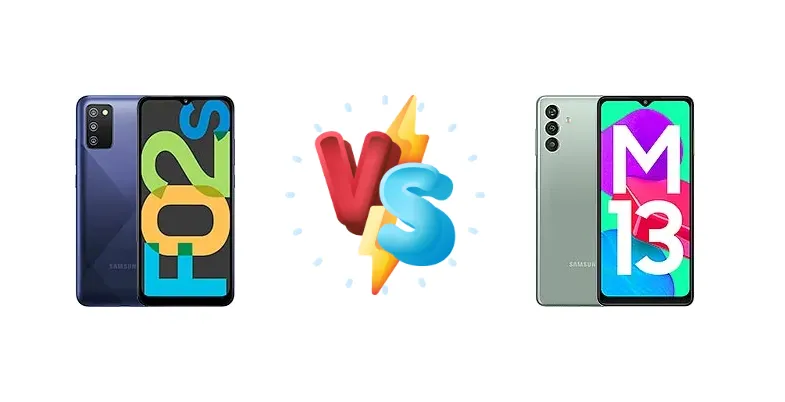
Samsung's budget lineup can be confusing. The Galaxy F02s, a mainstay for value-conscious buyers, now faces competition from the newer Galaxy M13 (India). While both aim for affordability, they represent different approaches to achieving it – one prioritizing established, if older, silicon, and the other opting for a more modern, though still entry-level, chipset. This comparison dissects the key differences to help you choose.
🏆 Quick Verdict
For most users, the Samsung Galaxy M13 (India) is the better choice. Its Exynos 850 chipset, built on a more efficient 8nm process, delivers noticeably improved performance and future-proofing compared to the F02s' aging Snapdragon 450. While both offer similar 15W charging, the M13's overall experience is smoother and more responsive.
| Network |
|---|
| 2G bands | GSM 850 / 900 / 1800 / 1900 | GSM 850 / 900 / 1800 / 1900 |
| 3G bands | HSDPA 850 / 900 / 2100 | HSDPA 850 / 900 / 2100 |
| 4G bands | 1, 3, 5, 7, 8, 20, 28, 38, 40, 41 | 1, 3, 5, 7, 8, 20, 28, 38, 40, 41 |
| Speed | HSPA 42.2/5.76 Mbps, LTE Cat4 150/50 Mbps | HSPA, LTE |
| Technology | GSM / HSPA / LTE | GSM / HSPA / LTE |
| Launch |
|---|
| Announced | 2021, April 05 | 2022, July 14 |
| Status | Available. Released 2021, April 09 | Available. Released 2022, July 23 |
| Body |
|---|
| Build | Glass front, plastic back, plastic frame | Glass front (Gorilla Glass 5), plastic back, plastic frame |
| Dimensions | 164.2 x 75.9 x 9.1 mm (6.46 x 2.99 x 0.36 in) | 165.4 x 76.9 x 9.3 mm (6.51 x 3.03 x 0.37 in) |
| SIM | Nano-SIM + Nano-SIM | Nano-SIM + Nano-SIM |
| Weight | 196 g (6.91 oz) | 207 g (7.30 oz) |
| Display |
|---|
| Protection | - | Corning Gorilla Glass 5 |
| Resolution | 720 x 1600 pixels, 20:9 ratio (~270 ppi density) | 1080 x 2408 pixels, 20:9 ratio (~400 ppi density) |
| Size | 6.5 inches, 102.0 cm2 (~81.8% screen-to-body ratio) | 6.6 inches, 104.9 cm2 (~82.5% screen-to-body ratio) |
| Type | PLS LCD | PLS LCD |
| Platform |
|---|
| CPU | Octa-core 1.8 GHz Cortex-A53 | Octa-core (4x2.0 GHz Cortex-A55 & 4x2.0 GHz Cortex-A55) |
| Chipset | Qualcomm SDM450 Snapdragon 450 (14 nm) | Exynos 850 (8 nm) |
| GPU | Adreno 506 | Mali-G52 |
| OS | Android 10 | Android 12, One UI Core 4 |
| Memory |
|---|
| Card slot | microSDXC (dedicated slot) | microSDXC (dedicated slot) |
| Internal | 32GB 3GB RAM, 64GB 4GB RAM | 64GB 4GB RAM, 128GB 6GB RAM |
| | eMMC 5.1 | eMMC 5.1 |
| Main Camera |
|---|
| Features | LED flash | LED flash, panorama, HDR |
| Single | 5 MP, f/2.2 | - |
| Triple | 13 MP, f/2.2, (wide), AF
2 MP (macro)
Auxiliary lens | 50 MP, f/1.8, (wide), PDAF
5 MP, f/2.2, 123˚ (ultrawide)
Auxiliary lens |
| Video | 1080p@30fps | 1080p@30fps |
| Selfie camera |
|---|
| Features | - | HDR |
| Single | 5 MP, f/2.2 | 8 MP, f/2.2, (wide) |
| Video | - | 1080p@30fps |
| Sound |
|---|
| 3.5mm jack | Yes | Yes |
| 35mm jack | Yes | Yes |
| Loudspeaker | Yes | Yes |
| Comms |
|---|
| Bluetooth | 4.2, A2DP | 5.0, A2DP, LE |
| NFC | No | No |
| Positioning | GPS, GLONASS, GALILEO, BDS | GPS, GLONASS, BDS, GALILEO, QZSS |
| Radio | FM radio | No |
| USB | USB Type-C 2.0, OTG | USB Type-C 2.0 |
| WLAN | Wi-Fi 802.11 b/g/n, Wi-Fi Direct | Wi-Fi 802.11 a/b/g/n/ac, dual-band, Wi-Fi Direct |
| Features |
|---|
| Sensors | Accelerometer, proximity | Fingerprint (side-mounted), accelerometer, compass |
| | - | Virtual proximity sensing |
| Battery |
|---|
| Charging | 15W wired | 15W wired |
| Type | Li-Po 5000 mAh | Li-Po 6000 mAh |
| Misc |
|---|
| Colors | Ceramic Blue, Ceramic White, Ceramic Black | Midnight Blue, Aqua Green, Stardust Brown |
| Models | SM-E025F, SM-E025F/DS | SM-M135FU, SM-M135FU/DS |
| Price | About 100 EUR | About 150 EUR |
| SAR | 0.52 W/kg (head) | 0.56 W/kg (head) |
Samsung Galaxy F02s
- Lowest possible price point
- Functional for basic tasks
- Simple and easy to use
- Outdated Snapdragon 450 chipset
- Poor performance with demanding apps
- Limited future-proofing
Samsung Galaxy M13 (India)
- More powerful and efficient Exynos 850
- Smoother user experience
- Better long-term software support
- Improved camera processing
- Slightly higher price
- Still a budget device with limitations
- 15W charging is relatively slow
Display Comparison
Neither device boasts a standout display. Both likely utilize LCD panels, a common cost-saving measure in this segment. However, the M13 benefits from the more modern Exynos 850's image signal processor, potentially leading to slightly better color reproduction. The F02s, with its Snapdragon 450, will likely exhibit more limited color gamut coverage. While specific nit brightness figures are unavailable, the newer chipset *could* allow for a brighter panel on the M13, improving outdoor visibility.
Camera Comparison
Without detailed sensor information, a direct comparison is difficult. However, the Exynos 850's ISP in the M13 provides a computational photography advantage. Expect better dynamic range and noise reduction in the M13's photos, even with similar sensor resolutions. The F02s' Snapdragon 450 ISP is older and less capable. The inclusion of a 2MP macro lens on both devices is largely a marketing gimmick; image quality will be limited. Focus on the main sensor performance, where the M13 is likely to excel due to its superior image processing capabilities.
Performance
The core difference lies here. The Galaxy M13's Exynos 850 (8nm) is a significant leap over the F02s' Snapdragon 450 (14nm). The 8nm process inherently offers better power efficiency, translating to less heat generation and potentially reduced throttling during sustained workloads. While both are octa-core CPUs, the M13 utilizes Cortex-A55 cores across the board, a more efficient architecture than the F02s' Cortex-A53. This means faster app loading times, smoother multitasking, and a more responsive overall experience on the M13. The F02s will struggle with demanding apps and games.
Battery Life
Both phones feature 15W wired charging, suggesting similar charging speeds – approximately 2-2.5 hours for a full charge. While battery capacity isn't specified, the Exynos 850's superior power efficiency in the M13 means it will likely deliver longer real-world battery life despite potentially having a similar capacity to the F02s. The Snapdragon 450 is a power-hungry chip, especially under load, leading to faster battery drain.
Buying Guide
Buy the Samsung Galaxy F02s if you absolutely need the lowest possible price and your usage is limited to basic tasks like calls, texts, and light social media. It's a functional device for minimal demands. Buy the Samsung Galaxy M13 (India) if you prioritize a smoother user experience, occasional gaming, and a chipset that will handle future Android updates with more grace. The M13 offers a better long-term investment for just a slight price premium.
Frequently Asked Questions
❓ Will the Exynos 850 in the M13 overheat during prolonged gaming sessions?
While the Exynos 850 isn't a high-end gaming chip, its 8nm process and improved thermal efficiency compared to the Snapdragon 450 in the F02s significantly reduce the risk of overheating. You can expect playable frame rates in less demanding games for extended periods, though throttling may occur in graphically intensive titles.
❓ Is the 2MP macro camera on either phone worth using?
Realistically, no. 2MP macro cameras on budget phones typically produce low-resolution, soft images with limited detail. They are primarily a marketing feature and offer little practical benefit. Focus on the main camera for better results.
❓ Can the Samsung Galaxy M13 (India) handle games like PUBG Mobile at acceptable frame rates?
The M13 can run PUBG Mobile, but don't expect ultra settings. You'll likely need to settle for balanced graphics and medium frame rates (around 30-40fps) for a smooth experience. The Snapdragon 450 in the F02s will struggle significantly with PUBG, even at the lowest settings.
❓ How much faster is the app loading speed on the M13 compared to the F02s?
App loading times on the M13 will be noticeably faster, likely 20-40% quicker, due to the Exynos 850's more efficient CPU architecture and faster storage access. This difference will be most apparent when launching frequently used apps.