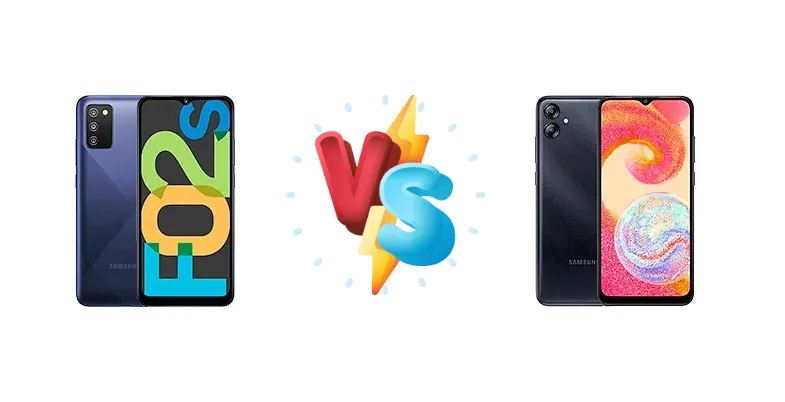
The Samsung Galaxy M04 and F02s represent Samsung's continued commitment to the ultra-budget smartphone market. While both aim to deliver essential smartphone functionality at a low price point, they differ significantly in their core processing power, stemming from the choice between MediaTek’s Helio P35 and Qualcomm’s Snapdragon 450. This comparison dissects these differences to determine which device offers the best value.
🏆 Quick Verdict
For most users, the Samsung Galaxy M04 offers a slight edge due to its more modern and efficient Helio P35 chipset. The P35’s higher clock speeds on four cores provide a noticeable performance boost in everyday tasks and light multitasking, making it the better choice for those seeking a smoother user experience.
| Network |
|---|
| 2G bands | GSM 850 / 900 / 1800 / 1900 | GSM 850 / 900 / 1800 / 1900 |
| 3G bands | HSDPA 850 / 900 / 2100 | HSDPA 850 / 900 / 2100 |
| 4G bands | 1, 3, 5, 7, 8, 20, 28, 38, 40, 41 | 1, 3, 5, 7, 8, 20, 28, 38, 40, 41 |
| Speed | HSPA 42.2/5.76 Mbps, LTE Cat4 150/50 Mbps | HSPA, LTE |
| Technology | GSM / HSPA / LTE | GSM / HSPA / LTE |
| Launch |
|---|
| Announced | 2021, April 05 | 2022, December 10 |
| Status | Available. Released 2021, April 09 | Available. Released 2022, December 16 |
| Body |
|---|
| Build | Glass front, plastic back, plastic frame | Glass front, plastic back, plastic frame |
| Dimensions | 164.2 x 75.9 x 9.1 mm (6.46 x 2.99 x 0.36 in) | 164.2 x 75.9 x 9.1 mm (6.46 x 2.99 x 0.36 in) |
| SIM | Nano-SIM + Nano-SIM | · Nano-SIM· Nano-SIM + Nano-SIM |
| Weight | 196 g (6.91 oz) | 188 g (6.63 oz) |
| Display |
|---|
| Resolution | 720 x 1600 pixels, 20:9 ratio (~270 ppi density) | 720 x 1600 pixels, 20:9 ratio (~270 ppi density) |
| Size | 6.5 inches, 102.0 cm2 (~81.8% screen-to-body ratio) | 6.5 inches, 102.0 cm2 (~81.8% screen-to-body ratio) |
| Type | PLS LCD | PLS LCD |
| Platform |
|---|
| CPU | Octa-core 1.8 GHz Cortex-A53 | Octa-core (4x2.35 GHz Cortex-A53 & 4x1.8 GHz Cortex-A53) |
| Chipset | Qualcomm SDM450 Snapdragon 450 (14 nm) | Mediatek MT6765 Helio P35 (12 nm) |
| GPU | Adreno 506 | PowerVR GE8320 |
| OS | Android 10 | Android 12, One UI Core 4.1 |
| Memory |
|---|
| Card slot | microSDXC (dedicated slot) | microSDXC (dedicated slot) |
| Internal | 32GB 3GB RAM, 64GB 4GB RAM | 64GB 4GB RAM, 128GB 4GB RAM |
| | eMMC 5.1 | - |
| Main Camera |
|---|
| Dual | - | 13 MP, f/2.2, (wide), AF
Auxiliary lens |
| Features | LED flash | LED flash |
| Single | 5 MP, f/2.2 | 5 MP, f/2.2 |
| Triple | 13 MP, f/2.2, (wide), AF
2 MP (macro)
Auxiliary lens | - |
| Video | 1080p@30fps | 1080p@30fps |
| Selfie camera |
|---|
| Single | 5 MP, f/2.2 | 5 MP, f/2.2 |
| Video | - | Yes |
| Sound |
|---|
| 3.5mm jack | Yes | Yes |
| 35mm jack | Yes | Yes |
| Loudspeaker | Yes | Yes |
| Comms |
|---|
| Bluetooth | 4.2, A2DP | 5.0, A2DP, LE |
| NFC | No | No |
| Positioning | GPS, GLONASS, GALILEO, BDS | GPS, GLONASS, GALILEO, BDS |
| Radio | FM radio | Unspecified |
| USB | USB Type-C 2.0, OTG | USB Type-C 2.0 |
| WLAN | Wi-Fi 802.11 b/g/n, Wi-Fi Direct | Wi-Fi 802.11 b/g/n, Wi-Fi Direct |
| Features |
|---|
| Sensors | Accelerometer, proximity | Accelerometer, proximity |
| Battery |
|---|
| Charging | 15W wired | 15W wired |
| Type | Li-Po 5000 mAh | Li-Po 5000 mAh |
| Misc |
|---|
| Colors | Ceramic Blue, Ceramic White, Ceramic Black | Sea Glass Green, Shadow Blue |
| Models | SM-E025F, SM-E025F/DS | SM-M045F, SM-M045F/DS |
| Price | About 100 EUR | About 100 EUR |
| SAR | 0.52 W/kg (head) | 0.38 W/kg (head) |
| SAR EU | - | 0.29 W/kg (head) 1.11 W/kg (body) |
Samsung Galaxy F02s
- Proven Snapdragon 450 chipset with established software support.
- Potentially lower cost due to being an older model.
- Reliable performance for basic tasks.
- Less efficient 14nm process.
- Lower peak performance compared to the Helio P35.
- May exhibit more noticeable slowdowns during multitasking.
Samsung Galaxy M04
- More efficient 12nm Helio P35 chipset.
- Faster clock speeds on four cores for improved responsiveness.
- Potential for better multitasking performance.
- Helio P35 may have less extensive software optimization compared to Snapdragon.
- Potentially slightly higher price point.
- May not see the same level of long-term software support.
Display Comparison
Both devices likely feature similar LCD panels, given their price bracket. However, detailed display specs (resolution, brightness) are unavailable. The focus here is on the chipset's ability to drive the display smoothly. The M04's Helio P35, while not a graphical powerhouse, benefits from a newer architecture that *may* translate to slightly smoother UI animations compared to the F02s' Snapdragon 450.
Camera Comparison
Without detailed camera sensor information, a direct comparison is difficult. Both phones likely feature basic camera setups geared towards casual photography. The image signal processor (ISP) within the Helio P35 *may* offer slightly improved image processing capabilities, but this is heavily dependent on Samsung’s software tuning. The absence of optical image stabilization (OIS) on either device suggests a reliance on software stabilization, where the P35’s ISP could play a more significant role.
Performance
The core difference lies in the chipsets. The Samsung Galaxy M04’s MediaTek Helio P35 (12nm) features an octa-core configuration with a heterogeneous setup: four cores clocked at 2.35 GHz and four at 1.8 GHz. This contrasts with the Samsung Galaxy F02s’ Qualcomm Snapdragon 450 (14nm), which utilizes a uniform octa-core 1.8 GHz Cortex-A53 setup. The P35’s faster cores provide a performance advantage in bursty workloads, like app launches and scrolling. The 12nm process node of the P35 also contributes to better power efficiency compared to the 14nm Snapdragon 450, potentially leading to longer battery life under load. While both use Cortex-A53 cores, the P35’s architecture is more refined.
Battery Life
Both devices share a 15W wired charging capability. The actual battery capacity is not specified, but the Helio P35’s 12nm process offers a power efficiency advantage. This means the M04 could potentially achieve similar or slightly better battery life with a comparable battery capacity to the F02s, despite both having the same charging wattage. The more efficient chipset translates to less energy consumption during typical usage.
Buying Guide
Buy the Samsung Galaxy F02s if you prioritize a proven, if older, chipset with established software compatibility and are primarily focused on basic communication and light app usage. Buy the Samsung Galaxy M04 if you prefer a slightly more responsive experience for everyday tasks, appreciate the potential for better multitasking, and want a chipset built on a more efficient 12nm process.
Frequently Asked Questions
❓ Will the Samsung Galaxy M04 handle popular apps like WhatsApp and Facebook smoothly?
Yes, the Helio P35 in the M04 is well-suited for running common social media and messaging apps like WhatsApp and Facebook. The faster cores will contribute to quicker app loading times and smoother scrolling within these applications compared to the F02s.
❓ Is the difference in performance between the Snapdragon 450 and Helio P35 noticeable for everyday use?
While neither chipset is designed for demanding tasks, the Helio P35’s faster cores will be noticeable during everyday use. Expect quicker app launches, smoother transitions, and a more responsive overall experience on the M04, especially when multitasking.
❓ Does the Samsung Galaxy F02s get hot during prolonged use?
The Snapdragon 450, being built on a 14nm process, can generate more heat under sustained load compared to the 12nm Helio P35. While not extreme, the F02s may become warmer during extended gaming or video playback sessions.
❓ Which phone is better for playing casual games like Candy Crush or Subway Surfers?
Both phones can handle casual games without issue. However, the Helio P35 in the M04 offers a slight advantage, potentially providing more consistent frame rates and smoother gameplay, especially as these games receive updates.