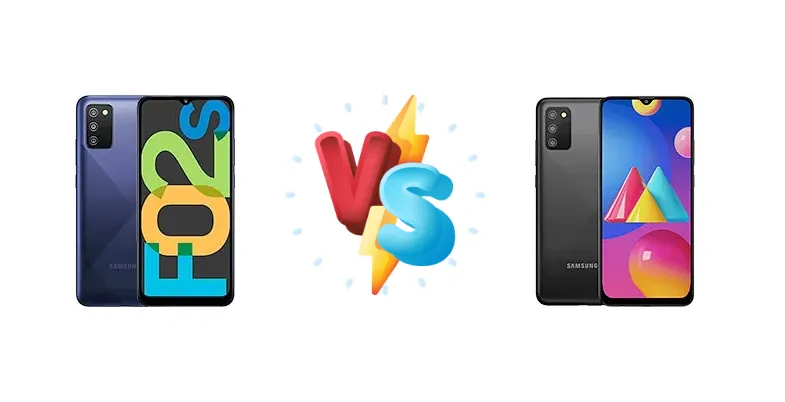
The Samsung Galaxy F02s and M02s represent Samsung’s continued focus on the ultra-budget smartphone market. While seemingly identical on paper, these devices often target different regional markets and price points, making a direct comparison crucial for consumers seeking the best value. This analysis will dissect their shared specifications to determine which, if either, offers a compelling advantage.
🏆 Quick Verdict
For the average user, the Samsung Galaxy M02s is the slightly better choice, primarily due to its typically wider availability and potentially more competitive pricing. Both phones deliver identical performance with the Snapdragon 450, but the M02s often represents the more accessible option.
| Network |
|---|
| 2G bands | GSM 850 / 900 / 1800 / 1900 | GSM 850 / 900 / 1800 / 1900 |
| 3G bands | HSDPA 850 / 900 / 2100 | HSDPA 850 / 900 / 2100 |
| 4G bands | 1, 3, 5, 7, 8, 20, 28, 38, 40, 41 | 1, 3, 5, 7, 8, 20, 28, 38, 40, 41 |
| Speed | HSPA 42.2/5.76 Mbps, LTE Cat4 150/50 Mbps | HSPA 42.2/5.76 Mbps, LTE Cat4 150/50 Mbps |
| Technology | GSM / HSPA / LTE | GSM / HSPA / LTE |
| Launch |
|---|
| Announced | 2021, April 05 | 2021, January 07 |
| Status | Available. Released 2021, April 09 | Available. Released 2021, January 19 |
| Body |
|---|
| Build | Glass front, plastic back, plastic frame | Glass front, plastic back, plastic frame |
| Dimensions | 164.2 x 75.9 x 9.1 mm (6.46 x 2.99 x 0.36 in) | 164.2 x 75.9 x 9.1 mm (6.46 x 2.99 x 0.36 in) |
| SIM | Nano-SIM + Nano-SIM | · Nano-SIM· Nano-SIM + Nano-SIM |
| Weight | 196 g (6.91 oz) | 196 g (6.91 oz) |
| Display |
|---|
| Resolution | 720 x 1600 pixels, 20:9 ratio (~270 ppi density) | 720 x 1600 pixels, 20:9 ratio (~270 ppi density) |
| Size | 6.5 inches, 102.0 cm2 (~81.8% screen-to-body ratio) | 6.5 inches, 102.0 cm2 (~81.8% screen-to-body ratio) |
| Type | PLS LCD | PLS LCD |
| Platform |
|---|
| CPU | Octa-core 1.8 GHz Cortex-A53 | Octa-core 1.8 GHz Cortex-A53 |
| Chipset | Qualcomm SDM450 Snapdragon 450 (14 nm) | Qualcomm SDM450 Snapdragon 450 (14 nm) |
| GPU | Adreno 506 | Adreno 506 |
| OS | Android 10 | Android 10 |
| Memory |
|---|
| Card slot | microSDXC (dedicated slot) | microSDXC (dedicated slot) |
| Internal | 32GB 3GB RAM, 64GB 4GB RAM | 32GB 3GB RAM, 64GB 4GB RAM |
| | eMMC 5.1 | eMMC 5.1 |
| Main Camera |
|---|
| - | Go |
| Features | LED flash | LED flash |
| Single | 5 MP, f/2.2 | - |
| Triple | 13 MP, f/2.2, (wide), AF
2 MP (macro)
Auxiliary lens | 13 MP, f/2.2, (wide), AF
2 MP (macro)
Auxiliary lens |
| Video | 1080p@30fps | 1080p@30fps |
| Selfie camera |
|---|
| Single | 5 MP, f/2.2 | 5 MP, f/2.2 |
| Sound |
|---|
| 3.5mm jack | Yes | Yes |
| 35mm jack | Yes | Yes |
| Loudspeaker | Yes | Yes |
| Comms |
|---|
| Bluetooth | 4.2, A2DP | Yes |
| NFC | No | No |
| Positioning | GPS, GLONASS, GALILEO, BDS | GPS, GLONASS, GALILEO, BDS |
| Radio | FM radio | FM radio |
| USB | USB Type-C 2.0, OTG | Yes |
| WLAN | Wi-Fi 802.11 b/g/n, Wi-Fi Direct | Wi-Fi 802.11 b/g/n, Wi-Fi Direct |
| Features |
|---|
| Sensors | Accelerometer, proximity | Accelerometer, proximity |
| Battery |
|---|
| Charging | 15W wired | 15W wired |
| Type | Li-Po 5000 mAh | Li-Po 5000 mAh |
| Misc |
|---|
| Colors | Ceramic Blue, Ceramic White, Ceramic Black | Black, Blue, Red |
| Models | SM-E025F, SM-E025F/DS | SM-M025F/DS, SM-M025F |
| Price | About 100 EUR | About 100 EUR |
| SAR | 0.52 W/kg (head) | 0.52 W/kg (head) |
| SAR EU | - | 0.40 W/kg (head) 1.37 W/kg (body) |
Samsung Galaxy F02s
- Identical performance to M02s due to shared Snapdragon 450 chipset.
- 15W charging provides adequate charging speed.
- Potentially lower price in specific regions.
- Availability may be limited compared to the M02s.
- Snapdragon 450 struggles with demanding tasks.
Samsung Galaxy M02s
- Identical performance to F02s due to shared Snapdragon 450 chipset.
- 15W charging provides adequate charging speed.
- Generally wider availability and retail presence.
- Snapdragon 450 struggles with demanding tasks.
- May be slightly more expensive than the F02s in some markets.
Display Comparison
Both the Galaxy F02s and M02s feature displays that prioritize affordability over cutting-edge technology. While specific panel types aren't detailed in the provided data, both likely utilize LCD panels given their price bracket. The absence of information regarding peak brightness or color gamut suggests neither device is geared towards media consumption in bright environments or color-critical work. Bezels are expected to be noticeable, typical of this segment. The 14nm Snapdragon 450 will likely be the limiting factor in rendering complex visuals, rather than the display itself.
Camera Comparison
Camera performance is likely to be similar on both devices, relying on the same underlying image signal processor (ISP) within the Snapdragon 450. Without sensor size or aperture information, it's difficult to assess image quality definitively. However, given the price point, expectations should be tempered. The inclusion of a 2MP macro camera on both devices is largely a marketing tactic, as the limited resolution and fixed focus will result in images lacking detail. The primary camera's performance will be the key differentiator, but without further specifications, it's impossible to determine which device captures better photos.
Performance
The core of both devices is the Qualcomm Snapdragon 450 (14 nm) chipset, paired with an octa-core 1.8 GHz Cortex-A53 CPU. This means performance will be virtually indistinguishable between the two. The Snapdragon 450 is a capable processor for basic tasks like calling, texting, and light social media browsing, but it will struggle with demanding applications or multitasking. The 14nm manufacturing process, while mature, isn't particularly power-efficient, meaning sustained performance may be limited by thermal throttling. RAM specifications are not provided, but are likely limited to 3GB or 4GB, further impacting multitasking capabilities.
Battery Life
Both the Galaxy F02s and M02s support 15W wired charging. While not fast charging by modern standards, it's adequate for their intended use case. Battery capacity isn't specified, but is likely in the 4000-5000 mAh range, providing all-day battery life for light users. The Snapdragon 450's relatively inefficient 14nm process will impact battery endurance, particularly during prolonged use of demanding applications. The 15W charging will take several hours to fully charge the battery from 0-100%.
Buying Guide
Buy the Samsung Galaxy F02s if you find it significantly cheaper in your region and availability isn't a concern. It offers the same core functionality as the M02s. Buy the Samsung Galaxy M02s if you prioritize ease of purchase and a potentially more consistent retail presence, as it's generally more widely distributed and may benefit from more frequent promotions.
Frequently Asked Questions
❓ Will the Snapdragon 450 handle popular games like PUBG Mobile?
The Snapdragon 450 can run PUBG Mobile, but expect to play at the lowest graphics settings and potentially experience frame rate drops, especially during intense action. It's not designed for demanding gaming experiences.
❓ Is the 2MP macro camera on either phone worth using?
The 2MP macro camera is primarily a marketing feature. Due to its low resolution and fixed focus, the resulting images will lack detail and sharpness. It's unlikely to provide significantly better results than using the main camera in close-up mode.
❓ How long will it take to fully charge the battery with the 15W charger?
Expect a full charge from 0-100% to take approximately 2.5 to 3.5 hours with the included 15W charger. Charging times will vary depending on battery capacity and usage during charging.