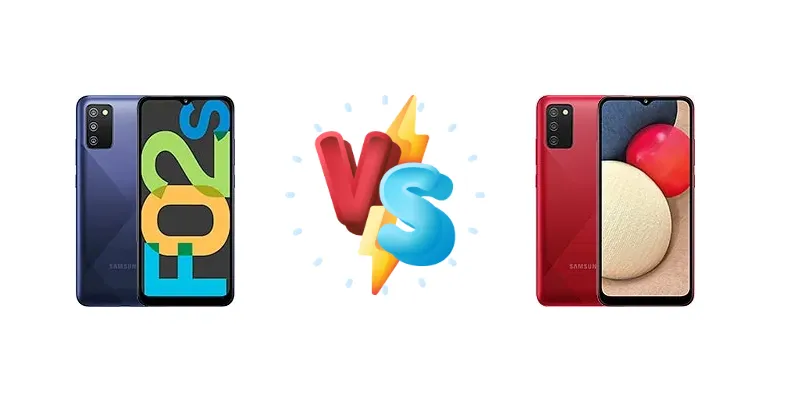
Samsung's Galaxy F02s and A02s represent the brand's entry point into the smartphone market. Both devices target price-sensitive consumers, but subtle differences in display quality and battery endurance may sway your decision. This comparison dissects the specifications to determine which phone delivers the best value.
🏆 Quick Verdict
For the average user prioritizing a slightly brighter and more visually appealing experience, the Samsung Galaxy A02s is the better choice. While both phones share the same Snapdragon 450 chipset and 15W charging, the A02s’s 406 nits of brightness and 1765:1 contrast ratio offer a noticeable improvement over what is implied for the F02s.
| Network |
|---|
| 2G bands | GSM 850 / 900 / 1800 / 1900 | GSM 850 / 900 / 1800 / 1900 |
| 3G bands | HSDPA 850 / 900 / 2100 | HSDPA 850 / 900 / 2100 |
| 4G bands | 1, 3, 5, 7, 8, 20, 28, 38, 40, 41 | 1, 3, 5, 7, 8, 20, 28, 38, 40, 41 |
| Speed | HSPA 42.2/5.76 Mbps, LTE Cat4 150/50 Mbps | HSPA 42.2/5.76 Mbps, LTE Cat4 150/50 Mbps |
| Technology | GSM / HSPA / LTE | GSM / HSPA / LTE |
| Launch |
|---|
| Announced | 2021, April 05 | 2020, November 24. Released 2021, January 04 |
| Status | Available. Released 2021, April 09 | Discontinued |
| Body |
|---|
| Build | Glass front, plastic back, plastic frame | Glass front, plastic back, plastic frame |
| Dimensions | 164.2 x 75.9 x 9.1 mm (6.46 x 2.99 x 0.36 in) | 164.2 x 75.9 x 9.1 mm (6.46 x 2.99 x 0.36 in) |
| SIM | Nano-SIM + Nano-SIM | · Nano-SIM· Nano-SIM + Nano-SIM |
| Weight | 196 g (6.91 oz) | 196 g (6.91 oz) |
| Display |
|---|
| Protection | - | Scratch-resistant glass |
| Resolution | 720 x 1600 pixels, 20:9 ratio (~270 ppi density) | 720 x 1600 pixels, 20:9 ratio (~270 ppi density) |
| Size | 6.5 inches, 102.0 cm2 (~81.8% screen-to-body ratio) | 6.5 inches, 102.0 cm2 (~81.8% screen-to-body ratio) |
| Type | PLS LCD | PLS LCD |
| Platform |
|---|
| CPU | Octa-core 1.8 GHz Cortex-A53 | Octa-core 1.8 GHz Cortex-A53 |
| Chipset | Qualcomm SDM450 Snapdragon 450 (14 nm) | Qualcomm SDM450 Snapdragon 450 (14 nm) |
| GPU | Adreno 506 | Adreno 506 |
| OS | Android 10 | Android 10, upgradable to Android 12, One UI 4.1 |
| Memory |
|---|
| Card slot | microSDXC (dedicated slot) | microSDXC (dedicated slot) |
| Internal | 32GB 3GB RAM, 64GB 4GB RAM | 16GB 1GB RAM, 32GB 2GB RAM, 32GB 3GB RAM, 32GB 4GB RAM, 64GB 3GB RAM, 64GB 4GB RAM |
| | eMMC 5.1 | eMMC 5.1 |
| Main Camera |
|---|
| Features | LED flash | LED flash |
| Single | 5 MP, f/2.2 | 3.15 MP |
| Triple | 13 MP, f/2.2, (wide), AF
2 MP (macro)
Auxiliary lens | 13 MP, f/2.2, (wide), AF
2 MP (macro)
Auxiliary lens |
| Video | 1080p@30fps | 1080p@30fps |
| Selfie camera |
|---|
| Single | 5 MP, f/2.2 | 5 MP, f/2.2 |
| Sound |
|---|
| 3.5mm jack | Yes | Yes |
| 35mm jack | Yes | Yes |
| Loudspeaker | Yes | Yes |
| Comms |
|---|
| Bluetooth | 4.2, A2DP | 4.2, A2DP |
| NFC | No | No |
| Positioning | GPS, GLONASS, GALILEO, BDS | GPS, GLONASS, GALILEO, BDS |
| Radio | FM radio | Unspecified |
| USB | USB Type-C 2.0, OTG | USB Type-C 2.0 |
| WLAN | Wi-Fi 802.11 b/g/n, Wi-Fi Direct | Wi-Fi 802.11 b/g/n, Wi-Fi Direct |
| Features |
|---|
| Sensors | Accelerometer, proximity | Accelerometer, proximity |
| Battery |
|---|
| Charging | 15W wired | 15W wired |
| Stand-by | - | Up to 530 h (2G) / Up to 530 h (3G) |
| Talk time | - | Up to 6 h 12 min (2G) / Up to 6 h 18 min (3G) |
| Type | Li-Po 5000 mAh | Li-Po 5000 mAh |
| Misc |
|---|
| Colors | Ceramic Blue, Ceramic White, Ceramic Black | Black, White, Red, Blue |
| Models | SM-E025F, SM-E025F/DS | SM-A025F, SM-A025F/DS, SM-A025G, SM-A025G/DS, SM-A025M, SM-A025M/DS, SM-A025U, SM-A025V, SM-A025A, SM-A025U1, SM-A025AZ, SM-S124DL |
| Price | About 100 EUR | About 110 EUR |
| SAR | 0.52 W/kg (head) | 1.15 W/kg (head) 0.79 W/kg (body) |
| SAR EU | - | 0.40 W/kg (head) 1.37 W/kg (body) |
| Tests |
|---|
| Audio quality | - |
Noise -81.4dB / Crosstalk -80.5dB |
| Battery life | - |
Endurance rating 114h
|
| Camera | - |
Photo / Video |
| Display | - |
Contrast ratio: 1765:1 (nominal) |
| Loudspeaker | - |
-29.8 LUFS (Average)
|
| Performance | - |
AnTuTu: 90811 (v8)
GeekBench: 495 (v5.1)
GFXBench: 6.1fps (ES 3.1 onscreen) |
Samsung Galaxy F02s
- Potentially lower price point
- Same Snapdragon 450 performance as A02s
- Functional for basic smartphone tasks
- Likely dimmer display
- Potentially lower battery endurance
- Limited camera capabilities
Samsung Galaxy A02s
- Brighter display (406 nits)
- Higher contrast ratio (1765:1)
- Better battery endurance (114h rating)
- May be slightly more expensive
- Same Snapdragon 450 performance as F02s
- Slow 15W charging
Display Comparison
Both the F02s and A02s feature displays designed for affordability, but the A02s edges ahead with a measured peak brightness of 406 nits and a 1765:1 contrast ratio. While the F02s display specifications are not provided, the A02s’s contrast ratio suggests a more vibrant image. This difference is particularly noticeable when viewing photos or videos. The A02s’s higher brightness also improves visibility under direct sunlight, making it more practical for outdoor use. We can infer the F02s display is likely dimmer and has lower contrast.
Camera Comparison
Both the F02s and A02s are equipped with photo and video capabilities, but detailed camera specifications are lacking. Given the target market, it’s reasonable to assume both feature basic camera setups. Without sensor size or aperture information, it’s difficult to assess image quality differences. The presence of a 2MP macro camera on both devices is likely more of a marketing feature than a significant improvement to photography. Image processing will likely be similar, relying on Samsung’s software optimizations.
Performance
Both devices are powered by the Qualcomm Snapdragon 450 (14 nm) chipset, featuring an octa-core 1.8 GHz Cortex-A53 CPU. This means performance will be virtually identical for everyday tasks like browsing, social media, and basic app usage. The Snapdragon 450 is a capable processor for entry-level smartphones, but it will struggle with demanding games or multitasking. The absence of information regarding RAM configurations suggests both likely utilize similar amounts, further solidifying the performance parity. Thermal management will also be similar, as the chipset and architecture are identical.
Battery Life
The Samsung Galaxy A02s boasts an endurance rating of 114 hours, indicating solid battery life for its class. While the F02s battery capacity isn’t specified, the A02s’s endurance rating suggests it can comfortably last a full day of moderate use. Both phones support 15W wired charging, which is relatively slow compared to modern fast-charging standards. The A02s’s higher endurance rating implies a more efficient power management system or a slightly larger battery capacity, providing a longer-lasting experience.
Buying Guide
Buy the Samsung Galaxy F02s if you need a basic, functional smartphone and are primarily concerned with minimizing cost. It will handle essential tasks like calls, messaging, and light social media use. Buy the Samsung Galaxy A02s if you prefer a more enjoyable viewing experience, particularly when consuming media outdoors or in brightly lit environments, and value the slightly improved battery endurance.
Frequently Asked Questions
❓ Is the Snapdragon 450 sufficient for playing games like PUBG Mobile on the Galaxy A02s?
While the Snapdragon 450 can run PUBG Mobile, expect to play at low graphics settings and potentially experience frame drops, especially during intense action. It's not optimized for demanding gaming experiences.
❓ Does the Samsung Galaxy F02s support VoLTE and VoWiFi for improved call quality?
Given its market segment, the F02s likely supports VoLTE (Voice over LTE) for faster call setup and higher quality calls on compatible networks. VoWiFi (Voice over Wi-Fi) support is less certain and depends on carrier compatibility.
❓ How long does it take to fully charge the Samsung Galaxy A02s with the 15W charger?
With the included 15W charger, expect a full charge from 0% to 100% to take approximately 2.5 to 3 hours. This is a relatively slow charging speed compared to modern smartphones.
❓ Is the 2MP macro camera on either phone worth using?
The 2MP macro camera on both phones is primarily a marketing feature. Image quality is generally low, and the limited resolution results in images lacking detail. It's usable for very close-up shots in good lighting, but don't expect professional-level results.