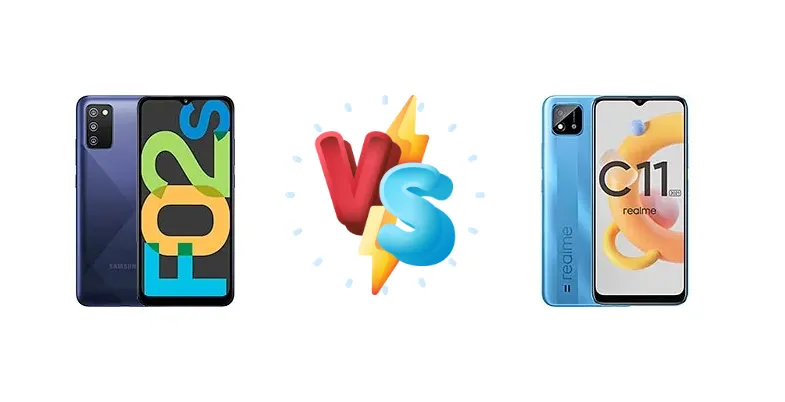
The Samsung Galaxy F02s and Realme C11 (2021) represent the extreme end of the smartphone price spectrum. Both aim to deliver essential functionality at a minimal cost, but they take different approaches to achieving this. The F02s leverages Qualcomm’s Snapdragon 450, while the C11 (2021) opts for Unisoc’s SC9863A. This comparison dissects these choices, revealing which device offers the best experience for the price-conscious consumer.
🏆 Quick Verdict
For most users, the Samsung Galaxy F02s emerges as the better choice. While both phones are incredibly affordable, the Snapdragon 450’s more efficient 14nm process and Cortex-A53 architecture provide a noticeable performance edge over the Unisoc SC9863A’s 28nm process, despite the C11’s slightly more complex CPU core arrangement.
| Network |
|---|
| 2G bands | GSM 850 / 900 / 1800 / 1900 | GSM 850 / 900 / 1800 / 1900 |
| 3G bands | HSDPA 850 / 900 / 2100 | HSDPA 850 / 900 / 1900 / 2100 |
| 4G bands | 1, 3, 5, 7, 8, 20, 28, 38, 40, 41 | 1, 3, 5, 8, 38, 40, 41 |
| Speed | HSPA 42.2/5.76 Mbps, LTE Cat4 150/50 Mbps | HSPA, LTE |
| Technology | GSM / HSPA / LTE | GSM / HSPA / LTE |
| Launch |
|---|
| Announced | 2021, April 05 | 2021, June 28 |
| Status | Available. Released 2021, April 09 | Available. Released 2021, June 28 |
| Body |
|---|
| Build | Glass front, plastic back, plastic frame | Glass front, plastic frame, plastic back |
| Dimensions | 164.2 x 75.9 x 9.1 mm (6.46 x 2.99 x 0.36 in) | 165.2 x 76.4 x 8.9 mm (6.50 x 3.01 x 0.35 in) |
| SIM | Nano-SIM + Nano-SIM | Nano-SIM + Nano-SIM |
| Weight | 196 g (6.91 oz) | 190 g (6.70 oz) |
| | - | Splash resistant design |
| Display |
|---|
| Resolution | 720 x 1600 pixels, 20:9 ratio (~270 ppi density) | 720 x 1600 pixels, 20:9 ratio (~269 ppi density) |
| Size | 6.5 inches, 102.0 cm2 (~81.8% screen-to-body ratio) | 6.52 inches, 102.6 cm2 (~81.3% screen-to-body ratio) |
| Type | PLS LCD | IPS LCD, 400 nits (typ) |
| Platform |
|---|
| CPU | Octa-core 1.8 GHz Cortex-A53 | Octa-core (4x1.6 GHz Cortex-A55 & 4x1.2 GHz Cortex-A55) |
| Chipset | Qualcomm SDM450 Snapdragon 450 (14 nm) | Unisoc SC9863A (28 nm) |
| GPU | Adreno 506 | IMG8322 |
| OS | Android 10 | Android 11, Realme Go UI |
| Memory |
|---|
| Card slot | microSDXC (dedicated slot) | microSDXC (dedicated slot) |
| Internal | 32GB 3GB RAM, 64GB 4GB RAM | 32GB 2GB RAM, 64GB 4GB RAM |
| | eMMC 5.1 | eMMC 5.1 |
| Main Camera |
|---|
| Features | LED flash | LED flash, HDR, panorama |
| Single | 5 MP, f/2.2 | 8 MP, f/2.0, (wide), AF |
| Triple | 13 MP, f/2.2, (wide), AF
2 MP (macro)
Auxiliary lens | - |
| Video | 1080p@30fps | 1080p@30fps |
| Selfie camera |
|---|
| Features | - | HDR, panorama |
| Single | 5 MP, f/2.2 | 5 MP, f/2.2, (wide) |
| Video | - | 1080p@30fps |
| Sound |
|---|
| 3.5mm jack | Yes | Yes |
| 35mm jack | Yes | Yes |
| Loudspeaker | Yes | Yes |
| Comms |
|---|
| Bluetooth | 4.2, A2DP | 4.2, A2DP |
| NFC | No | No |
| Positioning | GPS, GLONASS, GALILEO, BDS | GPS, GLONASS, GALILEO, BDS |
| Radio | FM radio | Unspecified |
| USB | USB Type-C 2.0, OTG | microUSB 2.0, OTG |
| WLAN | Wi-Fi 802.11 b/g/n, Wi-Fi Direct | Wi-Fi 802.11 b/g/n |
| Features |
|---|
| Sensors | Accelerometer, proximity | Accelerometer, gyro, proximity, compass |
| Battery |
|---|
| Charging | 15W wired | 10W wired
Reverse wired |
| Type | Li-Po 5000 mAh | 5000 mAh |
| Misc |
|---|
| Colors | Ceramic Blue, Ceramic White, Ceramic Black | Cool Blue, Cool Grey |
| Models | SM-E025F, SM-E025F/DS | RMX3231 |
| Price | About 100 EUR | About 80 EUR |
| SAR | 0.52 W/kg (head) | - |
Samsung Galaxy F02s
- More efficient Snapdragon 450 chipset
- Faster 15W charging
- Potentially better image processing
- Lacks reverse charging
- May have a smaller battery capacity
Realme C11 (2021)
- Reverse wired charging capability
- Potentially larger battery capacity
- Lower price (potentially)
- Less efficient Unisoc SC9863A chipset
- Slower 10W charging
- Potentially lower performance
Display Comparison
Neither device boasts a standout display. Both likely feature basic LCD panels with resolutions around 720p+, typical for this price point. However, the lack of detailed display specs necessitates focusing on the chipset’s ability to drive the UI smoothly. The Snapdragon 450’s GPU, while modest, is likely better optimized for this resolution than the Unisoc’s, potentially resulting in a slightly more fluid visual experience.
Camera Comparison
Both phones likely feature basic camera setups focused on affordability. Without detailed sensor information, it’s difficult to make a definitive judgment. However, the image signal processor (ISP) within the Snapdragon 450 is generally more refined than those found in Unisoc’s budget offerings, potentially leading to better image quality in good lighting conditions. Expect both to struggle in low light. The presence of a 2MP macro lens on either device is largely a marketing gimmick and shouldn’t factor into your decision.
Performance
The core difference lies in the chipsets. The Samsung Galaxy F02s’ Qualcomm Snapdragon 450, built on a 14nm process, features an octa-core Cortex-A53 CPU clocked at 1.8 GHz. The Realme C11 (2021) uses the Unisoc SC9863A, a 28nm chip with an octa-core configuration split between 4x1.6 GHz Cortex-A55 and 4x1.2 GHz Cortex-A55 cores. While the C11 has more cores, the older A53 architecture and significantly larger manufacturing process of the Snapdragon 450 give it an advantage in single-core performance and overall efficiency. The 28nm process of the Unisoc chip will likely result in higher power consumption for similar tasks. This translates to a snappier experience on the F02s for common operations.
Battery Life
The Realme C11 (2021) has a slight edge in charging versatility with its support for reverse wired charging, allowing it to act as a power bank for other devices. However, its 10W charging is slower than the Samsung Galaxy F02s’ 15W charging. While the Unisoc chip’s inefficiency might lead to faster battery drain during intensive use, the C11 likely has a larger battery capacity to compensate. The difference in charging speed will be noticeable when topping up from low percentages.
Buying Guide
Buy the Samsung Galaxy F02s if you prioritize consistent performance for everyday tasks like browsing, social media, and light gaming. Its Snapdragon 450 chipset offers a smoother experience and better long-term reliability. Buy the Realme C11 (2021) if battery life is your absolute top priority and you primarily use your phone for very basic communication – calls and texts – and are willing to accept slower app loading times and occasional stutters.
Frequently Asked Questions
❓ Will the Realme C11 (2021) struggle with multitasking?
Yes, the Unisoc SC9863A’s less powerful CPU and GPU, combined with its 28nm process, will likely result in noticeable slowdowns when running multiple apps simultaneously. Switching between apps may be sluggish, and demanding apps may take longer to load.
❓ Is the 15W charging on the Samsung Galaxy F02s a significant improvement over the Realme C11’s 10W?
Yes, while not a massive leap, 15W charging will noticeably reduce the time it takes to fully charge the Galaxy F02s. Expect a difference of at least 30-60 minutes in a full charge cycle, making it more convenient for users who need to quickly top up their battery.
❓ Can either of these phones handle popular mobile games like PUBG Mobile or Call of Duty Mobile?
Both phones will struggle with graphically intensive games like PUBG Mobile or Call of Duty Mobile. You’ll likely need to play on the lowest settings with reduced frame rates to achieve a playable experience. The Snapdragon 450 in the F02s will offer slightly better performance, but don’t expect a smooth, lag-free gaming experience on either device.