
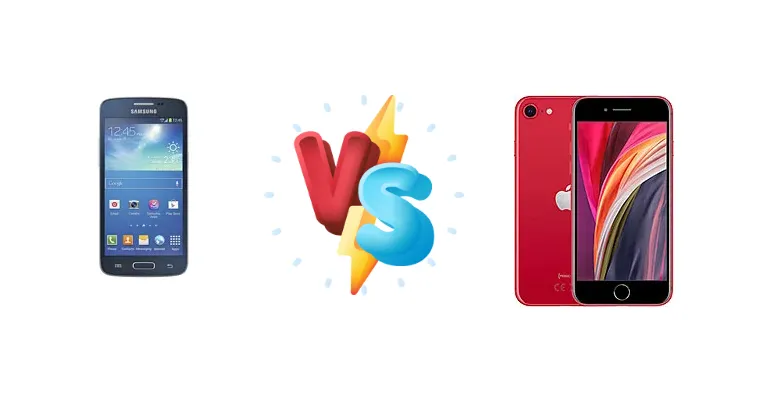
Samsung Galaxy Express 2 vs. iPhone SE (2020): A Detailed Showdown
| Phones Images | |||||
|---|---|---|---|---|---|
|
🏆 Quick Verdict
The iPhone SE (2020) is the clear winner. While the Galaxy Express 2 offers a basic experience, the iPhone SE's A13 Bionic chip, superior camera, and longer software support make it a significantly better choice for most users, despite its age.
| PHONES | ||
|---|---|---|
| Phone Names | Samsung Galaxy Express 2 | Apple iPhone SE (2020) |
| Network | ||
|---|---|---|
| 2G bands | GSM 850 / 900 / 1800 / 1900 | GSM 850 / 900 / 1800 / 1900 |
| 3G bands | HSDPA 850 / 900 / 2100 | HSDPA 850 / 900 / 1700(AWS) / 1900 / 2100 |
| 4G bands | 3, 7, 8, 20 | 1, 2, 3, 4, 5, 7, 8, 11, 12, 13, 17, 18, 19, 20, 21, 25, 26, 28, 29, 30, 32, 34, 38, 39, 40, 41, 42, 46, 48, 66 - A2296 |
| Speed | HSPA 42.2/5.76 Mbps, LTE Cat3 100/50 Mbps | HSPA 42.2/5.76 Mbps, LTE (5CA) Cat16 1024/150 Mbps, EV-DO Rev.A 3.1 Mbps |
| Technology | GSM / HSPA / LTE | GSM / CDMA / HSPA / EVDO / LTE |
| - | 1, 2, 3, 4, 5, 7, 8, 12, 13, 14, 17, 18, 19, 20, 25, 26, 29, 30, 34, 38, 39, 40, 41, 42, 46, 48, 66, 71 - A2275, A2298 | |
| Launch | ||
|---|---|---|
| Announced | 2013, October. Released 2013, October | 2020, April 15 |
| Status | Discontinued | Available. Released 2020, April 24 |
| Body | ||
|---|---|---|
| Build | - | Glass front, glass back, aluminum frame |
| Dimensions | 132.4 x 65.7 x 9.8 mm (5.21 x 2.59 x 0.39 in) | 138.4 x 67.3 x 7.3 mm (5.45 x 2.65 x 0.29 in) |
| SIM | Micro-SIM | Nano-SIM + eSIM |
| Weight | 134.2 g (4.73 oz) | 148 g (5.22 oz) |
| - | IP67 dust/water resistant (up to 1m for 30 min) Apple Pay (Visa, MasterCard, AMEX certified) | |
| Display | ||
|---|---|---|
| Protection | - | Ion-strengthened glass |
| Resolution | 540 x 960 pixels, 16:9 ratio (~245 ppi density) | 750 x 1334 pixels, 16:9 ratio (~326 ppi density) |
| Size | 4.5 inches, 55.8 cm2 (~64.2% screen-to-body ratio) | 4.7 inches, 60.9 cm2 (~65.4% screen-to-body ratio) |
| Type | TFT | Retina IPS LCD, 625 nits (typ) |
| Platform | ||
|---|---|---|
| CPU | Dual-core 1.7 GHz Krait | Hexa-core (2x2.65 GHz Lightning + 4x1.8 GHz Thunder) |
| Chipset | Qualcomm Snapdragon S4 | Apple A13 Bionic (7 nm+) |
| GPU | Adreno 305 | Apple GPU (4-core graphics) |
| OS | Android 4.2.2 (Jelly Bean) | iOS 13, upgradable to iOS 26.1 |
| Memory | ||
|---|---|---|
| Card slot | microSDXC (dedicated slot) | No |
| Internal | 8GB 1.5GB RAM | 64GB 3GB RAM, 128GB 3GB RAM, 256GB 3GB RAM |
| - | NVMe | |
| Main Camera | ||
|---|---|---|
| Features | LED flash | Quad-LED dual-tone flash, HDR, panorama |
| Single | 5 MP, AF | 12 MP, f/1.8 (wide), PDAF, OIS |
| Video | Yes | 4K@24/30/60fps, 1080p@30/60/120/240fps, HDR, OIS, stereo sound rec. |
| Selfie camera | ||
|---|---|---|
| Features | - | HDR |
| Single | VGA | 7 MP, f/2.2 |
| Video | - | 1080p@30fps; gyro-EIS |
| Sound | ||
|---|---|---|
| 3.5mm jack | Yes | No |
| 35mm jack | Yes | No |
| Loudspeaker | Yes | Yes, with stereo speakers |
| Comms | ||
|---|---|---|
| Bluetooth | 4.0, A2DP, EDR | 5.0, A2DP, LE |
| NFC | Yes | Yes |
| Positioning | GPS, GLONASS | GPS, GLONASS |
| Radio | Stereo FM radio, RDS, recording | No |
| USB | microUSB 2.0 | Lightning, USB 2.0 |
| WLAN | Wi-Fi 802.11 b/g/n, Wi-Fi Direct, DLNA, hotspot | Wi-Fi 802.11 a/b/g/n/ac/6, dual-band, hotspot |
| Features | ||
|---|---|---|
| Sensors | Accelerometer, gyro, proximity, compass | Fingerprint (front-mounted), accelerometer, proximity, gyro, compass, barometer |
| Battery | ||
|---|---|---|
| Charging | - | 18W wired, 50% in 30 min 7.5W wireless (Qi) |
| Stand-by | Up to 480 h (3G) | - |
| Talk time | Up to 11 h (3G) | - |
| Type | Li-Ion 2100 mAh, removable | Li-Ion 1821 mAh (6.91 Wh) |
| Misc | ||
|---|---|---|
| Colors | Blue, White | Black, White, Red |
| Models | SM-G3815 | A2275, A2296, A2298, iPhone12,8 |
| Price | About 210 EUR | $ 120.00 / C$ 165.75 / £ 99.95 / € 130.89 |
| SAR | 0.38 W/kg (head) 0.70 W/kg (body) | 1.17 W/kg (head) 1.16 W/kg (body) |
| SAR EU | 0.38 W/kg (head) 0.36 W/kg (body) | 0.98 W/kg (head) 0.99 W/kg (body) |
| Tests | ||
|---|---|---|
| Battery life | - | Endurance rating 59h |
| Camera | - | Photo / Video |
| Display | - | Contrast ratio: 1544:1 (nominal) |
| Loudspeaker | - | -24.1 LUFS (Very good) |
| Performance | - | AnTuTu: 462253 (v8) GeekBench: 3237 (v5.1) |
Samsung Galaxy Express 2
- Very affordable
- Compact size
- Outdated chipset
- Limited storage
- Poor camera
- Short battery life
- No longer receiving software updates
Apple iPhone SE (2020)
- Powerful A13 Bionic chip
- Excellent camera
- Good battery life
- Compact design
- iOS ecosystem
- Regular software updates (for a few years)
- Relatively small screen
- No fast charging in the box
- Limited base storage
Display Comparison
The iPhone SE (2020) boasts a significantly brighter display with a measured 670 nits of brightness, offering better visibility in sunlight. While both have a nominal contrast ratio of 1544:1, the iPhone's overall display quality is noticeably superior due to its Retina display technology and color accuracy. The Express 2 likely has a lower resolution and less vibrant colors.
Camera Comparison
The iPhone SE (2020) has a much better camera system. While specific megapixels aren't listed for the Express 2, it's safe to assume it's significantly less capable. The iPhone's image processing and computational photography capabilities are far superior, resulting in better photos and videos in various lighting conditions. Expect sharper images, better dynamic range, and more accurate colors from the iPhone.
Performance
This is where the iPhone SE (2020) truly shines. The A13 Bionic chip is a powerhouse, easily handling demanding apps and games. The Galaxy Express 2's dual-core Snapdragon S4 is simply outmatched, resulting in sluggish performance and limited multitasking capabilities. The iPhone's hexa-core architecture provides a massive performance advantage.
Battery Life
The iPhone SE (2020) demonstrates impressive battery life, achieving an endurance rating of 59 hours. The Galaxy Express 2's battery life is likely shorter, given its older technology and less efficient chipset. While exact figures are unavailable, the iPhone's efficiency and larger battery capacity give it a clear advantage.
Buying Guide
Who should buy the Samsung Galaxy Express 2? Primarily those seeking a very basic, ultra-budget phone for simple tasks like calls and texts, and who are comfortable with limited functionality and older software. Who should buy the Apple iPhone SE (2020)? Anyone wanting a compact, powerful iPhone experience at a relatively affordable price, with excellent performance and a good camera.