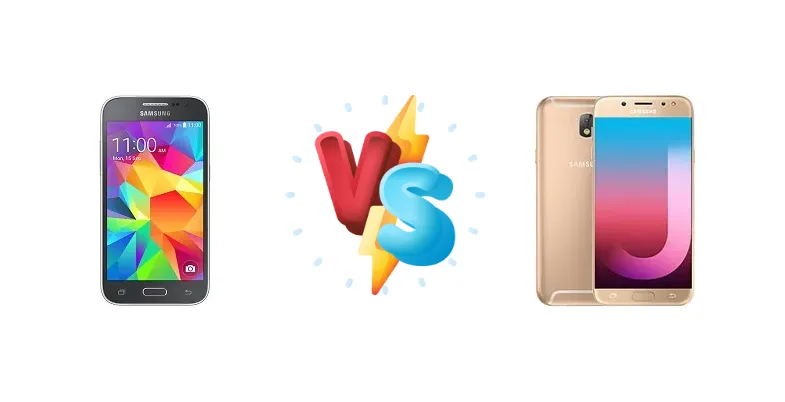
Choosing a new smartphone can be overwhelming, especially with so many options available. Today, we're pitting two Samsung devices against each other: the Galaxy Core Prime and the Galaxy J7 Pro. Let's dive into a detailed comparison to help you decide which one is right for you.
🏆 Quick Verdict
The Samsung Galaxy J7 Pro is the clear winner. While the Core Prime is a budget option, the J7 Pro boasts a significantly more powerful processor, better display, and impressive battery life, making it a more compelling choice for most users.
| Network |
|---|
| 2G bands | GSM 850 / 900 / 1800 / 1900 - SIM 1 & SIM 2 (dual-SIM model only) | GSM 850 / 900 / 1800 / 1900 - SIM 1 & SIM 2 (dual-SIM model only) |
| 3G bands | HSDPA 850 / 900 / 2100 - G360F | HSDPA 850 / 900 / 1700(AWS) / 1900 / 2100 |
| 4G bands | 1, 3, 5, 7, 8, 28 - G360G | 1, 2, 3, 4, 5, 7, 8, 12, 17, 20, 28, 38, 40, 41, 66 |
| Speed | HSPA 42.2/5.76 Mbps, LTE Cat4 150/50 Mbps | HSPA 42.2/5.76 Mbps, LTE (2CA) Cat6 300/50 Mbps |
| Technology | GSM / HSPA / LTE | GSM / HSPA / LTE |
| | 2, 4, 12 - G360T (T-Mobile) | - |
| Launch |
|---|
| Announced | 2014, November. Released 2014, November | 2017, June. Released 2017, July |
| Status | Discontinued | Discontinued |
| Body |
|---|
| Build | Glass front, plastic back, plastic frame | Glass front, aluminum back, aluminum frame |
| Dimensions | 130.8 x 67.9 x 8.8 mm (5.15 x 2.67 x 0.35 in) | 152.5 x 74.8 x 8 mm (6.00 x 2.94 x 0.31 in) |
| SIM | Single SIM (Micro-SIM) or Dual SIM (Micro-SIM, dual stand-by) | · Nano-SIM· Nano-SIM + Nano-SIM |
| Weight | 130 g (4.59 oz) | 181 g (6.38 oz) |
| Display |
|---|
| Resolution | 480 x 800 pixels, 5:3 ratio (~207 ppi density) | 1080 x 1920 pixels, 16:9 ratio (~401 ppi density) |
| Size | 4.5 inches, 57.6 cm2 (~64.9% screen-to-body ratio) | 5.5 inches, 83.4 cm2 (~73.1% screen-to-body ratio) |
| Type | TFT | Super AMOLED |
| | - | Always-on display |
| Platform |
|---|
| CPU | Quad-core 1.2 GHz Cortex-A53 | Octa-core 1.6 GHz Cortex-A53 |
| Chipset | Qualcomm MSM8916 Snapdragon 410 (28 nm) | Exynos 7870 Octa (14 nm) |
| GPU | Adreno 306 | Mali-T830 MP1 |
| OS | Android 4.4.4 (KitKat), upgradable to 5.1.1 (Lollipop) | Android 7.0 (Nougat), upgradable to Android 9.0 (Pie), One UI |
| Memory |
|---|
| Card slot | microSDXC (dedicated slot) | microSDXC (dedicated slot) |
| Internal | 8GB 1GB RAM | 16GB 3GB RAM, 32GB 3GB RAM, 64GB 3GB RAM |
| | eMMC 4.5 | eMMC 5.1 |
| Main Camera |
|---|
| Features | LED flash | LED flash, panorama, HDR |
| Single | 5 MP, f/2.6, AF | 13 MP, f/1.7, 27mm (wide), AF |
| Video | 720p@30fps | 1080p@30fps |
| Selfie camera |
|---|
| Features | - | LED flash |
| Single | 2 MP | 13 MP, f/1.9, 28mm (wide), 1/3.1", 1.12µm |
| Video | - | 1080p@30fps |
| Sound |
|---|
| 3.5mm jack | Yes | Yes |
| 35mm jack | Yes | Yes |
| Loudspeaker | Yes | Yes |
| Comms |
|---|
| Bluetooth | 4.0, A2DP | 4.1, A2DP, LE |
| NFC | Yes (LTE models, except SM-G360BT) | Yes |
| Positioning | GPS, GLONASS, BDS | GPS, GLONASS, BDS |
| Radio | FM radio | FM radio |
| USB | microUSB 2.0 | microUSB 2.0, OTG |
| WLAN | Wi-Fi 802.11 b/g/n, Wi-Fi Direct, hotspot | Wi-Fi 802.11 a/b/g/n/ac, dual-band, Wi-Fi Direct |
| Features |
|---|
| Sensors | Accelerometer, proximity | Fingerprint (front-mounted), accelerometer, gyro, proximity, compass |
| | Digital TV (SM-G360BT) | ANT+ |
| Battery |
|---|
| Music play | Up to 60 h | Up to 91 h |
| Talk time | Up to 13 h (3G) | Up to 24 h (3G) |
| Type | Li-Ion 2000 mAh, removable | Li-Ion 3600 mAh, non-removable |
| Misc |
|---|
| Colors | Black, White, Gray | Black, Blue, Gold, Rose Gold |
| Models | SM-G360T, SM-G3606, SM-G3608, SM-G3609, SM-G360BT, SM-G360F, SM-G360FY, SM-G360G, SM-G360GY, SM-G360H, SM-G360H/D, SM-G360BT, SM-G361, SM-G361H, SM-G361F, SM-G360HU, SM-G360T1, SM-G360M, SM-G360P, SM-G360V, SM-S820L, SM-G360AZ, SM-G361HU | SM-J730G, SM-J730GM |
| Price | About 150 EUR | About 200 EUR |
| SAR | 0.70 W/kg (head) 1.07 W/kg (body) | 0.71 W/kg (head) |
| SAR EU | 0.60 W/kg (head) 0.40 W/kg (body) | 0.57 W/kg (head) 1.33 W/kg (body) |
| Tests |
|---|
| Audio quality | - |
Noise -92.7dB / Crosstalk -92.4dB |
| Battery life | - |
Endurance rating 107h
|
| Camera |
Photo / Video |
Photo / Video |
| Display | - |
Contrast ratio: Infinite (nominal), 3.998 (sunlight) |
| Loudspeaker | - |
Voice 68dB / Noise 69dB / Ring 82dB
|
| Performance |
Basemark X: 1895 |
GeekBench: 3768 (v4.4)
GFXBench: 1.9fps (ES 3.1 onscreen) |
Samsung Galaxy Core Prime
- Very affordable
- Compact size
- Decent basic functionality
- Slow performance
- Low-resolution display
- Average camera
- Limited storage
Samsung Galaxy J7 Pro
- Faster performance
- Better display
- Improved camera
- Long battery life
- More storage
- Slightly more expensive than Core Prime
- Design may be considered dated
Display Comparison
The Galaxy J7 Pro features a superior display with a higher resolution and likely better color accuracy compared to the Core Prime. While both have a contrast ratio listed as 'Infinite' (likely a marketing term), the J7 Pro's likely higher resolution and potentially better panel technology give it an edge. The Core Prime's display is adequate for basic use but lacks the vibrancy and detail of the J7 Pro.
Camera Comparison
While both phones have 'Photo / Video' capabilities listed, the J7 Pro's likely has a higher resolution sensor and potentially better image processing. Expect better low-light performance and more detailed photos from the J7 Pro. The Core Prime's camera is functional but produces average results.
Performance
The J7 Pro's Exynos 7870 Octa chipset and 1.6 GHz CPU significantly outperform the Core Prime's Snapdragon 410 and 1.2 GHz CPU. This translates to faster app loading times, smoother multitasking, and a more responsive user experience on the J7 Pro. The Core Prime can feel sluggish at times, especially with demanding apps.
Battery Life
The J7 Pro's endurance rating of 107 hours is exceptional, suggesting significantly longer battery life than the Core Prime. While the Core Prime's battery is adequate for a day of light use, the J7 Pro can easily last for multiple days on a single charge.
Buying Guide
The Galaxy Core Prime is best suited for users on a very tight budget who prioritize basic functionality and affordability. The Galaxy J7 Pro is ideal for those seeking a smoother performance, better camera, and longer battery life without breaking the bank.
Frequently Asked Questions
❓ Is the Galaxy Core Prime still worth buying?
Only if you're on an extremely tight budget and need a basic phone for calls and texts. Otherwise, the J7 Pro offers significantly better value.
❓ What year were these phones released?
The Galaxy Core Prime was released in 2015, while the Galaxy J7 Pro was released in 2016. This age difference contributes to the J7 Pro's superior specs.