
Samsung Galaxy Core Prime vs. Galaxy J5 (2017): A Detailed Comparison
| Phones Images | |||||
|---|---|---|---|---|---|
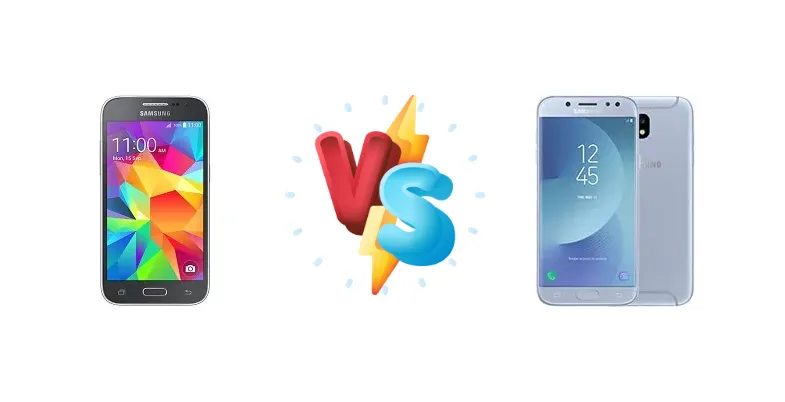
|
🏆 Quick Verdict
The Samsung Galaxy J5 (2017) is the clear winner. Its superior chipset, improved display contrast, and exceptional battery life outweigh the Core Prime's simpler design. While the Core Prime might be slightly cheaper, the J5 (2017) provides a significantly better overall user experience.
| PHONES | ||
|---|---|---|
| Phone Names | Samsung Galaxy Core Prime | Samsung Galaxy J5 (2017) |
| Network | ||
|---|---|---|
| 2G bands | GSM 850 / 900 / 1800 / 1900 - SIM 1 & SIM 2 (dual-SIM model only) | GSM 850 / 900 / 1800 / 1900 - SIM 1 & SIM 2 (dual-SIM model only) |
| 3G bands | HSDPA 850 / 900 / 2100 - G360F | HSDPA 850 / 900 / 1700(AWS) / 1900 / 2100 |
| 4G bands | 1, 3, 5, 7, 8, 28 - G360G | 1, 3, 5, 7, 8, 20, 40 |
| Speed | HSPA 42.2/5.76 Mbps, LTE Cat4 150/50 Mbps | HSPA 42.2/5.76 Mbps, LTE (2CA) Cat6 300/50 Mbps |
| Technology | GSM / HSPA / LTE | GSM / HSPA / LTE |
| 2, 4, 12 - G360T (T-Mobile) | - | |
| Launch | ||
|---|---|---|
| Announced | 2014, November. Released 2014, November | 2017, June. Released 2017, June |
| Status | Discontinued | Discontinued |
| Body | ||
|---|---|---|
| Build | Glass front, plastic back, plastic frame | Glass front, aluminum back, aluminum frame |
| Dimensions | 130.8 x 67.9 x 8.8 mm (5.15 x 2.67 x 0.35 in) | 146.2 x 71.3 x 8 mm (5.76 x 2.81 x 0.31 in) |
| SIM | Single SIM (Micro-SIM) or Dual SIM (Micro-SIM, dual stand-by) | · Nano-SIM· Nano-SIM + Nano-SIM |
| Weight | 130 g (4.59 oz) | 160 g (5.64 oz) |
| Display | ||
|---|---|---|
| Resolution | 480 x 800 pixels, 5:3 ratio (~207 ppi density) | 720 x 1280 pixels, 16:9 ratio (~282 ppi density) |
| Size | 4.5 inches, 57.6 cm2 (~64.9% screen-to-body ratio) | 5.2 inches, 74.5 cm2 (~71.5% screen-to-body ratio) |
| Type | TFT | Super AMOLED |
| Platform | ||
|---|---|---|
| CPU | Quad-core 1.2 GHz Cortex-A53 | Octa-core 1.6 GHz Cortex-A53 |
| Chipset | Qualcomm MSM8916 Snapdragon 410 (28 nm) | Exynos 7870 Octa (14 nm) |
| GPU | Adreno 306 | Mali-T830 MP1 |
| OS | Android 4.4.4 (KitKat), upgradable to 5.1.1 (Lollipop) | Android 7.0 (Nougat), upgradable to Android 9.0 (Pie), One UI |
| Memory | ||
|---|---|---|
| Card slot | microSDXC (dedicated slot) | microSDXC (dedicated slot) |
| Internal | 8GB 1GB RAM | 16GB 2GB RAM, 32GB 2GB RAM, 32GB 3GB RAM |
| eMMC 4.5 | eMMC 5.1 | |
| Main Camera | ||
|---|---|---|
| Features | LED flash | LED flash, panorama, HDR |
| Single | 5 MP, f/2.6, AF | 13 MP, f/1.7, 27mm (wide), 1/3.1", 1.12µm, AF |
| Video | 720p@30fps | 1080p@30fps |
| Selfie camera | ||
|---|---|---|
| Features | - | LED flash |
| Single | 2 MP | 13 MP, f/1.9, 1/3.1", 1.12µm |
| Video | - | 1080p@30fps |
| Sound | ||
|---|---|---|
| 3.5mm jack | Yes | Yes |
| 35mm jack | Yes | Yes |
| Loudspeaker | Yes | Yes |
| Comms | ||
|---|---|---|
| Bluetooth | 4.0, A2DP | 4.1, A2DP |
| NFC | Yes (LTE models, except SM-G360BT) | Yes |
| Positioning | GPS, GLONASS, BDS | GPS, GLONASS, BDS |
| Radio | FM radio | FM radio |
| USB | microUSB 2.0 | microUSB 2.0 |
| WLAN | Wi-Fi 802.11 b/g/n, Wi-Fi Direct, hotspot | Wi-Fi 802.11 a/b/g/n/ac, dual-band, Wi-Fi Direct |
| Features | ||
|---|---|---|
| Sensors | Accelerometer, proximity | Fingerprint (front-mounted), accelerometer, gyro, proximity, compass |
| Digital TV (SM-G360BT) | ANT+ | |
| Battery | ||
|---|---|---|
| Music play | Up to 60 h | Up to 83 h |
| Talk time | Up to 13 h (3G) | Up to 21 h (3G) |
| Type | Li-Ion 2000 mAh, removable | Li-Ion 3000 mAh, non-removable |
| Misc | ||
|---|---|---|
| Colors | Black, White, Gray | Blue, Pink, Gold, Black |
| Models | SM-G360T, SM-G3606, SM-G3608, SM-G3609, SM-G360BT, SM-G360F, SM-G360FY, SM-G360G, SM-G360GY, SM-G360H, SM-G360H/D, SM-G360BT, SM-G361, SM-G361H, SM-G361F, SM-G360HU, SM-G360T1, SM-G360M, SM-G360P, SM-G360V, SM-S820L, SM-G360AZ, SM-G361HU | SM-J530F, SM-J530Y, SM-J530FM, SM-J530G, SM-J530YM, SM-J530L, SM-J530S, SM-J530K, SM-J530GM |
| Price | About 150 EUR | About 130 EUR |
| SAR | 0.70 W/kg (head) 1.07 W/kg (body) | - |
| SAR EU | 0.60 W/kg (head) 0.40 W/kg (body) | 0.35 W/kg (head) 1.36 W/kg (body) |
| Tests | ||
|---|---|---|
| Audio quality | - | Noise -85.0dB / Crosstalk -90.3dB |
| Battery life | - | Endurance rating 97h |
| Camera | Photo / Video | Photo / Video |
| Display | - | Contrast ratio: Infinite (nominal), 3.599 (sunlight) |
| Loudspeaker | - | Voice 68dB / Noise 70dB / Ring 82dB |
| Performance | Basemark X: 1895 | GeekBench: 3667 (v4.4) GFXBench: 3.8fps (ES 3.1 onscreen) |
Samsung Galaxy Core Prime
- Compact size
- Affordable price
- Simple interface
- Outdated chipset
- Basic camera
- Short battery life
- Low screen resolution
Samsung Galaxy J5 (2017)
- Better performance
- Improved display
- Excellent battery life
- More modern design
- Slightly larger size
- May lack latest software updates
Display Comparison
Both phones feature Super AMOLED displays, but the J5 (2017) boasts a noticeably better contrast ratio (3.599 in sunlight, infinite nominal) compared to the Core Prime. While specific Core Prime display details are scarce, the J5's display is brighter and more vibrant, offering a more enjoyable viewing experience. The J5 also likely has a slightly larger screen size.
Camera Comparison
While both phones have 'Photo / Video' capabilities, the J5 (2017) generally has a better camera setup. The Core Prime's camera is known to be basic, producing acceptable but not impressive photos. The J5 (2017) likely features a higher resolution sensor and potentially better image processing, resulting in clearer and more detailed photos, especially in good lighting conditions. Low-light performance is also expected to be better on the J5.
Performance
The Galaxy J5 (2017) holds a significant advantage here. Its Exynos 7870 Octa chipset (14nm) is considerably more powerful than the Core Prime's Qualcomm MSM8916 Snapdragon 410 (28nm). The J5's Octa-core 1.6 GHz Cortex-A53 CPU outperforms the Core Prime's Quad-core 1.2 GHz Cortex-A53, resulting in smoother multitasking, faster app loading, and better overall responsiveness. Gaming performance will also be noticeably better on the J5.
Battery Life
The Galaxy J5 (2017) shines in battery life. Its endurance rating of 97 hours is exceptional. The Core Prime's battery capacity is smaller, and its battery life is considerably shorter, likely struggling to last a full day with moderate use. The J5's superior battery performance is a major selling point.
Buying Guide
The Samsung Galaxy Core Prime is best suited for users on an extremely tight budget who prioritize basic functionality and a smaller form factor. The Samsung Galaxy J5 (2017) is ideal for those seeking a more modern experience with better performance, a brighter display, and significantly longer battery life, without breaking the bank.