
Samsung Galaxy Core Prime vs. Galaxy J3 (2016): A Detailed Comparison
| Phones Images | |||||
|---|---|---|---|---|---|
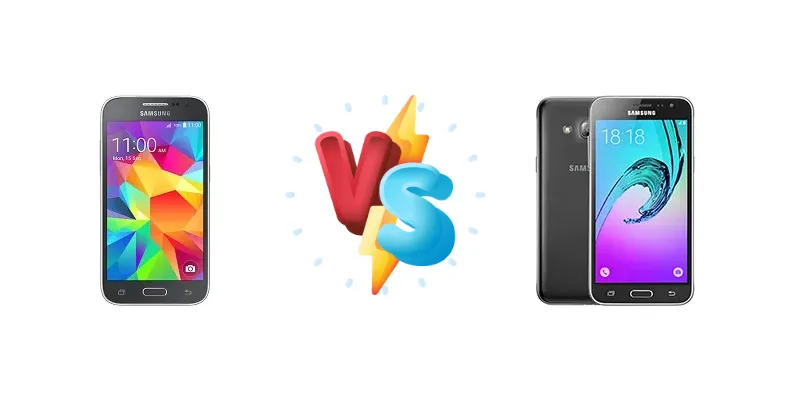
|
🏆 Quick Verdict
The Galaxy J3 (2016) edges out the Core Prime thanks to its significantly better battery life and slightly more powerful processor. While both are budget phones, the J3 provides a more enduring and responsive experience, making it the slightly better choice overall.
| PHONES | ||
|---|---|---|
| Phone Names | Samsung Galaxy Core Prime | Samsung Galaxy J3 (2016) |
| Network | ||
|---|---|---|
| 2G bands | GSM 850 / 900 / 1800 / 1900 - SIM 1 & SIM 2 (dual-SIM model only) | GSM 850 / 900 / 1800 / 1900 - SIM 1 & SIM 2 (dual-SIM model only) |
| 3G bands | HSDPA 850 / 900 / 2100 - G360F | HSDPA 850 / 900 / 1900 / 2100 |
| 4G bands | 1, 3, 5, 7, 8, 28 - G360G | 1, 3, 5, 7, 8, 20 |
| Speed | HSPA 42.2/5.76 Mbps, LTE Cat4 150/50 Mbps | HSPA 42.2/5.76 Mbps, LTE Cat4 150/50 Mbps |
| Technology | GSM / HSPA / LTE | GSM / HSPA / LTE |
| 2, 4, 12 - G360T (T-Mobile) | - | |
| Launch | ||
|---|---|---|
| Announced | 2014, November. Released 2014, November | 2016, March 31. Released 2016, May 06 |
| Status | Discontinued | Discontinued |
| Body | ||
|---|---|---|
| Build | Glass front, plastic back, plastic frame | Glass front (Asahi Dragontrail), plastic back, plastic frame |
| Dimensions | 130.8 x 67.9 x 8.8 mm (5.15 x 2.67 x 0.35 in) | 142.3 x 71 x 7.9 mm (5.60 x 2.80 x 0.31 in) |
| SIM | Single SIM (Micro-SIM) or Dual SIM (Micro-SIM, dual stand-by) | · Micro-SIM· Micro-SIM + Micro-SIM· Nano-SIM (USA models only) |
| Weight | 130 g (4.59 oz) | 138 g (4.87 oz) |
| Display | ||
|---|---|---|
| Protection | - | Asahi Dragontrail Glass |
| Resolution | 480 x 800 pixels, 5:3 ratio (~207 ppi density) | 720 x 1280 pixels, 16:9 ratio (~294 ppi density) |
| Size | 4.5 inches, 57.6 cm2 (~64.9% screen-to-body ratio) | 5.0 inches, 68.9 cm2 (~68.2% screen-to-body ratio) |
| Type | TFT | Super AMOLED |
| Platform | ||
|---|---|---|
| CPU | Quad-core 1.2 GHz Cortex-A53 | Quad-core 1.5 GHz Cortex-A7Quad-core 1.3 GHz Cortex-A7 - USA |
| Chipset | Qualcomm MSM8916 Snapdragon 410 (28 nm) | Spreadtrum SC9830Exynos 3475 Quad (28 nm) - USA |
| GPU | Adreno 306 | Mali-400Mali-T720 - USA |
| OS | Android 4.4.4 (KitKat), upgradable to 5.1.1 (Lollipop) | Android 5.1.1 (Lollipop) or Android 6.0 (Marshmallow), upgradable to 7.1.1 (Nougat) |
| Memory | ||
|---|---|---|
| Card slot | microSDXC (dedicated slot) | microSDXC (dedicated slot) |
| Internal | 8GB 1GB RAM | 8GB 1.5GB RAM, 16GB 2GB RAM |
| eMMC 4.5 | eMMC 4.5 | |
| Main Camera | ||
|---|---|---|
| Features | LED flash | LED flash, HDR |
| Single | 5 MP, f/2.6, AF | 8 MP, f/2.2, AF 5 MP, f/2.2, AF - USA |
| Video | 720p@30fps | 720p@30fps |
| Selfie camera | ||
|---|---|---|
| Single | 2 MP | 2 MP (USA) 5 MP, f/2.2 (all other regions) |
| Video | - | 720p@30fps |
| Sound | ||
|---|---|---|
| 3.5mm jack | Yes | Yes |
| 35mm jack | Yes | Yes |
| Loudspeaker | Yes | Yes |
| Comms | ||
|---|---|---|
| Bluetooth | 4.0, A2DP | 4.0/4.1, A2DP, LE |
| NFC | Yes (LTE models, except SM-G360BT) | Yes (market dependent) |
| Positioning | GPS, GLONASS, BDS | GPS, GLONASS |
| Radio | FM radio | FM radio, RDS, recording (market dependent) |
| USB | microUSB 2.0 | microUSB 2.0, OTG |
| WLAN | Wi-Fi 802.11 b/g/n, Wi-Fi Direct, hotspot | Wi-Fi 802.11 b/g/n, Wi-Fi Direct |
| Features | ||
|---|---|---|
| Sensors | Accelerometer, proximity | Accelerometer, proximity |
| Digital TV (SM-G360BT) | - | |
| Battery | ||
|---|---|---|
| Music play | Up to 60 h | Up to 77 h |
| Stand-by | - | Up to 349 h |
| Talk time | Up to 13 h (3G) | Up to 22 h |
| Type | Li-Ion 2000 mAh, removable | Li-Ion 2600 mAh, removable |
| Misc | ||
|---|---|---|
| Colors | Black, White, Gray | White, Black, Gold |
| Models | SM-G360T, SM-G3606, SM-G3608, SM-G3609, SM-G360BT, SM-G360F, SM-G360FY, SM-G360G, SM-G360GY, SM-G360H, SM-G360H/D, SM-G360BT, SM-G361, SM-G361H, SM-G361F, SM-G360HU, SM-G360T1, SM-G360M, SM-G360P, SM-G360V, SM-S820L, SM-G360AZ, SM-G361HU | SM-J320H, SM-J3109, SM-J320FN, SM-J320P, SM-J320F, SM-J320M, SM-J320Y, SM-J320A, SM-J320G, SM-J327T1, SM-J320V, SM-J320YZ, SM-J320W8, SM-J320ZN, SM-J320N0, SM-J320R4 |
| Price | About 150 EUR | About 120 EUR |
| SAR | 0.70 W/kg (head) 1.07 W/kg (body) | 1.17 W/kg (head) 1.12 W/kg (body) |
| SAR EU | 0.60 W/kg (head) 0.40 W/kg (body) | 0.48 W/kg (head) 0.42 W/kg (body) |
| Tests | ||
|---|---|---|
| Audio quality | - | Noise -92.4dB / Crosstalk -91.3dB |
| Battery life | - | Endurance rating 66h |
| Camera | Photo / Video | Photo / Video |
| Display | - | Contrast ratio: Infinite (nominal), 3.523 (sunlight) |
| Loudspeaker | - | Voice 64dB / Noise 65dB / Ring 68dB |
| Performance | Basemark X: 1895 | Basemark OS II 2.0: 326Basemark X: 1424 |
Samsung Galaxy Core Prime
- Compact size
- Affordable price
- Basic functionality
- Short battery life
- Modest performance
- Low-resolution display
- Limited camera quality
Samsung Galaxy J3 (2016)
- Longer battery life
- Slightly better performance
- Decent sunlight visibility
- More modern design (compared to Core Prime)
- Still a budget phone
- Limited camera quality
- Small display
- Performance not suitable for demanding tasks
Display Comparison
Both phones feature relatively small displays, typical for their era and price point. While contrast ratios are listed as 'Infinite' (likely a marketing term), real-world sunlight performance is reported around 3.523 for both. Expect decent visibility indoors, but struggles in direct sunlight. Neither display is particularly vibrant or high-resolution.
Camera Comparison
Camera quality on both devices is modest, as expected for budget phones. Both feature Photo/Video capabilities, but detailed specifications (resolution, aperture) are missing. Image quality will be acceptable for casual snapshots in good lighting, but expect noise and limited detail in low-light conditions. Video recording will be limited to basic quality.
Performance
The Galaxy J3 (2016) has a slight advantage here. Its 1.5 GHz Quad-core Cortex-A7 (and a secondary 1.3 GHz Cortex-A7) chipset, though not powerful, generally outperforms the Core Prime's 1.2 GHz Quad-core Cortex-A53. Expect slightly faster app loading and smoother multitasking on the J3. Both will struggle with demanding games.
Battery Life
This is where the Galaxy J3 (2016) truly shines. Its endurance rating of 66 hours significantly surpasses what the Core Prime offered. The Core Prime's battery life was considerably shorter, requiring more frequent charging. This makes the J3 a much better choice for users who need a phone that can last through a full day or more.
Buying Guide
The Samsung Galaxy Core Prime is a good option for users prioritizing a compact size and basic functionality on a very tight budget. The Galaxy J3 (2016) is ideal for those needing longer battery life and a slightly smoother performance for everyday tasks, even if it's still a budget device.