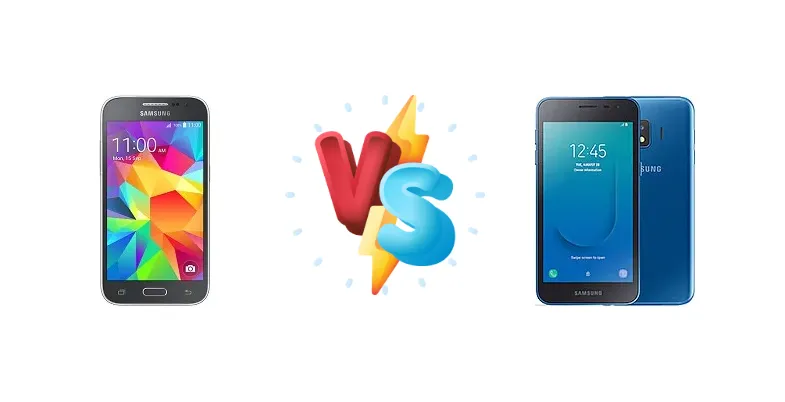
Looking for an affordable Android phone? The Samsung Galaxy Core Prime and Galaxy J2 Core (2020) are both contenders in the budget market. But which one offers the best bang for your buck? This comprehensive comparison dives deep into their specs, performance, and features to help you decide.
🏆 Quick Verdict
The Galaxy J2 Core (2020) edges out the Core Prime thanks to its slightly faster processor and improved chipset. While both are budget devices, the J2 Core offers a more responsive experience and a bit more future-proofing. However, the Core Prime might be slightly cheaper depending on current pricing.
| Network |
|---|
| 2G bands | GSM 850 / 900 / 1800 / 1900 - SIM 1 & SIM 2 (dual-SIM model only) | GSM 850 / 900 / 1800 / 1900 |
| 3G bands | HSDPA 850 / 900 / 2100 - G360F | HSDPA 850 / 900 / 2100 |
| 4G bands | 1, 3, 5, 7, 8, 28 - G360G | 1, 3, 5, 8, 40, 41 |
| Speed | HSPA 42.2/5.76 Mbps, LTE Cat4 150/50 Mbps | HSPA 42.2/5.76 Mbps, LTE Cat4 150/50 Mbps |
| Technology | GSM / HSPA / LTE | GSM / HSPA / LTE |
| | 2, 4, 12 - G360T (T-Mobile) | - |
| Launch |
|---|
| Announced | 2014, November. Released 2014, November | 2020, April 27. Released 2020, April 27 |
| Status | Discontinued | Discontinued |
| Body |
|---|
| Build | Glass front, plastic back, plastic frame | Glass front, plastic back, plastic frame |
| Dimensions | 130.8 x 67.9 x 8.8 mm (5.15 x 2.67 x 0.35 in) | 143.4 x 72.1 x 8.9 mm (5.65 x 2.84 x 0.35 in) |
| SIM | Single SIM (Micro-SIM) or Dual SIM (Micro-SIM, dual stand-by) | Dual SIM (Micro-SIM, dual stand-by) |
| Weight | 130 g (4.59 oz) | 154 g (5.43 oz) |
| Display |
|---|
| Resolution | 480 x 800 pixels, 5:3 ratio (~207 ppi density) | 540 x 960 pixels, 16:9 ratio (~220 ppi density) |
| Size | 4.5 inches, 57.6 cm2 (~64.9% screen-to-body ratio) | 5.0 inches, 68.9 cm2 (~66.7% screen-to-body ratio) |
| Type | TFT | PLS LCD |
| Platform |
|---|
| CPU | Quad-core 1.2 GHz Cortex-A53 | Quad-core 1.4 GHz Cortex-A53 |
| Chipset | Qualcomm MSM8916 Snapdragon 410 (28 nm) | Qualcomm MSM8917 Snapdragon 425 (28 nm) |
| GPU | Adreno 306 | Adreno 308 |
| OS | Android 4.4.4 (KitKat), upgradable to 5.1.1 (Lollipop) | Android 8.1 Oreo (Go edition) |
| Memory |
|---|
| Card slot | microSDXC (dedicated slot) | microSDXC (dedicated slot) |
| Internal | 8GB 1GB RAM | 16GB 1GB RAM |
| | eMMC 4.5 | eMMC 5.0 |
| Main Camera |
|---|
| Features | LED flash | LED flash, HDR, panorama |
| Single | 5 MP, f/2.6, AF | 8 MP, f/2.2, AF |
| Video | 720p@30fps | 1080p@30fps |
| Selfie camera |
|---|
| Single | 2 MP | 5 MP, f/2.2 |
| Sound |
|---|
| 3.5mm jack | Yes | Yes |
| 35mm jack | Yes | Yes |
| Loudspeaker | Yes | Yes |
| Comms |
|---|
| Bluetooth | 4.0, A2DP | 4.2, A2DP |
| NFC | Yes (LTE models, except SM-G360BT) | No |
| Positioning | GPS, GLONASS, BDS | GPS, GLONASS, BDS |
| Radio | FM radio | FM radio |
| USB | microUSB 2.0 | microUSB 2.0, OTG |
| WLAN | Wi-Fi 802.11 b/g/n, Wi-Fi Direct, hotspot | Wi-Fi 802.11 b/g/n, Wi-Fi Direct |
| Features |
|---|
| Sensors | Accelerometer, proximity | Accelerometer, proximity |
| | Digital TV (SM-G360BT) | - |
| Battery |
|---|
| Music play | Up to 60 h | - |
| Talk time | Up to 13 h (3G) | - |
| Type | Li-Ion 2000 mAh, removable | Li-Ion 2600 mAh, removable |
| Misc |
|---|
| Colors | Black, White, Gray | Black, Gold, Blue |
| Models | SM-G360T, SM-G3606, SM-G3608, SM-G3609, SM-G360BT, SM-G360F, SM-G360FY, SM-G360G, SM-G360GY, SM-G360H, SM-G360H/D, SM-G360BT, SM-G361, SM-G361H, SM-G361F, SM-G360HU, SM-G360T1, SM-G360M, SM-G360P, SM-G360V, SM-S820L, SM-G360AZ, SM-G361HU | SM-J260GU, SM-J260GU/DS, SM-J260FU, SM-J260MU |
| Price | About 150 EUR | About 130 EUR |
| SAR | 0.70 W/kg (head) 1.07 W/kg (body) | 0.99 W/kg (head) |
| SAR EU | 0.60 W/kg (head) 0.40 W/kg (body) | - |
| Tests |
|---|
| Camera |
Photo / Video | - |
| Performance |
Basemark X: 1895 | - |
Samsung Galaxy Core Prime
- Compact size
- Familiar Samsung UI
- Generally more affordable (potentially)
- Outdated chipset
- Limited performance
- Smaller battery
- Likely limited software updates
Samsung Galaxy J2 Core (2020)
- Slightly better performance
- Larger display
- Better battery life
- Potentially longer software support
- Still a budget phone
- Basic camera quality
- Limited storage
Display Comparison
Both phones feature relatively small, basic LCD displays. The Core Prime typically has a 4.5-inch display, while the J2 Core (2020) has a 5.0-inch display. Resolution is likely to be similar, around 800x480 pixels. The J2 Core's larger screen offers a slightly more immersive experience, but neither phone excels in display quality.
Camera Comparison
Camera specs are similar on both devices, typically featuring a rear camera around 8MP. Image quality will be adequate for casual snapshots in good lighting conditions, but expect noise and limited detail in low light. The J2 Core (2020) might have slightly improved image processing due to its newer chipset. Front cameras are likely 5MP on both.
Performance
The Galaxy J2 Core (2020) boasts a Snapdragon 425 chipset and a 1.4 GHz Quad-core Cortex-A53 CPU, a modest upgrade over the Core Prime's Snapdragon 410 and 1.2 GHz Quad-core Cortex-A53. This translates to slightly snappier performance in everyday tasks and a bit better multitasking capability on the J2 Core. Both phones will struggle with demanding games.
Battery Life
The Galaxy J2 Core (2020) generally has a slightly larger battery capacity (around 3000 mAh) compared to the Core Prime (around 2000 mAh). This should translate to noticeably better battery life on the J2 Core, allowing for more usage throughout the day.
Buying Guide
The Samsung Galaxy Core Prime is a good option for users on an extremely tight budget who prioritize basic functionality and a familiar Samsung interface. The Galaxy J2 Core (2020) is better suited for those who want a slightly more modern experience, a bit more processing power, and a phone that will likely receive software updates for a longer period.
Frequently Asked Questions
❓ Are these phones still worth buying in 2024?
Both phones are quite old. While they can still function for basic tasks, newer budget phones offer significantly better performance and features. Consider them only if you're on an extremely tight budget and need a very basic device.
❓ Which phone has better software support?
The Galaxy J2 Core (2020) is likely to have received slightly more software updates than the Core Prime, but both are nearing the end of their support lifecycle. Don't expect major Android version upgrades.