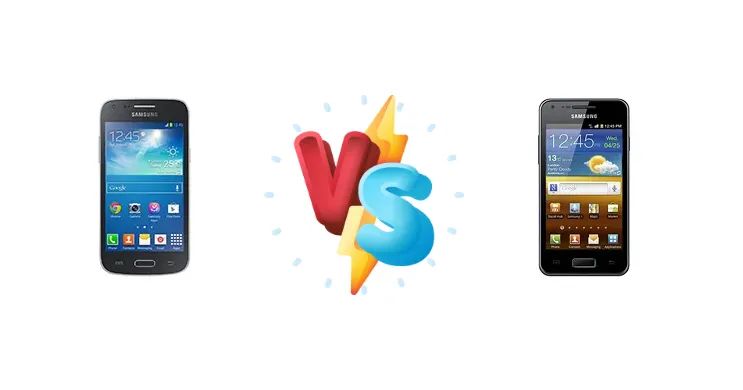
Nostalgia for older smartphones? We're pitting two Samsung devices, the Galaxy Core Plus and the Galaxy S Advance, against each other. Both offer affordable entry points into the Samsung ecosystem, but which one holds up best in 2024? Let's dive into a detailed comparison.
🏆 Quick Verdict
The Galaxy S Advance edges out the Core Plus thanks to its Cortex-A9 processor and potentially better display technology (despite both claiming 'infinite' contrast). While both are dated, the S Advance offers a slightly more responsive experience and a more modern chipset, making it the preferable choice for those seeking a functional older device.
| Network |
|---|
| 2G bands | GSM 850 / 900 / 1800 / 1900 - G3500 | GSM 850 / 900 / 1800 / 1900 |
| 3G bands | HSDPA 900 / 2100 | HSDPA 850 / 900 / 1900 / 2100 |
| Speed | HSPA 21.1/5.76 Mbps | HSPA 14.4/5.76 Mbps |
| Technology | GSM / HSPA | GSM / HSPA |
| Launch |
|---|
| Announced | 2013, October. Released 2013, October | 2012, January. Released 2012, April |
| Status | Discontinued | Discontinued |
| Body |
|---|
| Dimensions | 129.7 x 66 x 9.5 mm (5.11 x 2.60 x 0.37 in) | 123.2 x 63 x 9.7 mm (4.85 x 2.48 x 0.38 in) |
| Keyboard | QWERTY | - |
| SIM | Single SIM (Micro-SIM) or Dual SIM (Micro-SIM, dual stand-by) | Mini-SIM |
| Weight | 132.5 g (4.66 oz) | 120 g (4.23 oz) |
| Display |
|---|
| Resolution | 480 x 800 pixels, 5:3 ratio (~217 ppi density) | 480 x 800 pixels, 5:3 ratio (~233 ppi density) |
| Size | 4.3 inches, 52.6 cm2 (~61.5% screen-to-body ratio) | 4.0 inches, 45.5 cm2 (~58.7% screen-to-body ratio) |
| Type | TFT | Super AMOLED |
| Platform |
|---|
| CPU | Dual-core 1.2 GHz | Dual-core 1.0 GHz Cortex-A9 |
| Chipset | - | NovaThor U8500 |
| GPU | - | Mali-400 |
| OS | Android 4.2 (Jelly Bean) | Android 2.3.6 (Gingerbread), upgradable to 4.1.2 (Jelly Bean), TouchWiz UI 4 |
| Memory |
|---|
| Call records | Yes | - |
| Card slot | microSDXC (dedicated slot) | microSDHC (dedicated slot) |
| Internal | 4GB | 8GB 768MB RAM, 16GB 768MB RAM |
| Phonebook | 1000 entries, Photocall | - |
| Main Camera |
|---|
| Features | LED flash | LED flash |
| Single | 5 MP, AF | 5 MP, AF |
| Video | 720p@30fps | 720p@30fps |
| Selfie camera |
|---|
| Single | VGA | 1.3 MP |
| Video | | - |
| Sound |
|---|
| 3.5mm jack | Yes | Yes |
| 35mm jack | Yes | Yes |
| Alert types | Vibration; Downloadable polyphonic, MP3 ringtones | - |
| Loudspeaker | Yes | Yes |
| Comms |
|---|
| Bluetooth | 3.0 | 3.0, A2DP, aptX |
| NFC | Yes | Optional |
| Positioning | GPS, GLONASS | GPS, A-GPS |
| Radio | FM radio | Stereo FM radio, RDS |
| USB | microUSB 2.0 | microUSB 2.0 |
| WLAN | Wi-Fi 802.11 b/g/n, Wi-Fi Direct, hotspot | Wi-Fi 802.11 a/b/g/n, dual-band, DLNA, hotspot |
| Features |
|---|
| Browser | WAP 2.0/xHTML, HTML, Adobe Flash Lite | - |
| Games | Yes | - |
| Java | No | - |
| Messaging | SMS, MMS, Email | - |
| Sensors | Accelerometer, proximity | Accelerometer, gyro, proximity, compass |
| Battery |
|---|
| Music play | Up to 40 h | - |
| Stand-by | Up to 320 h | Up to 570 h (2G) / Up to 550 h (3G) |
| Talk time | Up to 9 h | Up to 15 h (2G) / Up to 7 h 20 min (3G) |
| Type | Li-Ion 1800 mAh, removable | Removable Li-Ion 1500 mAh battery |
| Misc |
|---|
| Colors | White, Black, Pink | Black, White |
| Models | SM-G3502, SM-G350, SM-G352, SM-G3520, SM-G3502C, SM-G3502U | GT-I9070 |
| Price | About 150 EUR | About 150 EUR |
| SAR | 0.61 W/kg (head) 1.11 W/kg (body) | 0.37 W/kg (head) 0.98 W/kg (body) |
| SAR EU | 0.54 W/kg (head) 0.46 W/kg (body) | 0.54 W/kg (head) |
| Tests |
|---|
| Audio quality |
Noise -91.8dB / Crosstalk -73.5dB |
Noise -88.6dB / Crosstalk -88.0dB |
| Camera | - |
Photo / Video |
| Display | - |
Contrast ratio: Infinite (nominal) |
| Loudspeaker |
Voice 66dB / Noise 65dB / Ring 71dB |
Voice 74dB / Noise 66dB / Ring 75dB |
Samsung Galaxy Core Plus
- Ultra-budget friendly
- Simple and easy to use
- Decent call quality
- Slow performance
- Outdated display
- Limited storage
- Basic camera
Samsung I9070 Galaxy S Advance
- More powerful processor
- Potentially better display (Super AMOLED)
- Slightly better camera
- More modern design (for its time)
- Still dated hardware
- Limited storage
- Battery life may be limited
- Software updates long discontinued
Display Comparison
Both phones boast a 'nominal infinite' contrast ratio, which is a marketing term often used for older displays. The Galaxy S Advance likely has a slightly better panel due to its Super AMOLED technology (common in that era), offering more vibrant colors and deeper blacks compared to the Core Plus's likely TFT LCD. Resolution is likely similar, around 800x480, so don't expect high-definition visuals.
Camera Comparison
Camera specs are broadly similar – both offer photo and video capabilities. However, the Galaxy S Advance's chipset and potentially better image processing algorithms likely result in slightly better image quality, especially in low-light conditions. Expect decent, but not exceptional, results from either device.
Performance
Here's where the Galaxy S Advance shines. Its dual-core 1.0 GHz Cortex-A9 processor is significantly more powerful than the Core Plus's 1.2 GHz dual-core processor. The Cortex-A9 architecture is more efficient and provides better overall performance for multitasking and app loading. The Core Plus will feel noticeably slower.
Battery Life
Battery capacity is likely around 1500-2000 mAh for both devices. Battery life will depend heavily on usage, but the Galaxy S Advance's more efficient processor *might* offer slightly better battery endurance, though this is marginal.
Buying Guide
The Samsung Galaxy Core Plus is best suited for users needing a basic, ultra-budget phone primarily for calls and simple messaging. The Galaxy S Advance is a better option for those wanting slightly improved performance for light browsing and occasional photography, and who appreciate a potentially better display.
Frequently Asked Questions
❓ Are these phones still receiving software updates?
No, both the Galaxy Core Plus and Galaxy S Advance are long past their software update cycles. Security patches and Android version upgrades are no longer provided.
❓ Can I use a modern SIM card in these phones?
It depends on your region. Both phones likely support older SIM card formats. You may need an adapter or a SIM card cut to fit.