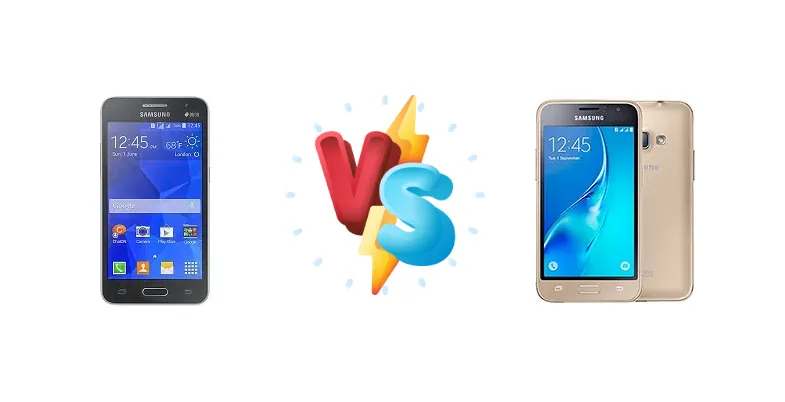
Looking for an affordable Samsung smartphone? The Galaxy Core II and Galaxy J1 (2016) were popular budget options. But which one offers the best value for your money? We'll break down their specs, performance, and features to help you decide.
🏆 Quick Verdict
The Galaxy J1 (2016) edges out the Core II thanks to its slightly faster processor and potentially more optimized software. However, the Core II might offer a more familiar Samsung experience for some. Ultimately, both are entry-level devices with compromises, but the J1 (2016) provides a marginally better overall experience.
| Network |
|---|
| 2G bands | GSM 850 / 900 / 1800 / 1900 - SIM 1 & SIM 2 | GSM 850 / 900 / 1800 / 1900 - SIM 1 & SIM 2 (dual-SIM model only) |
| 3G bands | HSDPA 900 / 2100 | HSDPA 850 / 900 / 1900 / 2100 - J120F |
| 4G bands | - | 1, 3, 5, 7, 8, 20 - J120F |
| Speed | HSPA 21.1/5.76 Mbps | HSPA 21.1/5.76 Mbps, LTE Cat4 150/50 Mbps |
| Technology | GSM / HSPA | GSM / HSPA / LTE |
| | - | 1, 2, 3, 4, 5, 7, 12 - J120A |
| Launch |
|---|
| Announced | 2014, June. Released 2014, July | 2016, January. Released 2016, January |
| Status | Discontinued | Discontinued |
| Body |
|---|
| Build | Glass front, plastic back, plastic frame | Glass front, plastic back, plastic frame |
| Dimensions | 130.3 x 68 x 9.8 mm (5.13 x 2.68 x 0.39 in) | 132.6 x 69.3 x 8.9 mm (5.22 x 2.73 x 0.35 in) |
| SIM | Dual SIM (Micro-SIM, dual stand-by) | Single SIM (Micro-SIM) or Dual SIM (Micro-SIM, dual stand-by) |
| Weight | 138 g (4.87 oz) | 131 g (4.62 oz) |
| Display |
|---|
| Resolution | 480 x 800 pixels, 5:3 ratio (~207 ppi density) | 480 x 800 pixels, 5:3 ratio (~207 ppi density) |
| Size | 4.5 inches, 57.6 cm2 (~65.1% screen-to-body ratio) | 4.5 inches, 57.6 cm2 (~62.7% screen-to-body ratio) |
| Type | TFT, 256K colors | Super AMOLED |
| Platform |
|---|
| CPU | Quad-core 1.2 GHz | Quad-core 1.3 GHz Cortex-A7 |
| Chipset | - | Spreadtrum SC9830 |
| GPU | - | Mali-400 |
| OS | Android 4.4.2 (KitKat) | Android 5.1.1 (Lollipop), upgradable to Android 6.0.1 (Marshmallow) |
| Memory |
|---|
| Card slot | microSDXC (dedicated slot) | microSDXC (dedicated slot) |
| Internal | 4GB 768MB RAM | 8GB 1GB RAM |
| Main Camera |
|---|
| Features | LED flash | LED flash |
| Single | 5 MP, AF | 5 MP, f/2.2, AF |
| Video | 480p@30fps | 720p@30fps |
| Selfie camera |
|---|
| Single | VGA | 2 MP, f/2.2 |
| Sound |
|---|
| 3.5mm jack | Yes | Yes |
| 35mm jack | Yes | Yes |
| Loudspeaker | Yes | Yes |
| Comms |
|---|
| Bluetooth | 4.0, A2DP | 4.1, A2DP, LE |
| NFC | No | No |
| Positioning | GPS, GLONASS | GPS, GLONASS |
| Radio | FM radio | FM radio, RDS, recording |
| USB | microUSB 2.0 | microUSB 2.0 |
| WLAN | Wi-Fi 802.11 b/g/n, Wi-Fi Direct, hotspot | Wi-Fi 802.11 b/g/n, Wi-Fi Direct, hotspot |
| Features |
|---|
| Sensors | Accelerometer | Accelerometer, proximity |
| Battery |
|---|
| Music play | Up to 30 h | Up to 39 h |
| Talk time | Up to 7 h (3G) | Up to 12 h (3G) |
| Type | Li-Ion 2000 mAh, removable | Li-Ion 2050 mAh, removable |
| Misc |
|---|
| Colors | White, Black | White, Black, Gold |
| Models | SM-G355H, SM-G355HN, SM-G355M | SM-J120F, SM-J120H, SM-J120M, SM-J120M, SM-J120T, SM-J120G, SM-J120A, SM-J120FN, SM-J120AZ, SM-J120ZN, SM-J120W |
| Price | About 130 EUR | About 130 EUR |
| SAR | - | 1.58 W/kg (head) 1.18 W/kg (body) |
| SAR EU | 0.42 W/kg (head) 0.45 W/kg (body) | 0.70 W/kg (head) 0.59 W/kg (body) |
Samsung Galaxy Core II
- Potentially larger screen size
- Familiar Samsung UI
- Often had expandable storage (microSD)
- Generally more readily available replacement parts (due to age)
- Slightly slower processor
- Lower resolution display
- Can feel dated
- Software updates likely discontinued
Samsung Galaxy J1 (2016)
- Slightly faster processor
- More compact design
- Potentially better software optimization
- Ultra Power Saving Mode for extended battery life
- Smaller screen size
- Lower rear camera resolution
- Limited storage (often 4GB)
- Software updates likely discontinued
Display Comparison
Both phones feature relatively basic LCD displays. The Galaxy Core II typically had a larger screen size (around 4.5-5 inches) compared to the J1 (2016)'s smaller 4.5-inch display. Resolution was generally low on both, around WVGA (800x480), resulting in a pixelated image. Viewing angles and color accuracy are not strengths of either device.
Camera Comparison
Camera quality on both phones is modest. The Galaxy Core II often featured a slightly higher megapixel count on the rear camera (typically 8MP) compared to the J1 (2016)'s 5MP. However, image quality is heavily dependent on software and sensor size, and both phones struggle in low-light conditions. Front-facing cameras were basic, typically 2MP on both.
Performance
The Galaxy J1 (2016) boasts a slightly faster 1.3 GHz Quad-core Cortex-A7 processor compared to the Core II's 1.2 GHz Quad-core. While both are entry-level chips, the J1's processor, paired with its chipset, generally provides a smoother experience for basic tasks and light multitasking. The Core II might feel slightly sluggish by comparison, especially with older Android versions.
Battery Life
Battery life is a crucial factor in budget phones. The Galaxy Core II often had a larger battery capacity (around 2000mAh) than the J1 (2016) (around 1900mAh). However, battery life is also affected by software optimization and usage patterns. Both phones offer adequate battery life for a day of light use, but heavy users will need to charge them more frequently.
Buying Guide
The Samsung Galaxy Core II is a good choice for users prioritizing a familiar Samsung interface and potentially slightly better screen size (depending on specific models). The Samsung Galaxy J1 (2016) is ideal for those seeking a slightly more modern chipset and a more compact design, prioritizing a bit more performance within a tight budget.
Frequently Asked Questions
❓ Are these phones still worth buying?
Given their age, finding these phones new is unlikely. Used, they are only worth considering if you need a very basic phone for calls and texts and are on an extremely tight budget. Newer, more capable budget phones are readily available.
❓ Which phone has better software support?
Neither phone receives active software updates. Both are running older versions of Android, posing potential security risks. It's recommended to use these phones with caution and avoid sensitive data.