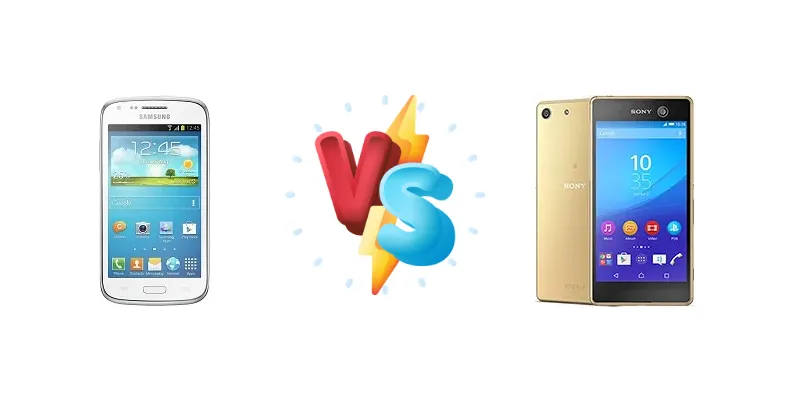
Released in different eras of the budget smartphone market, the Samsung Galaxy Core I8260 and the Sony Xperia M5 represent distinct approaches to delivering value. The Core I8260, a 2014 release, prioritized endurance and simplicity, while the Xperia M5, arriving later, aimed for a more modern experience with a faster processor and improved camera features. This comparison dissects their key differences to help users understand which device best suits their needs.
🏆 Quick Verdict
For the average user seeking a functional, long-lasting device, the Sony Xperia M5 emerges as the better choice. Its octa-core Helio X10 processor provides significantly improved performance over the Galaxy Core I8260’s dual-core Snapdragon S4 Play, and its superior sunlight contrast ratio enhances outdoor visibility. While the Core I8260 boasts respectable battery endurance, the M5’s overall capabilities offer a more compelling user experience.
| Network |
|---|
| 2G bands | GSM 850 / 900 / 1800 / 1900 - GT-I8260 | GSM 850 / 900 / 1800 / 1900 |
| 3G bands | HSDPA 900 / 2100 | HSDPA 850 / 900 / 1900 / 2100 - E5603, E5653 |
| 4G bands | - | 1, 3, 5, 7, 8, 20 - E5603 |
| Speed | HSPA 7.2/5.76 Mbps | HSPA 42.2/5.76 Mbps, LTE Cat4 150/50 Mbps |
| Technology | GSM / HSPA | GSM / HSPA / LTE |
| | - | 1, 3, 5, 7, 8, 28, 40 - E5653 |
| Launch |
|---|
| Announced | 2013, May. Released 2013, June | 2015, August. Released 2015, September |
| Status | Discontinued | Discontinued |
| Body |
|---|
| Build | Glass front, plastic back, plastic frame | - |
| Dimensions | 129.3 x 67.6 x 9 mm (5.09 x 2.66 x 0.35 in) | 145 x 72 x 7.6 mm (5.71 x 2.83 x 0.30 in) |
| SIM | Single SIM (Micro-SIM) or Dual SIM (Micro-SIM, dual stand-by) | Nano-SIM |
| Weight | 124 g (4.37 oz) | 142.5 g (5.04 oz) |
| | - | IP68 dust/water resistant (up to 1.5m for 30 min) |
| Display |
|---|
| Protection | - | Scratch-resistant glass |
| Resolution | 480 x 800 pixels, 5:3 ratio (~217 ppi density) | 1080 x 1920 pixels, 16:9 ratio (~441 ppi density) |
| Size | 4.3 inches, 52.6 cm2 (~60.2% screen-to-body ratio) | 5.0 inches, 68.9 cm2 (~66.0% screen-to-body ratio) |
| Type | TFT | IPS LCD |
| Platform |
|---|
| CPU | Dual-core 1.2 GHz Cortex-A5 | Octa-core 2.0 GHz Cortex-A53 |
| Chipset | Qualcomm MSM8225 Snapdragon S4 Play | Mediatek MT6795 Helio X10 (28 nm) |
| GPU | Adreno 203 | PowerVR G6200 |
| OS | Android 4.1.2 (Jelly Bean) | Android 5.0.1 (Lollipop), upgradable to 6.0.1 (Marshmallow) |
| Memory |
|---|
| Card slot | microSDXC (dedicated slot) | microSDXC (dedicated slot) |
| Internal | 8GB (4.5GB user available), 1GB RAM | 16GB 3GB RAM |
| | - | eMMC 5.0 |
| Main Camera |
|---|
| Features | LED flash | LED flash, HDR, panorama |
| Single | 5 MP, f/2.6, AF | 21.2 MP, f/2.2, PDAF |
| Video | 480p@30fps | 4K@30fps, HDR |
| Selfie camera |
|---|
| Single | VGA | 13 MP, f/2.0, AF |
| Video | - | 1080p@30fps |
| Sound |
|---|
| 3.5mm jack | - | Yes |
| 35mm jack | Yes | Yes |
| Loudspeaker | Yes | Yes |
| Comms |
|---|
| Bluetooth | 3.0, A2DP | 4.1, A2DP, LE, aptX |
| NFC | No | Yes |
| Positioning | GPS | GPS, GLONASS |
| Radio | FM radio, RDS | FM radio, RDS |
| USB | microUSB 2.0 | microUSB 2.0 |
| WLAN | Wi-Fi 802.11 b/g/n, hotspot | Wi-Fi 802.11 a/b/g/n, dual-band, Wi-Fi Direct, DLNA, hotspot |
| Features |
|---|
| Sensors | Accelerometer, proximity, compass | Accelerometer, proximity, compass |
| Battery |
|---|
| Music play | - | Up to 62 h 30 min |
| Stand-by | Up to 500 h (2G) / Up to 300 h (3G) | Up to 671 h (2G) / Up to 656 h (3G) |
| Talk time | Up to 14 h (2G) / Up to 9 h (3G) | Up to 11 h 49 min (2G) / Up to 12 h 11 min (3G) |
| Type | Li-Ion 1800 mAh, removable | Li-Ion 2600 mAh, non-removable |
| Misc |
|---|
| Colors | Metallic Blue, Chic White | Black, White, Gold |
| Models | GT-I8260, GT-I8262 | E5603, E5606, E5653 |
| Price | About 160 EUR | About 110 EUR |
| SAR | - | 0.32 W/kg (head) 1.39 W/kg (body) |
| SAR EU | 0.29 W/kg (head) 0.95 W/kg (body) | 0.19 W/kg (head) 0.40 W/kg (body) |
| Tests |
|---|
| Audio quality | - |
Noise -94.1dB / Crosstalk -93.4dB |
| Camera | - |
Photo / Video |
| Display | - |
Contrast ratio: 839 (nominal), 2.69(sunlight) |
| Loudspeaker | - |
Voice 65dB / Noise 64dB / Ring 68dB
|
| Performance | - |
Basemark OS II 2.0: 860Basemark X: 7780 |
Samsung Galaxy Core I8260
- Exceptional battery endurance (49h rating)
- Simple and user-friendly interface
- Lower price point (likely, given its age)
- Outdated dual-core processor
- Poor performance with modern apps
- Inferior display quality, especially in sunlight
Sony Xperia M5
- Powerful octa-core Helio X10 processor
- Superior sunlight contrast ratio
- Video recording capabilities
- Potentially shorter battery life than Core I8260
- May be more expensive than the older Core I8260
- No specific endurance rating provided
Display Comparison
Both devices feature similar nominal contrast ratios around 840:1, but the Xperia M5 pulls ahead significantly in sunlight readability with a contrast ratio of 2.69:1 compared to the Core I8260’s 1.563:1. This difference is crucial for users who frequently use their phones outdoors. While neither device boasts high-end display technology like OLED or high refresh rates (common in later models), the M5’s improved sunlight contrast makes it the more practical choice for everyday use. The lack of detailed display specs like resolution or panel type for the Core I8260 suggests a lower-quality panel overall.
Camera Comparison
Both phones offer photo capabilities, but the Xperia M5 expands on this with video recording functionality, indicating a more versatile camera system. While specific sensor details are missing for both, the inclusion of video recording on the M5 suggests a more capable image signal processor (ISP) within the Helio X10 chipset. The Core I8260 likely offers basic photo capture, suitable for casual snapshots, while the M5 provides more options for creative photography and videography. The absence of details regarding aperture or sensor size on either device makes a precise comparison difficult, but the M5’s broader feature set points to a superior camera experience.
Performance
The performance gap between these two devices is substantial. The Samsung Galaxy Core I8260’s Qualcomm MSM8225 Snapdragon S4 Play, with its dual-core 1.2 GHz Cortex-A5 CPU, is significantly outmatched by the Sony Xperia M5’s MediaTek MT6795 Helio X10, an octa-core 2.0 GHz Cortex-A53 processor built on a 28nm process. The Helio X10’s architecture allows for far more efficient multitasking and smoother performance in demanding applications. The Core I8260 will struggle with modern apps and games, while the M5 offers a more responsive and enjoyable experience. The 28nm process of the Helio X10 also suggests better power efficiency compared to the older Snapdragon S4 Play.
Battery Life
The Samsung Galaxy Core I8260 boasts an endurance rating of 49 hours, suggesting excellent battery life for its time. However, the Xperia M5, despite lacking a specific endurance rating in the provided data, benefits from a more efficient processor and potentially optimized power management. While the Core I8260 excels in longevity, the M5’s faster processor allows for quicker task completion, potentially reducing overall screen-on time and mitigating battery drain. The lack of charging wattage information for both devices makes it difficult to assess charging speeds, but the M5’s more modern chipset likely supports faster charging protocols.
Buying Guide
Buy the Samsung Galaxy Core I8260 if you prioritize maximum battery life and a simple, straightforward Android experience, and are operating on a very tight budget. It’s ideal for users who primarily need a phone for calls, texts, and basic app usage. Buy the Sony Xperia M5 if you value performance for multitasking, media consumption, and photography, and require a more modern display with better outdoor visibility. This is the better option for users who want a more versatile smartphone experience.
Frequently Asked Questions
❓ Is the MediaTek Helio X10 in the Xperia M5 prone to overheating during extended gaming sessions?
While the Helio X10 was a capable processor for its time, it's known to generate more heat than some of its competitors. However, the Xperia M5’s design and thermal management likely mitigate this to some extent. Expect some throttling during prolonged, graphically intensive gaming, but it shouldn't lead to complete shutdowns.
❓ Given the age of the Samsung Galaxy Core I8260, are software updates still available?
It is highly unlikely that the Samsung Galaxy Core I8260 receives any further software updates. Being a 2014 device, it has long passed its end-of-life support period. Users should be aware of potential security vulnerabilities and limited app compatibility.
❓ Does the Sony Xperia M5 support 4K video recording?
The Sony Xperia M5 is capable of recording video in 1080p at 30fps. While it doesn't support 4K recording, this was a common limitation for smartphones in its price range at the time of release.