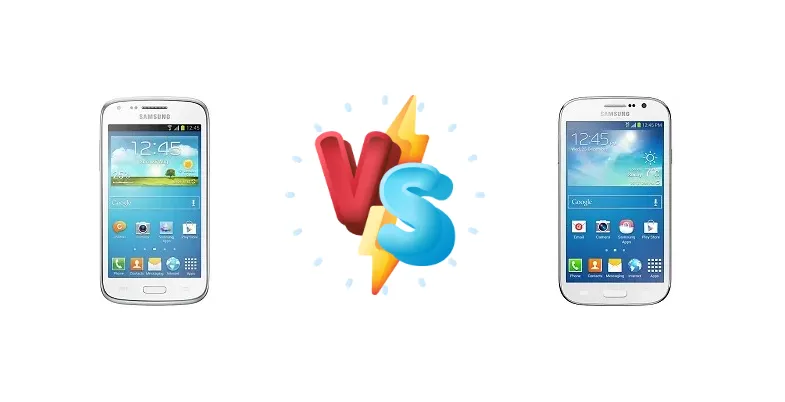
Released in a similar era of budget-focused Android devices, the Samsung Galaxy Core I8260 and Galaxy Grand Neo represent different approaches to affordability. The Core I8260 prioritized a more compact form factor and Qualcomm’s Snapdragon S4 Play, while the Grand Neo opted for a larger screen and a quad-core Spreadtrum processor. This comparison dissects their key differences to determine which device offers the best value today.
🏆 Quick Verdict
For the average user seeking a slightly more responsive experience, the Samsung Galaxy Grand Neo is the better choice. Its quad-core processor, despite using the Cortex-A7 architecture, provides a noticeable performance uplift over the Core I8260’s dual-core Snapdragon S4 Play, making it more suitable for multitasking and modern app usage. However, the Core I8260’s smaller size may appeal to some.
| Network |
|---|
| 2G bands | GSM 850 / 900 / 1800 / 1900 - GT-I8260 | GSM 850 / 900 / 1800 / 1900 - I9060, I9060I |
| 3G bands | HSDPA 900 / 2100 | HSDPA 900 / 2100 |
| Speed | HSPA 7.2/5.76 Mbps | HSPA 21.1/5.76 Mbps |
| Technology | GSM / HSPA | GSM / HSPA |
| | - | GSM 850 / 900 / 1800 / 1900 - SIM 1 & SIM 2 - I9062 |
| Launch |
|---|
| Announced | 2013, May. Released 2013, June | 2014, January. Released 2014, February |
| Status | Discontinued | Discontinued |
| Body |
|---|
| Build | Glass front, plastic back, plastic frame | Glass front, plastic back, plastic frame |
| Dimensions | 129.3 x 67.6 x 9 mm (5.09 x 2.66 x 0.35 in) | 143.7 x 77.1 x 9.6 mm (5.66 x 3.04 x 0.38 in) |
| SIM | Single SIM (Micro-SIM) or Dual SIM (Micro-SIM, dual stand-by) | Single SIM (Mini-SIM) or Dual SIM (Mini-SIM, dual stand-by) |
| Weight | 124 g (4.37 oz) | 163 g (5.75 oz) |
| Display |
|---|
| Resolution | 480 x 800 pixels, 5:3 ratio (~217 ppi density) | 480 x 800 pixels, 5:3 ratio (~186 ppi density) |
| Size | 4.3 inches, 52.6 cm2 (~60.2% screen-to-body ratio) | 5.01 inches, 71.4 cm2 (~64.5% screen-to-body ratio) |
| Type | TFT | TFT |
| Platform |
|---|
| CPU | Dual-core 1.2 GHz Cortex-A5 | Quad-core 1.2 GHz Cortex-A7 |
| Chipset | Qualcomm MSM8225 Snapdragon S4 Play | Broadcom BCM23550Spreadtrum SC8830 - GT-I9060I |
| GPU | Adreno 203 | Broadcom VideoCore IVMali-400MP2 - GT-I9060I |
| OS | Android 4.1.2 (Jelly Bean) | Android 4.2 (Jelly Bean)Android 4.4.4 (KitKat) - GT-I9060I |
| Memory |
|---|
| Card slot | microSDXC (dedicated slot) | microSDXC (dedicated slot) |
| Internal | 8GB (4.5GB user available), 1GB RAM | 8GB 1GB RAM, 16GB 1GB RAM |
| Main Camera |
|---|
| Features | LED flash | LED flash |
| Single | 5 MP, f/2.6, AF | 5 MP, f/2.6, AF |
| Video | 480p@30fps | 720p@30fps |
| Selfie camera |
|---|
| Single | VGA | VGA/ 2 MP, GT-I9060I |
| Sound |
|---|
| 3.5mm jack | - | Yes |
| 35mm jack | Yes | Yes |
| Loudspeaker | Yes | Yes |
| Comms |
|---|
| Bluetooth | 3.0, A2DP | 4.0, A2DP, LE |
| NFC | No | No |
| Positioning | GPS | GPS, GLONASS |
| Radio | FM radio, RDS | FM radio |
| USB | microUSB 2.0 | microUSB 2.0 |
| WLAN | Wi-Fi 802.11 b/g/n, hotspot | Wi-Fi 802.11 b/g/n, Wi-Fi Direct, hotspot |
| Features |
|---|
| Sensors | Accelerometer, proximity, compass | Accelerometer, proximity, compass |
| Battery |
|---|
| Music play | - | Up to 38 h |
| Stand-by | Up to 500 h (2G) / Up to 300 h (3G) | Up to 430 h |
| Talk time | Up to 14 h (2G) / Up to 9 h (3G) | Up to 11 h |
| Type | Li-Ion 1800 mAh, removable | Li-Ion 2100 mAh, removable |
| Misc |
|---|
| Colors | Metallic Blue, Chic White | White, Midnight Black, Orange, Lime Green |
| Models | GT-I8260, GT-I8262 | GT-I9060I, GT-I9062, GT-I9060, GT-I9060C, GT-I9060M, GT-I9060L, GT-I9168I |
| Price | About 160 EUR | About 130 EUR |
| SAR EU | 0.29 W/kg (head) 0.95 W/kg (body) | 0.21 W/kg (head) 0.32 W/kg (body) |
| Tests |
|---|
| Battery life | - |
Endurance rating 59h
|
| Camera | - |
Photo / Video |
| Display | - |
Contrast ratio: 786:1 (nominal), 1.393 (sunlight) |
| Loudspeaker | - |
Voice 72dB / Noise 65dB / Ring 73dB
|
Samsung Galaxy Core I8260
- More compact and pocketable design.
- Slightly higher nominal display contrast ratio.
- Qualcomm chipset known for stable performance (at the time).
- Dual-core processor limits multitasking capabilities.
- Shorter battery life compared to the Grand Neo.
- Lacks video recording functionality.
Samsung Galaxy Grand Neo
- Quad-core processor offers improved performance.
- Longer battery life for all-day use.
- Includes video recording functionality.
- Larger size may be less comfortable for some users.
- Slightly lower nominal display contrast ratio.
- Spreadtrum chipset may not be as refined as Qualcomm’s.
Display Comparison
Both devices feature displays with similar contrast ratios – the Core I8260 achieving 842:1 (nominal) and 1.563:1 (sunlight), while the Grand Neo registers 786:1 (nominal) and 1.393 (sunlight). While the Core I8260 has a slightly higher nominal contrast, the difference is unlikely to be perceptible to the average user. Neither device boasts particularly high brightness, suggesting both will struggle in direct sunlight. The Grand Neo’s larger screen size, however, provides a more immersive viewing experience, though at the cost of increased bulk.
Camera Comparison
Both devices are equipped with cameras capable of capturing photos, but the Grand Neo adds video recording functionality, a significant advantage for users who wish to record memories. Details regarding sensor size and aperture are unavailable, making a direct comparison of image quality difficult. However, the inclusion of video recording suggests a slightly more versatile camera system on the Grand Neo. The lack of detailed camera specs implies both devices target casual photography rather than serious enthusiasts.
Performance
The core difference lies in the chipsets. The Galaxy Core I8260 utilizes the Qualcomm MSM8225 Snapdragon S4 Play, featuring a dual-core 1.2 GHz Cortex-A5 CPU. The Galaxy Grand Neo, conversely, is powered by a Broadcom BCM23550/Spreadtrum SC8830, sporting a quad-core 1.2 GHz Cortex-A7 CPU. While both CPUs operate at the same clock speed, the Cortex-A7 architecture in the Grand Neo offers improved performance per clock cycle compared to the Cortex-A5. This translates to a smoother user experience, particularly when handling multiple apps or more demanding tasks. The Grand Neo’s quad-core configuration further enhances multitasking capabilities.
Battery Life
The Samsung Galaxy Grand Neo demonstrates a clear advantage in battery endurance, achieving a rating of 59 hours compared to the Core I8260’s 49 hours. This 10-hour difference suggests the Grand Neo’s quad-core processor, despite its increased processing power, is more power-efficient or is paired with a larger battery capacity. While neither device offers fast charging by today’s standards, the Grand Neo’s longer endurance provides greater peace of mind for users who rely heavily on their smartphones throughout the day.
Buying Guide
Buy the Samsung Galaxy Core I8260 if you prioritize a more pocketable device and are primarily focused on basic smartphone functions like calls, texts, and light web browsing. Buy the Samsung Galaxy Grand Neo if you prefer a larger screen for media consumption and require a more capable processor for smoother multitasking and running a wider range of applications, even if it means sacrificing some portability.
Frequently Asked Questions
❓ Is the Spreadtrum chipset in the Grand Neo reliable long-term?
Spreadtrum chipsets, while offering good value, historically haven't had the same level of software support or long-term driver updates as Qualcomm. However, for basic smartphone functions, the Grand Neo should remain functional for a reasonable period, but don't expect extensive software updates.
❓ Will the Galaxy Grand Neo struggle with modern Android apps?
The Galaxy Grand Neo’s quad-core Cortex-A7 processor and limited RAM will likely struggle with demanding modern apps and games. While it can handle basic tasks, expect slowdowns and potential crashes when running resource-intensive applications. It's best suited for lighter usage scenarios.
❓ Can I expand the storage on either of these phones?
While the context data doesn't explicitly state it, both the Galaxy Core I8260 and Grand Neo likely feature a microSD card slot for storage expansion, a common feature in budget smartphones of that era. This is crucial given the limited internal storage typically found in these devices.
❓ Which phone is better for older users who primarily make calls and send texts?
The Samsung Galaxy Core I8260 is arguably better suited for older users prioritizing simplicity and portability. Its smaller size makes it easier to hold and carry, and the dual-core processor is sufficient for basic communication tasks without overwhelming the user.