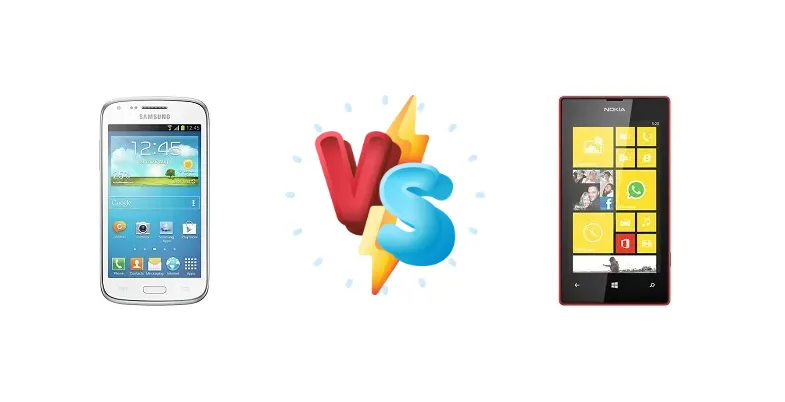
Released around the same time, the Samsung Galaxy Core i8260 and Nokia Lumia 520 represent two distinct approaches to the budget smartphone market of 2013. The Core i8260 ran Android, leveraging Samsung’s established ecosystem, while the Lumia 520 championed Windows Phone 8, offering a different user experience and a focus on essential features. This comparison dissects their hardware to determine which device offered the better value proposition.
🏆 Quick Verdict
For the average user prioritizing a slightly more versatile camera experience and a more established app ecosystem, the Nokia Lumia 520 emerges as the better choice. While both phones offer identical battery endurance, the Lumia 520’s inclusion of video recording capabilities and the smoother Windows Phone 8 interface provide a more compelling overall package.
| Network |
|---|
| 2G bands | GSM 850 / 900 / 1800 / 1900 - GT-I8260 | GSM 850 / 900 / 1800 / 1900 - all versions |
| 3G bands | HSDPA 900 / 2100 | HSDPA 900 / 2100 - RM-914 |
| Speed | HSPA 7.2/5.76 Mbps | HSPA 21.1/5.76 Mbps |
| Technology | GSM / HSPA | GSM / HSPA |
| | - | HSDPA 850 / 1700 / 1900 / 2100 - RM-917 |
| Launch |
|---|
| Announced | 2013, May. Released 2013, June | 2013, February. Released 2013, April |
| Status | Discontinued | Discontinued |
| Body |
|---|
| Build | Glass front, plastic back, plastic frame | Glass front, plastic back, plastic frame |
| Dimensions | 129.3 x 67.6 x 9 mm (5.09 x 2.66 x 0.35 in) | 119.9 x 64 x 9.9 mm, 75.7 cc (4.72 x 2.52 x 0.39 in) |
| SIM | Single SIM (Micro-SIM) or Dual SIM (Micro-SIM, dual stand-by) | Micro-SIM |
| Weight | 124 g (4.37 oz) | 124 g (4.37 oz) |
| Display |
|---|
| Protection | - | Scratch-resistant glass |
| Resolution | 480 x 800 pixels, 5:3 ratio (~217 ppi density) | 480 x 800 pixels, 5:3 ratio (~233 ppi density) |
| Size | 4.3 inches, 52.6 cm2 (~60.2% screen-to-body ratio) | 4.0 inches, 45.5 cm2 (~59.3% screen-to-body ratio) |
| Type | TFT | IPS LCD |
| Platform |
|---|
| CPU | Dual-core 1.2 GHz Cortex-A5 | Dual-core 1.0 GHz |
| Chipset | Qualcomm MSM8225 Snapdragon S4 Play | Qualcomm MSM8227 |
| GPU | Adreno 203 | Adreno 305 |
| OS | Android 4.1.2 (Jelly Bean) | Microsoft Windows Phone 8, upgradable to 8.1 |
| Memory |
|---|
| Card slot | microSDXC (dedicated slot) | microSDXC (dedicated slot) |
| Internal | 8GB (4.5GB user available), 1GB RAM | 8GB 512MB RAM |
| Main Camera |
|---|
| Features | LED flash | - |
| Single | 5 MP, f/2.6, AF | 5 MP, f/2.4, 28mm (wide), 1/4.0", AF |
| Video | 480p@30fps | 720p@30fps |
| Selfie camera |
|---|
| Single | VGA | - |
| | - | No |
| Sound |
|---|
| 3.5mm jack | - | Yes |
| 35mm jack | Yes | Yes |
| Loudspeaker | Yes | Yes |
| Comms |
|---|
| Bluetooth | 3.0, A2DP | 4.0, A2DP, LE/ aptX after WP8 Denim update |
| NFC | No | No |
| Positioning | GPS | GPS, GLONASS |
| Radio | FM radio, RDS | FM Radio |
| USB | microUSB 2.0 | microUSB 2.0 |
| WLAN | Wi-Fi 802.11 b/g/n, hotspot | Wi-Fi 802.11 b/g/n, hotspot |
| Features |
|---|
| Sensors | Accelerometer, proximity, compass | Accelerometer, proximity |
| Battery |
|---|
| Music play | - | Up to 61 h |
| Stand-by | Up to 500 h (2G) / Up to 300 h (3G) | Up to 360 h (3G) |
| Talk time | Up to 14 h (2G) / Up to 9 h (3G) | Up to 14 h 40 min (2G) / Up to 9 h 40 min (3G) |
| Type | Li-Ion 1800 mAh, removable | Li-Ion 1430 mAh, removable (BL-5J) |
| Misc |
|---|
| Colors | Metallic Blue, Chic White | Yellow, red, cyan, white/black |
| Models | GT-I8260, GT-I8262 | - |
| Price | About 160 EUR | About 70 EUR |
| SAR | - | 0.77 W/kg (head) |
| SAR EU | 0.29 W/kg (head) 0.95 W/kg (body) | 1.09 W/kg (head) |
| Tests |
|---|
| Audio quality | - |
Noise -82.3dB / Crosstalk -81.8dB |
| Battery life | - |
Endurance rating 49h
|
| Camera | - |
Photo / Video |
| Display | - |
Contrast ratio: 834:1 (nominal) / 1.161:1 (sunlight) |
| Loudspeaker | - |
Voice 68dB / Noise 69dB / Ring 66dB
|
Samsung Galaxy Core I8260
- Slightly faster processor (1.2 GHz vs 1.0 GHz)
- Familiar Android operating system
- Greater customization options
- No video recording capability
- Less streamlined user interface
- Potentially more bloatware
Nokia Lumia 520
- Video recording capability
- Clean and efficient Windows Phone 8 OS
- Better sunlight visibility (slightly)
- Slower processor (1.0 GHz vs 1.2 GHz)
- Limited app ecosystem compared to Android
- Less customization options
Display Comparison
Both the Samsung Galaxy Core i8260 and Nokia Lumia 520 feature displays with similar contrast ratios – 842:1 (nominal) and 834:1 (nominal) respectively. However, the Lumia 520’s sunlight contrast ratio of 1.161:1 slightly outperforms the Core i8260’s 1.563:1, suggesting marginally better visibility in direct sunlight. While neither display is expected to offer exceptional color accuracy or resolution, the slight edge in sunlight readability favors the Lumia 520 for outdoor use. The panel technology used in both devices is likely TFT LCD, common for this price point.
Camera Comparison
The Nokia Lumia 520 distinguishes itself with the ability to record video, a feature absent on the Samsung Galaxy Core i8260, which is limited to still photography. Both devices utilize similar basic camera sensors, but the inclusion of video recording significantly expands the Lumia 520’s versatility. While neither camera is expected to deliver exceptional image quality, the Lumia 520 offers more creative options for content capture. The absence of Optical Image Stabilization (OIS) on both devices means image stabilization relies solely on software processing.
Performance
The Nokia Lumia 520’s Qualcomm MSM8227 chipset, with a dual-core 1.0 GHz Cortex-A5 CPU, represents a slight downgrade in raw processing power compared to the Samsung Galaxy Core i8260’s Qualcomm MSM8225 Snapdragon S4 Play, featuring a dual-core 1.2 GHz Cortex-A5 CPU. While the difference in clock speed is modest, the Snapdragon S4 Play benefits from a slightly more efficient architecture. However, the real-world performance difference is likely minimal, as both devices are constrained by limited RAM and the demands of their respective operating systems. Windows Phone 8’s optimized nature may mitigate the hardware deficit, providing a fluid experience on the Lumia 520.
Battery Life
Both the Samsung Galaxy Core i8260 and Nokia Lumia 520 achieve an endurance rating of 49 hours, indicating comparable battery life under similar usage conditions. This suggests that despite the slightly faster processor in the Core i8260, the efficiency of the software and the battery capacity are well-matched. Neither device supports fast charging, meaning a full charge from 0-100% will likely take several hours.
Buying Guide
Buy the Samsung Galaxy Core i8260 if you need the familiarity of the Android operating system and prefer a wider range of customization options. Buy the Nokia Lumia 520 if you prefer a clean, streamlined user interface, value a more capable camera with video recording, and are open to exploring the Windows Phone ecosystem. Both are excellent choices for first-time smartphone owners or those seeking a reliable secondary device.
Frequently Asked Questions
❓ Is the Qualcomm MSM8227 in the Lumia 520 powerful enough for basic multitasking?
Yes, the MSM8227 is sufficient for handling everyday tasks like browsing, social media, and basic apps. Windows Phone 8 is known for its efficient resource management, allowing the Lumia 520 to perform smoothly even with limited hardware.
❓ Does the Samsung Galaxy Core i8260 support expandable storage via microSD card?
Yes, the Samsung Galaxy Core i8260 supports microSD card expansion, allowing users to increase the storage capacity beyond the internal memory. This is a crucial feature for storing photos, videos, and apps.
❓ Which phone is easier to use for someone unfamiliar with smartphones?
The Nokia Lumia 520 with Windows Phone 8 is generally considered easier to learn for first-time smartphone users due to its simpler, more intuitive interface. Android on the Core i8260 offers more customization but can be overwhelming for beginners.
❓ How does the app availability compare between Android and Windows Phone 8 on these devices?
Android, running on the Core i8260, has a significantly larger app ecosystem than Windows Phone 8 on the Lumia 520. While essential apps are available on both platforms, Android offers a wider selection and more frequent updates.