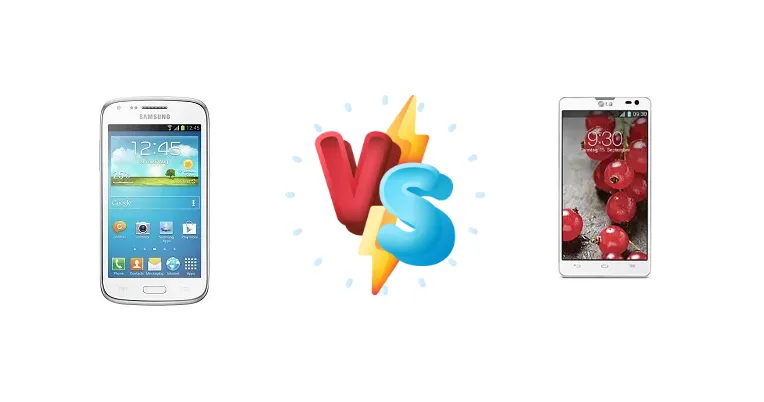
Released around the same timeframe, the Samsung Galaxy Core I8260 and LG Optimus L9 II represent a generation of affordable Android smartphones striving for balance between features and cost. Both devices utilized Qualcomm Snapdragon chipsets, but differed significantly in their implementation, impacting performance and user experience. This comparison dissects those differences to determine which phone offered the better value proposition in its day.
🏆 Quick Verdict
For the average user prioritizing responsiveness and future-proofing, the LG Optimus L9 II emerges as the better choice. Its Snapdragon 400 chipset, built on a more modern 28nm process, delivers a noticeable performance uplift over the Galaxy Core I8260’s Snapdragon S4 Play, despite both featuring dual-core CPUs.
| Network |
|---|
| 2G bands | GSM 850 / 900 / 1800 / 1900 - GT-I8260 | GSM 850 / 900 / 1800 / 1900 |
| 3G bands | HSDPA 900 / 2100 | HSDPA 900 / 2100 |
| Speed | HSPA 7.2/5.76 Mbps | HSPA 42.2/5.76 Mbps |
| Technology | GSM / HSPA | GSM / HSPA |
| | - | HSDPA 850 / 900 / 1900 / 2100 |
| Launch |
|---|
| Announced | 2013, May. Released 2013, June | 2013, August. Released 2013, October |
| Status | Discontinued | Discontinued |
| Body |
|---|
| Build | Glass front, plastic back, plastic frame | - |
| Dimensions | 129.3 x 67.6 x 9 mm (5.09 x 2.66 x 0.35 in) | 128.4 x 66.5 x 9 mm (5.06 x 2.62 x 0.35 in) |
| SIM | Single SIM (Micro-SIM) or Dual SIM (Micro-SIM, dual stand-by) | Mini-SIM |
| Weight | 124 g (4.37 oz) | 120 g (4.23 oz) |
| Display |
|---|
| Resolution | 480 x 800 pixels, 5:3 ratio (~217 ppi density) | 720 x 1280 pixels, 16:9 ratio (~312 ppi density) |
| Size | 4.3 inches, 52.6 cm2 (~60.2% screen-to-body ratio) | 4.7 inches, 60.9 cm2 (~71.3% screen-to-body ratio) |
| Type | TFT | True HD-IPS LCD |
| Platform |
|---|
| CPU | Dual-core 1.2 GHz Cortex-A5 | Dual-core 1.4 GHz Krait |
| Chipset | Qualcomm MSM8225 Snapdragon S4 Play | Qualcomm MSM8230 Snapdragon 400 (28 nm) |
| GPU | Adreno 203 | Adreno 305 |
| OS | Android 4.1.2 (Jelly Bean) | Android 4.1.2 (Jelly Bean), upgradаble to 4.4.2 (KitKat) |
| Memory |
|---|
| Card slot | microSDXC (dedicated slot) | microSDHC (dedicated slot) |
| Internal | 8GB (4.5GB user available), 1GB RAM | 8GB 1GB RAM |
| | - | eMMC 4.5 |
| Main Camera |
|---|
| Features | LED flash | LED flash |
| Single | 5 MP, f/2.6, AF | 8 MP, AF |
| Video | 480p@30fps | 1080p@30fps |
| Selfie camera |
|---|
| Single | VGA | 1.3 MP |
| Sound |
|---|
| 3.5mm jack | - | Yes |
| 35mm jack | Yes | Yes |
| Loudspeaker | Yes | Yes |
| Comms |
|---|
| Bluetooth | 3.0, A2DP | 4.0, A2DP, LE |
| Infrared port | - | Yes |
| NFC | No | Yes |
| Positioning | GPS | GPS |
| Radio | FM radio, RDS | Stereo FM radio, RDS |
| USB | microUSB 2.0 | microUSB 2.0 HS |
| WLAN | Wi-Fi 802.11 b/g/n, hotspot | Wi-Fi 802.11 a/b/g/n, dual-band, Wi-Fi Direct, DLNA, hotspot |
| Features |
|---|
| Sensors | Accelerometer, proximity, compass | Accelerometer, proximity, compass |
| Battery |
|---|
| Stand-by | Up to 500 h (2G) / Up to 300 h (3G) | Up to 480 h (2G) / Up to 480 h (3G) |
| Talk time | Up to 14 h (2G) / Up to 9 h (3G) | Up to 7 h 40 min (2G) / Up to 10 h 50 min (3G) |
| Type | Li-Ion 1800 mAh, removable | Li-Ion 2150 mAh, removable |
| Misc |
|---|
| Colors | Metallic Blue, Chic White | White, Black |
| Models | GT-I8260, GT-I8262 | D605 |
| Price | About 160 EUR | About 250 EUR |
| SAR | - | 0.42 W/kg (head) 0.82 W/kg (body) |
| SAR EU | 0.29 W/kg (head) 0.95 W/kg (body) | 0.47 W/kg (head) 0.46 W/kg (body) |
Samsung Galaxy Core I8260
- Higher contrast ratio for potentially better outdoor visibility
- Proven 49-hour endurance rating
- Established Samsung brand recognition
- Less powerful Snapdragon S4 Play chipset
- Older 40nm process technology leads to lower efficiency
- Limited performance headroom for future apps
LG Optimus L9 II
- More powerful Snapdragon 400 chipset with Krait architecture
- 28nm process technology for improved efficiency and thermal management
- Potentially smoother user experience and better multitasking
- Battery life specifics are unknown
- Display specifications are less detailed
- LG’s brand recognition was less strong than Samsung’s at the time
Display Comparison
The Samsung Galaxy Core I8260 boasts a contrast ratio of 842:1 (nominal) and 1.563:1 in sunlight, suggesting decent visibility outdoors. However, the LG Optimus L9 II’s display specifications are not provided, making a direct comparison difficult. Given LG’s history with IPS panels, it’s reasonable to assume the L9 II offered wider viewing angles and potentially more accurate color reproduction. The Core I8260’s higher contrast ratio is its main advantage, but without knowing the L9 II’s brightness levels, it’s hard to definitively declare a winner. Both devices likely featured similar resolutions typical of the budget segment at the time.
Camera Comparison
Both devices feature a 'Photo' camera, a vague descriptor that provides little insight. Without megapixel counts or sensor sizes, a meaningful comparison is impossible. It’s safe to assume both cameras were adequate for basic snapshots in good lighting conditions, but likely struggled in low-light scenarios. The absence of detailed camera specifications suggests neither device was a standout performer in this area.
Performance
The core difference lies in the chipsets. The Samsung Galaxy Core I8260 utilizes the Qualcomm MSM8225 Snapdragon S4 Play, featuring a dual-core 1.2 GHz Cortex-A5 CPU. The LG Optimus L9 II, however, steps up to the Qualcomm MSM8230 Snapdragon 400, with a dual-core 1.4 GHz Krait CPU. Crucially, the Snapdragon 400 is fabricated on a 28nm process, offering significantly improved power efficiency and thermal performance compared to the S4 Play. This translates to less throttling under sustained load and a smoother overall user experience on the L9 II. While both are dual-core, the Krait architecture in the L9 II is demonstrably more efficient and powerful than the Cortex-A5 in the Core I8260.
Battery Life
The Samsung Galaxy Core I8260 claims an endurance rating of 49 hours, a respectable figure for the time. The LG Optimus L9 II’s battery capacity and charging specifications are unknown. However, the Snapdragon 400’s superior power efficiency likely allowed the L9 II to achieve comparable, or even better, real-world battery life despite potentially having a smaller battery capacity. The 28nm process node is a significant advantage in this regard, reducing power consumption during both active use and standby.
Buying Guide
Buy the Samsung Galaxy Core I8260 if you prioritize a slightly higher contrast ratio in display viewing, and are looking for a device with a proven endurance rating of 49 hours. Buy the LG Optimus L9 II if you value a more responsive user experience, benefit from a more efficient chipset, and anticipate running more demanding applications, even within the constraints of the era.
Frequently Asked Questions
❓ Will the Snapdragon S4 Play in the Galaxy Core I8260 struggle with modern apps, even lightweight ones?
Yes, the Snapdragon S4 Play, while functional for its time, is significantly underpowered by today’s standards. Even basic apps may exhibit lag or slow loading times due to the limited processing power and older architecture. The L9 II’s Snapdragon 400 offers a more tolerable experience, but still won’t be ideal.
❓ Is the difference in chipset performance between the Snapdragon S4 Play and Snapdragon 400 noticeable in everyday tasks like browsing and social media?
Absolutely. The Snapdragon 400’s Krait architecture and 28nm process provide a noticeable improvement in responsiveness. Web pages will load faster, scrolling will be smoother, and app switching will be less prone to lag on the LG Optimus L9 II. The difference is particularly apparent when multitasking.
❓ Given the limited camera information, should I expect similar photo quality from both devices?
Likely, yes. Without specific details like sensor size or megapixel count, it’s reasonable to assume both cameras offered comparable image quality – adequate for casual snapshots in good lighting, but lacking in low-light performance. Don't expect flagship-level results from either device.