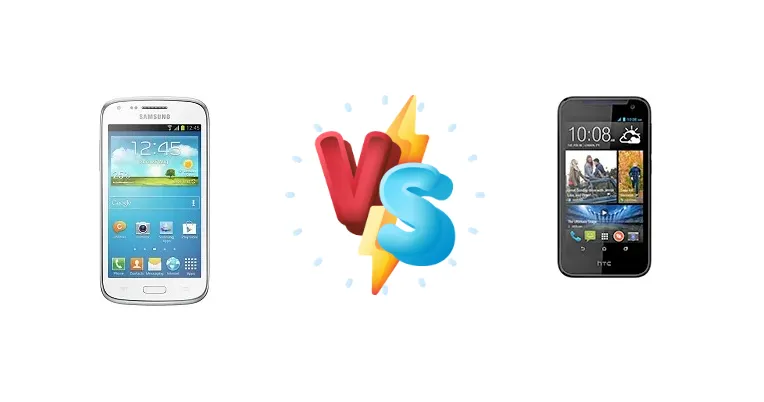
Released around the same timeframe, the Samsung Galaxy Core I8260 and HTC Desire 310 represent competing visions for the entry-level Android market. The Core I8260, powered by a Qualcomm Snapdragon S4 Play, aimed for a balance of features, while the Desire 310 leveraged a Mediatek quad-core processor to offer a perceived performance boost. This comparison dissects the key differences to determine which device delivers the best experience for today's user.
🏆 Quick Verdict
For the average user seeking a functional, if basic, smartphone experience, the HTC Desire 310 emerges as the slightly better choice. Its quad-core processor provides a noticeable advantage in multitasking and app loading speeds, offsetting the Galaxy Core I8260’s superior display contrast. However, the Core I8260’s endurance rating is a significant plus.
| Network |
|---|
| 2G bands | GSM 850 / 900 / 1800 / 1900 - GT-I8260 | GSM 850 / 900 / 1800 / 1900 |
| 3G bands | HSDPA 900 / 2100 | HSDPA 900 / 2100 - EU, Asia, China |
| EDGE | - | No |
| GPRS | - | Yes |
| Speed | HSPA 7.2/5.76 Mbps | HSPA 21.1/5.76 Mbps |
| Technology | GSM / HSPA | GSM / HSPA |
| Launch |
|---|
| Announced | 2013, May. Released 2013, June | 2014, January. Released 2014, April |
| Status | Discontinued | Discontinued |
| Body |
|---|
| Build | Glass front, plastic back, plastic frame | - |
| Dimensions | 129.3 x 67.6 x 9 mm (5.09 x 2.66 x 0.35 in) | 132.4 x 68 x 11.3 mm (5.21 x 2.68 x 0.44 in) |
| SIM | Single SIM (Micro-SIM) or Dual SIM (Micro-SIM, dual stand-by) | Mini-SIM |
| Weight | 124 g (4.37 oz) | 140 g (4.94 oz) |
| Display |
|---|
| Resolution | 480 x 800 pixels, 5:3 ratio (~217 ppi density) | 480 x 854 pixels, 16:9 ratio (~218 ppi density) |
| Size | 4.3 inches, 52.6 cm2 (~60.2% screen-to-body ratio) | 4.5 inches, 55.8 cm2 (~62.0% screen-to-body ratio) |
| Type | TFT | TFT |
| Platform |
|---|
| CPU | Dual-core 1.2 GHz Cortex-A5 | Quad-core 1.3 GHz Cortex-A7 |
| Chipset | Qualcomm MSM8225 Snapdragon S4 Play | Mediatek MT6582M (28 nm) |
| GPU | Adreno 203 | Mali-400MP2 |
| OS | Android 4.1.2 (Jelly Bean) | Android 4.2.2 (Jelly Bean), Sense UI 5.1 |
| Memory |
|---|
| Call records | - | Yes |
| Card slot | microSDXC (dedicated slot) | microSDHC (dedicated slot) |
| Internal | 8GB (4.5GB user available), 1GB RAM | 4GB 512MB, 4GB 1GB RAM |
| Phonebook | - | Yes |
| Main Camera |
|---|
| Features | LED flash | - |
| Single | 5 MP, f/2.6, AF | 5 MP |
| Video | 480p@30fps | 1080p@30fps |
| Selfie camera |
|---|
| Single | VGA | VGA |
| Video | - | 480p |
| | - | No |
| Sound |
|---|
| 3.5mm jack | - | Yes |
| 35mm jack | Yes | Yes |
| Loudspeaker | Yes | Yes |
| Comms |
|---|
| Bluetooth | 3.0, A2DP | 4.0, A2DP, aptX |
| NFC | No | No |
| Positioning | GPS | GPS, GLONASS |
| Radio | FM radio, RDS | No |
| USB | microUSB 2.0 | microUSB 2.0 |
| WLAN | Wi-Fi 802.11 b/g/n, hotspot | Wi-Fi 802.11 b/g/n, hotspot |
| Features |
|---|
| Games | - | Downloadable |
| Java | - | No |
| Messaging | - | SMS, IM |
| Sensors | Accelerometer, proximity, compass | Accelerometer |
| | - | Audio/video player |
| Battery |
|---|
| Stand-by | Up to 500 h (2G) / Up to 300 h (3G) | Up to 852 h |
| Talk time | Up to 14 h (2G) / Up to 9 h (3G) | Up to 11 h |
| Type | Li-Ion 1800 mAh, removable | Li-Ion 2000 mAh, removable |
| Misc |
|---|
| Colors | Metallic Blue, Chic White | Black, White, Red |
| Models | GT-I8260, GT-I8262 | D310n |
| Price | About 160 EUR | About 150 EUR |
| SAR EU | 0.29 W/kg (head) 0.95 W/kg (body) | - |
Samsung Galaxy Core I8260
- Superior display contrast for better viewing experience
- Excellent battery endurance (49h rating)
- Qualcomm Snapdragon optimizations
- Dual-core processor is slower than the Desire 310
- Limited multitasking capabilities
HTC Desire 310
- Quad-core processor for faster performance
- More responsive user interface
- Modern Cortex-A7 architecture
- Likely shorter battery life
- Inferior display contrast
Display Comparison
The Samsung Galaxy Core I8260 boasts a superior display contrast ratio, achieving 842:1 nominally and 1.563:1 in sunlight. This translates to deeper blacks and better visibility outdoors. While the Desire 310’s display specifications are unavailable, HTC’s historical focus in this segment suggests a more basic panel. The higher contrast of the Core I8260 will be particularly noticeable when viewing photos and videos, offering a more immersive experience. The lack of detailed display specs for the Desire 310 suggests a cost-cutting measure in this area.
Camera Comparison
Both devices feature cameras described simply as 'Photo,' lacking specific details about sensor size or resolution. Given the market segment, it’s safe to assume both cameras are basic and intended for casual snapshots. Without further information, it’s impossible to definitively declare a winner. Image quality will likely be similar, with both struggling in low-light conditions. The absence of detailed camera specs highlights the focus on core functionality over advanced imaging capabilities in these devices.
Performance
The HTC Desire 310’s Mediatek MT6582M quad-core 1.3 GHz Cortex-A7 processor represents a significant architectural leap over the Samsung Galaxy Core I8260’s dual-core 1.2 GHz Cortex-A5 Snapdragon S4 Play. The Cortex-A7 architecture, built on a 28nm process, offers improved performance per clock cycle and greater energy efficiency compared to the older Cortex-A5. While the Core I8260 benefits from Qualcomm’s optimizations, the sheer core count advantage of the Desire 310 will result in smoother multitasking and faster app loading times. However, the Snapdragon’s integrated GPU may offer slightly better graphics performance in some scenarios.
Battery Life
The Samsung Galaxy Core I8260 holds a distinct advantage in battery endurance, achieving a rating of 49 hours. This suggests a combination of efficient hardware and software optimization. The Desire 310’s battery capacity and charging specifications are unknown, but the more power-hungry quad-core processor is likely to consume more energy. Users prioritizing long battery life will find the Galaxy Core I8260 a more reliable choice, potentially lasting a full day on a single charge with moderate use.
Buying Guide
Buy the Samsung Galaxy Core I8260 if you prioritize display quality and longer battery life, and are willing to trade some processing power. This phone is ideal for users who primarily make calls, send texts, and occasionally browse the web. Buy the HTC Desire 310 if you value responsiveness and multitasking capabilities, even if it means sacrificing some battery endurance and display contrast. This is a better fit for users who download and use multiple apps simultaneously.
Frequently Asked Questions
❓ Will the HTC Desire 310 struggle with demanding apps like Facebook or WhatsApp?
While the Desire 310’s quad-core processor is an improvement over the Galaxy Core I8260, it’s still an entry-level chipset. Expect some lag when running multiple apps simultaneously or using resource-intensive features within Facebook or WhatsApp. Basic functionality should be acceptable, but don’t expect a fluid experience.
❓ Is the Samsung Galaxy Core I8260 a good choice for someone who primarily uses their phone for calls and texts?
Absolutely. The Galaxy Core I8260’s long battery life and reliable performance make it an excellent choice for users who prioritize basic communication features. The superior display contrast will also enhance the readability of text messages and contacts.
❓ Does the Mediatek MT6582M in the Desire 310 get hot during extended use?
The MT6582M, being a 28nm chip, is relatively efficient. However, sustained use of demanding apps or gaming will likely cause some heat buildup. It’s unlikely to reach critical temperatures, but users should be aware of potential thermal throttling, which could slightly reduce performance over time.