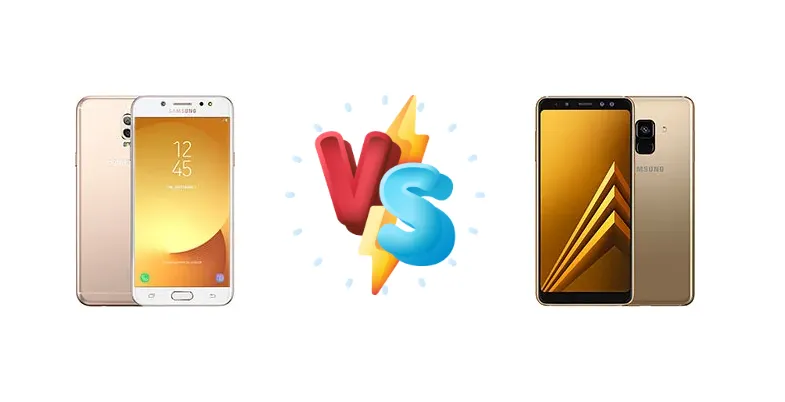
Choosing between two older Samsung phones can be tricky. The Galaxy C7 (2017) and Galaxy A8 (2018) both offer a premium feel, but which one delivers the better overall experience? We'll break down their specs, performance, and features to help you decide.
🏆 Quick Verdict
The Galaxy A8 (2018) edges out the C7 (2017) thanks to its more modern chipset (Exynos 7885), faster charging (18W), and slightly improved overall performance. While both offer solid battery life, the A8's advancements make it the preferable choice for most users.
| Network |
|---|
| 2G bands | GSM 850 / 900 / 1800 / 1900 - SIM 1 & SIM 2 | GSM 850 / 900 / 1800 / 1900 - SIM 1 & SIM 2 (dual-SIM model only) |
| 3G bands | HSDPA 850 / 900 / 1900 / 2100 | HSDPA 850 / 900 / 1700(AWS) / 1900 / 2100 |
| 4G bands | 1, 3, 5, 7, 8, 20, 28, 38, 40, 41 | 1, 2, 3, 4, 5, 7, 8, 12, 13, 17, 18, 19, 20, 26, 28, 38, 40, 41, 66 |
| Speed | HSPA, LTE | HSPA 42.2/5.76 Mbps, LTE (3CA) Cat11 600/75 Mbps |
| Technology | GSM / HSPA / LTE | GSM / HSPA / LTE |
| Launch |
|---|
| Announced | 2017, September. Released 2017, October | 2017, December. Released 2018, January |
| Status | Discontinued | Discontinued |
| Body |
|---|
| Build | Glass front, aluminum back, aluminum frame | Glass front (Gorilla Glass 4), glass back (Gorilla Glass 5), aluminum frame |
| Dimensions | 152.4 x 74.7 x 7.9 mm (6.00 x 2.94 x 0.31 in) | 149.2 x 70.6 x 8.4 mm (5.87 x 2.78 x 0.33 in) |
| SIM | Nano-SIM + Nano-SIM | · Nano-SIM· Nano-SIM + Nano-SIM |
| Weight | 180 g (6.35 oz) | 172 g (6.07 oz) |
| | - | IP68 dust/water resistant (up to 1.5m for 30 min) |
| Display |
|---|
| Protection | - | Corning Gorilla Glass 4 |
| Resolution | 1080 x 1920 pixels, 16:9 ratio (~401 ppi density) | 1080 x 2220 pixels, 18.5:9 ratio (~441 ppi density) |
| Size | 5.5 inches, 83.4 cm2 (~73.3% screen-to-body ratio) | 5.6 inches, 79.6 cm2 (~75.6% screen-to-body ratio) |
| Type | Super AMOLED | Super AMOLED |
| | Always-on display | Always-on display |
| Platform |
|---|
| CPU | Octa-core (4x2.4 GHz & 4x1.7 GHz) | Octa-core (2x2.2 GHz Cortex-A73 & 6x1.6 GHz Cortex-A53) |
| Chipset | - | Exynos 7885 (14 nm) |
| GPU | - | Mali-G71 |
| OS | Android 7.1 (Nougat) | Android 7.1.1 (Nougat), upgradable to Android 9.0 (Pie), One UI |
| Memory |
|---|
| Card slot | microSDXC (uses shared SIM slot) | microSDXC (dedicated slot) |
| Internal | 32GB 4GB RAM | 32GB 4GB RAM, 64GB 4GB RAM |
| | - | eMMC 5.1 |
| Main Camera |
|---|
| Dual | 13 MP, f/1.7, AF
Auxiliary lens | - |
| Features | LED flash, panorama, HDR | LED flash, panorama, HDR |
| Single | - | 16 MP, f/1.7, 26mm (wide), 1/2.8”, 1.12µm, PDAF |
| Video | 1080p@30fps | 1080p@30fps |
| Selfie camera |
|---|
| Dual | - | 16 MP, f/1.9, 26mm (wide), 1/3.06", 1.0µm
8 MP, f/1.9, 24mm (wide), 1/4.0", 1.12µm |
| Single | 16 MP, f/1.9, 26mm (wide), 1/3.06", 1.0µm | - |
| Video | - | 1080p@30fps |
| Sound |
|---|
| 3.5mm jack | Yes | Yes |
| 35mm jack | Yes | Yes |
| Loudspeaker | Yes | Yes |
| | - | 24-bit/192kHz audio
|
| Comms |
|---|
| Bluetooth | 4.2, A2DP, LE | 5.0, A2DP, EDR, LE |
| NFC | No | Yes |
| Positioning | GPS, GLONASS | GPS, GLONASS, BDS |
| Radio | FM radio | FM radio |
| USB | microUSB 2.0, OTG | USB Type-C 2.0 |
| WLAN | Wi-Fi 802.11 a/b/g/n/ac, dual-band, Wi-Fi Direct | Wi-Fi 802.11 a/b/g/n/ac, dual-band, Wi-Fi Direct |
| Features |
|---|
| Sensors | Fingerprint (front-mounted), accelerometer, gyro, proximity, compass | Fingerprint (rear-mounted), accelerometer, gyro, proximity, compass, barometer |
| | - | ANT+
Samsung Pay |
| Battery |
|---|
| Charging | - | 18W wired |
| Music play | Up to 78 h | Up to 66 h |
| Talk time | Up to 16 h (3G) | Up to 24 h (3G) |
| Type | Li-Ion 3000 mAh, non-removable | Li-Ion 3000 mAh, non-removable |
| Misc |
|---|
| Colors | Gold, Black, Pink | Black, orchid grey, gold, blue |
| Models | SM-C710F, SM-C7100, SM-C7108 | SM-A530F, SM-A530F, SM-A530K, SM-A530L, SM-A530S, SM-A530N, SM-A530W |
| Price | About 230 EUR | About 250 EUR |
| SAR EU | 0.98 W/kg (head) 1.47 W/kg (body) | 0.24 W/kg (head) 1.25 W/kg (body) |
| Tests |
|---|
| Audio quality | - |
Noise -92.1dB / Crosstalk -90.0dB |
| Battery life | - |
Endurance rating 92h
|
| Camera | - |
Photo / Video |
| Display | - |
Contrast ratio: Infinity (nominal), 3.842 (sunlight) |
| Loudspeaker | - |
Voice 69dB / Noise 70dB / Ring 81dB
|
| Performance | - |
GeekBench: 4418 (v4.4)
GFXBench: 5.2fps (ES 3.1 onscreen) |
Samsung Galaxy C7 (2017)
- Large 5.7-inch display
- Solid build quality
- Good value for money (if found at a low price)
- Older chipset
- Slower charging
- Less refined design
Samsung Galaxy A8 (2018)
- Modern 'Infinity Display'
- Faster Exynos 7885 chipset
- 18W fast charging
- Improved camera performance
- Can be harder to find new
- Price may be higher than C7 (2017) if found
Display Comparison
Both phones feature Super AMOLED displays, offering vibrant colors and deep blacks. The A8 (2018) has a slightly more modern design with its 'Infinity Display,' providing a more immersive viewing experience. Both have similar contrast ratios, but the A8's design gives it a slight edge.
Camera Comparison
Both phones offer capable cameras, but the A8 (2018) generally produces slightly better images, especially in low light. The A8's image processing algorithms are more refined. Both have photo/video capabilities, but the A8's front-facing camera is often considered superior for selfies.
Performance
The Galaxy A8 (2018)'s Exynos 7885 chipset is a noticeable upgrade over the C7 (2017)'s octa-core processor. The A8's CPU architecture (Cortex-A73 cores) provides better single-core performance, resulting in smoother multitasking and app loading times. The C7 (2017) is still capable, but the A8 feels more responsive.
Battery Life
Both phones boast impressive battery life, with an endurance rating of 92h. This suggests similar real-world usage times. However, the A8 (2018)'s 18W fast charging provides a significant advantage when it comes to topping up the battery quickly.
Buying Guide
The Samsung Galaxy C7 (2017) is a good option for budget-conscious buyers who prioritize a large display and don't need the absolute latest performance. The Samsung Galaxy A8 (2018) is ideal for users seeking a more refined experience with better processing power, faster charging, and a slightly more modern design.
Frequently Asked Questions
❓ Is the Galaxy C7 (2017) still worth buying?
If you're on a very tight budget and primarily need a large screen for media consumption, the C7 (2017) can be a decent option. However, the A8 (2018) offers a better overall experience.
❓ Which phone has better performance for gaming?
The Galaxy A8 (2018) with its Exynos 7885 chipset will provide a smoother gaming experience, especially for more demanding titles.