
Samsung Galaxy C55 vs Xiaomi Redmi Note 13 Pro+: A Deep Dive into Mid-Range Power
| Phones Images | |||||
|---|---|---|---|---|---|
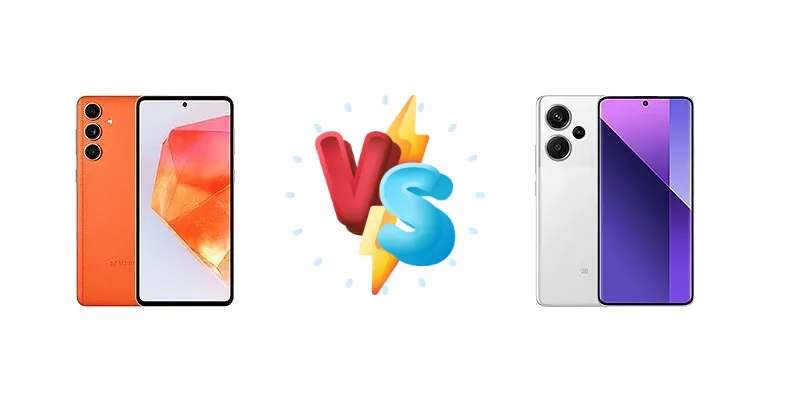
|
🏆 Quick Verdict
For users prioritizing blazing-fast charging and a brighter display, the Xiaomi Redmi Note 13 Pro+ is the clear winner. However, the Samsung Galaxy C55 provides a solid all-around experience with a capable processor and a more established brand reputation, making it a strong contender for those seeking reliability.
| PHONES | ||
|---|---|---|
| Phone Names | Samsung Galaxy C55 | Xiaomi Redmi Note 13 Pro+ |
| Network | ||
|---|---|---|
| 2G bands | GSM 850 / 900 / 1800 / 1900 | GSM 850 / 900 / 1800 / 1900 |
| 3G bands | HSDPA 850 / 900 / 1900 / 2100 | HSDPA 800 / 850 / 900 / 1700(AWS) / 1900 / 2100 - International |
| 4G bands | 1, 2, 3, 4, 5, 7, 8, 12, 17, 20, 25, 28, 34, 38, 39, 40, 41, 66 | 1, 2, 3, 4, 5, 7, 8, 12, 13, 17, 18, 19, 20, 26, 28, 32, 38, 40, 41, 66 - International |
| 5G bands | 1, 3, 5, 8, 20, 28, 41, 66, 77, 78, 79 SA/NSA/Sub6 | 1, 3, 5, 7, 8, 20, 28, 38, 40, 41, 66, 77, 78 SA/NSA- International |
| Speed | HSPA, LTE, 5G | HSPA, LTE, 5G |
| Technology | GSM / HSPA / LTE / 5G | GSM / CDMA / HSPA / EVDO / LTE / 5G |
| Launch | ||
|---|---|---|
| Announced | 2024, April 22 | 2023, September 21 |
| Status | Available. Released 2024, April 22 | Available. Released 2023, September 21 |
| Body | ||
|---|---|---|
| Build | Glass front, silicone polymer (eco leather) back, plastic frame | Glass front (Gorilla Glass Victus), glass back or silicone polymer back (eco leather) |
| Dimensions | 163.9 x 76.5 x 7.8 mm (6.45 x 3.01 x 0.31 in) | 161.4 x 74.2 x 8.9 mm (6.35 x 2.92 x 0.35 in) |
| SIM | Nano-SIM + Nano-SIM | · Nano-SIM + eSIM· Nano-SIM + Nano-SIM |
| Weight | 180 g (6.35 oz) | 199 g or 204.5 g (7.02 oz) |
| Display | ||
|---|---|---|
| Protection | - | Corning Gorilla Glass Victus |
| Resolution | 1080 x 2400 pixels, 20:9 ratio (~393 ppi density) | 1220 x 2712 pixels, 20:9 ratio (~446 ppi density) |
| Size | 6.7 inches, 108.4 cm2 (~86.4% screen-to-body ratio) | 6.67 inches, 107.4 cm2 (~89.7% screen-to-body ratio) |
| Type | Super AMOLED+, 120Hz, 1000 nits (HBM) | AMOLED, 68B colors, 120Hz, 1920Hz PWM, Dolby Vision, HDR10+, 1800 nits (peak) |
| Platform | ||
|---|---|---|
| CPU | Octa-core (1x2.4 GHz Cortex-A710 & 3x2.36 GHz Cortex-A710 & 4x1.8 GHz Cortex-A510) | Octa-core (2x2.8 GHz Cortex-A715 & 6x2.0 GHz Cortex-A510) |
| Chipset | Qualcomm SM7450-AB Snapdragon 7 Gen 1 (4 nm) | Mediatek Dimensity 7200 Ultra (4 nm) |
| GPU | Adreno 644 | Mali-G610 MC4 |
| OS | Android 14, One UI 6.1 | Android 13, up to 3 major Android upgrades, HyperOS |
| Memory | ||
|---|---|---|
| Card slot | microSDXC (uses shared SIM slot) | No |
| Internal | 256GB 8GB RAM, 256GB 12GB RAM | 256GB 8GB RAM, 256GB 12GB RAM, 512GB 8GB RAM, 512GB 12GB RAM, 512GB 16GB RAM |
| Main Camera | ||
|---|---|---|
| Features | LED flash, panorama, HDR | Dual-LED dual-tone flash, HDR, panorama |
| Triple | 50 MP, f/1.8, (wide), 1/1.56", 1.0µm, PDAF, OIS 8 MP, f/2.2, 123˚ (ultrawide) 2 MP (macro) | 200 MP, f/1.7, 23mm (wide), 1/1.4", 0.56µm, multi-directional PDAF, OIS 8 MP, f/2.2, 16mm, 120˚ (ultrawide), 1/4.0", 1.12µm 2 MP (macro) |
| Video | 4K@30fps, 1080p@30/60fps, gyro-EIS, OIS | 4K@24/30fps, 1080p@30/60/120fps, gyro-EIS |
| Selfie camera | ||
|---|---|---|
| Features | - | HDR, panorama |
| Single | 50 MP, f/2.4, (wide) | 16 MP, f/2.4, (wide) |
| Video | 4K@30fps, 1080p@30/60fps | 1080p@30/60fps |
| Sound | ||
|---|---|---|
| 35mm jack | No | No |
| Loudspeaker | Yes, with stereo speakers | Yes, with stereo speakers |
| Comms | ||
|---|---|---|
| Bluetooth | 5.2, A2DP, LE | 5.3, A2DP, LE |
| Infrared port | - | Yes |
| NFC | Yes | Yes (market/region dependent) |
| Positioning | GPS, GALILEO, GLONASS, BDS, QZSS | GPS, GLONASS, BDS, GALILEO, QZSS |
| Radio | No | No |
| USB | USB Type-C 2.0, OTG | USB Type-C 2.0, OTG |
| WLAN | Wi-Fi 802.11 a/b/g/n/ac/6, dual-band, Wi-Fi Direct | Wi-Fi 802.11 a/b/g/n/ac/6, dual-band, Wi-Fi Direct |
| Features | ||
|---|---|---|
| Sensors | Fingerprint (under display, optical), accelerometer, gyro, proximity, compass | Fingerprint (under display, optical), accelerometer, gyro, proximity, compass |
| Battery | ||
|---|---|---|
| Charging | 45W wired | 120W wired, PD3.0, 100% in 19 min |
| Type | 5000 mAh | Li-Po 5000 mAh |
| Misc | ||
|---|---|---|
| Colors | Black, Orange | Midnight Black (Fushion Black), Moonlight White (Fushion White), Aurora Purple, Fushion Purple, Camo Green |
| Models | SM-C5560 | 23090RA98C, 23090RA98G, 23090RA98I |
| Price | - | $ 299.98 / £ 299.00 / € 208.98 / ₹ 24,999 |
| SAR | - | 1.09 W/kg (head) 0.85 W/kg (body) |
| SAR EU | - | 0.98 W/kg (head) 1.00 W/kg (body) |
Samsung Galaxy C55
- Reliable Snapdragon 7 Gen 1 performance
- Established Samsung brand and software support
- Potentially more efficient power management
- Slower 45W charging
- Likely less bright display compared to Redmi
- Potentially less advanced camera system
Xiaomi Redmi Note 13 Pro+
- Blazing-fast 120W charging
- Brighter 1283 nit display
- More powerful Dimensity 7200 Ultra processor
- MIUI software can be polarizing
- Potential for more aggressive battery optimization
- Xiaomi’s software update track record is less consistent than Samsung’s
Display Comparison
The Redmi Note 13 Pro+ boasts a significantly brighter display, reaching a measured 1283 nits, making it far more usable in direct sunlight compared to the Galaxy C55 (brightness data unavailable, but typically lower for this segment). While both likely utilize AMOLED panels, the Redmi’s peak brightness is a substantial advantage. We expect the Redmi Note 13 Pro+ to offer a more vivid and engaging viewing experience, particularly for HDR content. Bezels are expected to be comparable, typical of this price bracket, but the brightness difference is the key differentiator.
Camera Comparison
Without detailed camera specs for the Galaxy C55, a direct comparison is limited. However, the Redmi Note 13 Pro+ is expected to feature a more advanced camera system, potentially including a higher resolution main sensor and more sophisticated image processing algorithms. The Redmi’s focus on camera features is a key selling point, and it’s likely to outperform the C55 in low-light conditions and dynamic range. We anticipate the Redmi Note 13 Pro+ to offer more versatile photography options, while the C55 will likely provide adequate image quality for casual users.
Performance
The Redmi Note 13 Pro+’s MediaTek Dimensity 7200 Ultra, with its Cortex-A715 cores clocked at 2.8 GHz, offers a theoretical CPU performance advantage over the Galaxy C55’s Snapdragon 7 Gen 1 (2.4 GHz Cortex-A710). The Dimensity 7200 Ultra’s newer architecture should translate to better multi-core performance and potentially improved efficiency. However, the Snapdragon 7 Gen 1 is still a capable performer, and real-world differences may be less pronounced in everyday tasks. Both devices utilize a 4nm process, suggesting similar thermal efficiency, but the Redmi’s more powerful CPU could lead to slightly higher temperatures under sustained load.
Battery Life
The Redmi Note 13 Pro+’s 120W wired charging is a game-changer, achieving a full charge in just 19 minutes. This is a massive advantage over the Galaxy C55’s 45W charging. While the Redmi Note 13 Pro+ achieves an active use score of 10:38h, the faster charging significantly reduces downtime. The Galaxy C55 will take considerably longer to fully recharge, impacting user convenience. The difference in charging speed is a major factor for users who frequently need to top up their battery.
Buying Guide
Buy the Samsung Galaxy C55 if you need a dependable daily driver with a well-rounded feature set and prefer the Samsung ecosystem. It’s ideal for users who value software stability and a familiar user interface. Buy the Xiaomi Redmi Note 13 Pro+ if you prioritize rapid charging, a vibrant display for media consumption, and are comfortable with Xiaomi’s MIUI software, offering a more aggressive feature set and potentially better value for the price.