
Samsung Galaxy C55 vs A55: A Deep Dive into Samsung's Mid-Range Champions
| Phones Images | |||||
|---|---|---|---|---|---|
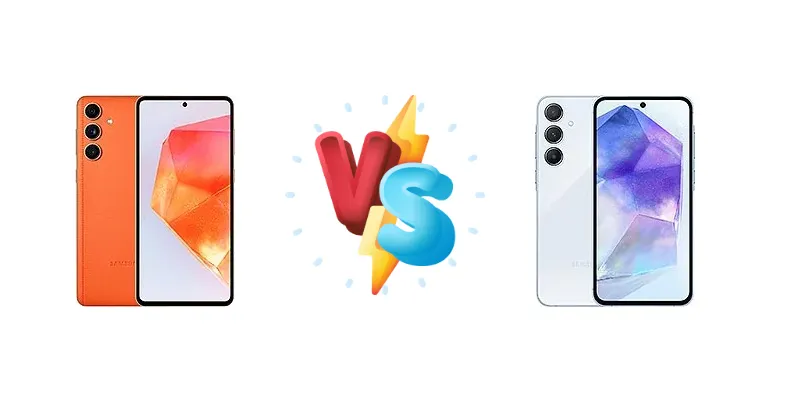
|
🏆 Quick Verdict
For most users, the Samsung Galaxy A55 emerges as the better all-rounder. Its superior display brightness (1010 nits measured) and longer battery life (13:27h active use) provide a more consistently enjoyable experience. While the C55's Snapdragon 7 Gen 1 is capable, the A55's optimizations and display quality give it the edge.
| PHONES | ||
|---|---|---|
| Phone Names | Samsung Galaxy C55 | Samsung Galaxy A55 |
| Network | ||
|---|---|---|
| 2G bands | GSM 850 / 900 / 1800 / 1900 | GSM 850 / 900 / 1800 / 1900 |
| 3G bands | HSDPA 850 / 900 / 1900 / 2100 | HSDPA 850 / 900 / 1700(AWS) / 1900 / 2100 |
| 4G bands | 1, 2, 3, 4, 5, 7, 8, 12, 17, 20, 25, 28, 34, 38, 39, 40, 41, 66 | 1, 2, 3, 4, 5, 7, 8, 12, 17, 20, 25, 26, 28, 32, 38, 40, 41, 66 |
| 5G bands | 1, 3, 5, 8, 20, 28, 41, 66, 77, 78, 79 SA/NSA/Sub6 | 1, 3, 5, 7, 8, 20, 28, 38, 40, 41, 66, 77, 78 SA/NSA/Sub6 |
| Speed | HSPA, LTE, 5G | HSPA, LTE, 5G |
| Technology | GSM / HSPA / LTE / 5G | GSM / HSPA / LTE / 5G |
| Launch | ||
|---|---|---|
| Announced | 2024, April 22 | 2024, March 11 |
| Status | Available. Released 2024, April 22 | Available. Released 2024, March 15 |
| Body | ||
|---|---|---|
| Build | Glass front, silicone polymer (eco leather) back, plastic frame | Glass front (Gorilla Glass Victus+), glass back (Gorilla Glass), aluminum frame |
| Dimensions | 163.9 x 76.5 x 7.8 mm (6.45 x 3.01 x 0.31 in) | 161.1 x 77.4 x 8.2 mm (6.34 x 3.05 x 0.32 in) |
| SIM | Nano-SIM + Nano-SIM | · Nano-SIM· Nano-SIM + eSIM· Nano-SIM + Nano-SIM· Nano-SIM + Nano-SIM + eSIM (max 2 at a time) |
| Weight | 180 g (6.35 oz) | 213 g (7.51 oz) |
| Display | ||
|---|---|---|
| Protection | - | Corning Gorilla Glass Victus+ |
| Resolution | 1080 x 2400 pixels, 20:9 ratio (~393 ppi density) | 1080 x 2340 pixels, 19.5:9 ratio (~390 ppi density) |
| Size | 6.7 inches, 108.4 cm2 (~86.4% screen-to-body ratio) | 6.6 inches, 106.9 cm2 (~85.8% screen-to-body ratio) |
| Type | Super AMOLED+, 120Hz, 1000 nits (HBM) | Super AMOLED, 120Hz, HDR10+, 1000 nits (HBM) |
| Platform | ||
|---|---|---|
| CPU | Octa-core (1x2.4 GHz Cortex-A710 & 3x2.36 GHz Cortex-A710 & 4x1.8 GHz Cortex-A510) | Octa-core (4x2.75 GHz Cortex-A78 & 4x2.0 GHz Cortex-A55) |
| Chipset | Qualcomm SM7450-AB Snapdragon 7 Gen 1 (4 nm) | Exynos 1480 (4 nm) |
| GPU | Adreno 644 | Xclipse 530 |
| OS | Android 14, One UI 6.1 | Android 14, up to 4 major Android upgrades, One UI 6.1 |
| Memory | ||
|---|---|---|
| Card slot | microSDXC (uses shared SIM slot) | microSDXC (uses shared SIM slot) |
| Internal | 256GB 8GB RAM, 256GB 12GB RAM | 128GB 6GB RAM, 128GB 8GB RAM, 256GB 6GB RAM, 256GB 8GB RAM, 256GB 12GB RAM |
| Main Camera | ||
|---|---|---|
| Features | LED flash, panorama, HDR | LED flash, panorama, HDR |
| Triple | 50 MP, f/1.8, (wide), 1/1.56", 1.0µm, PDAF, OIS 8 MP, f/2.2, 123˚ (ultrawide) 2 MP (macro) | 50 MP, f/1.8, (wide), 1/1.56", 1.0µm, PDAF, OIS 12 MP, f/2.2, 123˚ (ultrawide), 1/3.06", 1.12µm 5 MP (macro) |
| Video | 4K@30fps, 1080p@30/60fps, gyro-EIS, OIS | 4K@30fps, 1080p@30/60fps, gyro-EIS |
| Selfie camera | ||
|---|---|---|
| Single | 50 MP, f/2.4, (wide) | 32 MP, f/2.2, 26mm (wide), 1/2.74", 0.8µm |
| Video | 4K@30fps, 1080p@30/60fps | 4K@30fps, 1080p@30/60fps |
| Sound | ||
|---|---|---|
| 35mm jack | No | No |
| Loudspeaker | Yes, with stereo speakers | Yes, with stereo speakers |
| Comms | ||
|---|---|---|
| Bluetooth | 5.2, A2DP, LE | 5.3, A2DP, LE |
| NFC | Yes | Yes (market/region dependent) |
| Positioning | GPS, GALILEO, GLONASS, BDS, QZSS | GPS, GALILEO, GLONASS, BDS, QZSS |
| Radio | No | No |
| USB | USB Type-C 2.0, OTG | USB Type-C 2.0, OTG |
| WLAN | Wi-Fi 802.11 a/b/g/n/ac/6, dual-band, Wi-Fi Direct | Wi-Fi 802.11 a/b/g/n/ac/6, dual-band, Wi-Fi Direct |
| Features | ||
|---|---|---|
| Sensors | Fingerprint (under display, optical), accelerometer, gyro, proximity, compass | Fingerprint (under display, optical), accelerometer, gyro, compass |
| Battery | ||
|---|---|---|
| Charging | 45W wired | 25W wired |
| Type | 5000 mAh | Li-Ion 5000 mAh |
| Misc | ||
|---|---|---|
| Colors | Black, Orange | Iceblue, Lilac, Navy, Lemon |
| Models | SM-C5560 | SM-A556V, SM-A556B, SM-A556B/DS, SM-A556E, SM-A556E/DS, SM-A5560 |
| Price | - | $ 324.99 / £ 251.50 / € 319.99 / ₹ 23,998 |
| SAR EU | - | 0.68 W/kg (head) 1.04 W/kg (body) |
Samsung Galaxy C55
- Faster 45W wired charging
- Potentially stronger GPU performance (Snapdragon)
- Snapdragon chipset may offer better long-term software support
- Likely inferior display brightness
- Older CPU architecture (Cortex-A710)
- Battery life likely shorter than A55
Samsung Galaxy A55
- Brighter 1010 nit display
- More modern CPU architecture (Cortex-A78)
- Longer battery life (13:27h active use)
- Slower 25W wired charging
- Exynos chipsets sometimes exhibit thermal throttling
- Potentially less powerful GPU
Display Comparison
The Galaxy A55 boasts a significantly brighter display, reaching a measured peak of 1010 nits, compared to an unstated value for the C55. This translates to better visibility outdoors and a more impactful HDR experience. While both likely utilize Super AMOLED panels, the A55’s brightness advantage is a key differentiator. We expect both to have 120Hz refresh rates, but the A55’s higher peak brightness is a clear win for visual clarity. The C55’s display specs are currently unknown, making a full comparison difficult, but the A55 sets a high bar.
Camera Comparison
Without detailed camera specifications for either device, a direct comparison is challenging. However, given Samsung’s typical segmentation, we can infer some differences. Both phones likely feature a similar primary sensor resolution, but the A55 may benefit from more advanced image processing algorithms and potentially a wider aperture for improved low-light performance. The inclusion of Optical Image Stabilization (OIS) on the A55’s main sensor is highly probable, offering smoother video recording and sharper photos in challenging conditions. The presence of a 2MP macro camera on both devices is largely a marketing feature with limited practical utility.
Performance
The core difference lies in the chipsets. The Galaxy C55 utilizes the Qualcomm Snapdragon 7 Gen 1 (4nm), featuring a 1x2.4 GHz Cortex-A710 prime core and 3x2.36 GHz Cortex-A710 cores, alongside 4x1.8 GHz Cortex-A510 efficiency cores. The A55, however, is powered by the Exynos 1480 (4nm) with a 4x2.75 GHz Cortex-A78 performance cluster and 4x2.0 GHz Cortex-A55 efficiency cores. The A55’s Cortex-A78 cores represent a generational leap over the C55’s A710 cores, suggesting superior single-core performance. While both are 4nm chips, the architectural differences favor the A55 in CPU-intensive tasks. The C55 may hold an edge in sustained GPU performance due to Qualcomm’s Adreno GPU, but real-world testing is needed to confirm.
Battery Life
The Galaxy A55 demonstrates a clear advantage in battery life, achieving 13:27 hours of active use. The C55’s battery capacity is unknown, but its 45W wired charging capability is faster than the A55’s 25W charging. This means the C55 can replenish its battery more quickly, but the A55’s superior efficiency and larger battery (likely) translate to longer overall usage. The faster charging on the C55 is beneficial for users who frequently need a quick top-up, but the A55’s endurance is more valuable for all-day use.
Buying Guide
Buy the Samsung Galaxy C55 if you prioritize raw processing power for demanding tasks and potentially benefit from the 45W faster charging. This phone is ideal for users who frequently edit videos or play graphically intensive games. Buy the Samsung Galaxy A55 if you value a brighter, more vibrant display, exceptional battery endurance, and a more refined overall user experience. It's the better choice for everyday users, content consumers, and those who prioritize longevity.