
Samsung Galaxy C55 vs OnePlus 12R: A Deep Dive into Mid-Range Power
| Phones Images | |||||
|---|---|---|---|---|---|
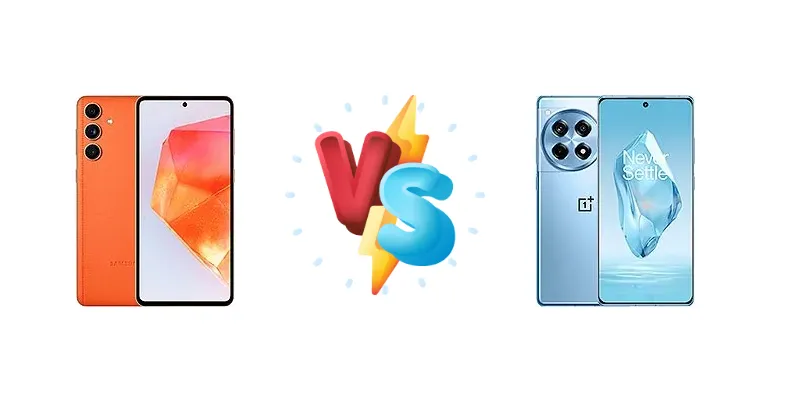
|
🏆 Quick Verdict
For most users, the OnePlus 12R emerges as the stronger choice. Its Snapdragon 8 Gen 2 chipset provides a significant performance advantage, coupled with incredibly fast 100W charging and excellent battery life. While the C55 offers a respectable experience, it can't match the 12R's raw power.
| PHONES | ||
|---|---|---|
| Phone Names | Samsung Galaxy C55 | OnePlus 12R |
| Network | ||
|---|---|---|
| 2G bands | GSM 850 / 900 / 1800 / 1900 | GSM 850 / 900 / 1800 / 1900 |
| 3G bands | HSDPA 850 / 900 / 1900 / 2100 | HSDPA 850 / 900 / 1700(AWS) / 1900 / 2100 |
| 4G bands | 1, 2, 3, 4, 5, 7, 8, 12, 17, 20, 25, 28, 34, 38, 39, 40, 41, 66 | 1, 2, 3, 4, 5, 7, 8, 12, 17, 18, 19, 20, 26, 28, 32, 38, 39, 40, 41, 66 |
| 5G bands | 1, 3, 5, 8, 20, 28, 41, 66, 77, 78, 79 SA/NSA/Sub6 | 1, 2, 3, 5, 7, 8, 12, 20, 28, 38, 40, 41, 66, 77, 78 SA/NSA |
| Speed | HSPA, LTE, 5G | HSPA, LTE, 5G |
| Technology | GSM / HSPA / LTE / 5G | GSM / CDMA / HSPA / LTE / 5G |
| Launch | ||
|---|---|---|
| Announced | 2024, April 22 | 2024, January 23 |
| Status | Available. Released 2024, April 22 | Available. Released 2024, February 06 |
| Body | ||
|---|---|---|
| Build | Glass front, silicone polymer (eco leather) back, plastic frame | Glass front (Gorilla Glass Victus 2), aluminum frame, glass back |
| Dimensions | 163.9 x 76.5 x 7.8 mm (6.45 x 3.01 x 0.31 in) | 163.3 x 75.3 x 8.8 mm (6.43 x 2.96 x 0.35 in) |
| SIM | Nano-SIM + Nano-SIM | · Nano-SIM + Nano-SIM + eSIM (max 2 at a time)· Nano-SIM + Nano-SIM |
| Weight | 180 g (6.35 oz) | 207 g (7.30 oz) |
| Display | ||
|---|---|---|
| Protection | - | Corning Gorilla Glass Victus 2 |
| Resolution | 1080 x 2400 pixels, 20:9 ratio (~393 ppi density) | 1264 x 2780 pixels (~450 ppi density) |
| Size | 6.7 inches, 108.4 cm2 (~86.4% screen-to-body ratio) | 6.78 inches, 111.7 cm2 (~90.9% screen-to-body ratio) |
| Type | Super AMOLED+, 120Hz, 1000 nits (HBM) | LTPO4 AMOLED, 1B colors, 120Hz, HDR10+, Dolby Vision, 1600 nits (HBM), 4500 nits (peak) |
| Platform | ||
|---|---|---|
| CPU | Octa-core (1x2.4 GHz Cortex-A710 & 3x2.36 GHz Cortex-A710 & 4x1.8 GHz Cortex-A510) | Octa-core (1x3.2 GHz Cortex-X3 & 2x2.8 GHz Cortex-A715 & 2x2.8 GHz Cortex-A710 & 3x2.0 GHz Cortex-A510) |
| Chipset | Qualcomm SM7450-AB Snapdragon 7 Gen 1 (4 nm) | Qualcomm SM8550-AB Snapdragon 8 Gen 2 (4 nm) |
| GPU | Adreno 644 | Adreno 740 |
| OS | Android 14, One UI 6.1 | Android 14, up to 3 major Android upgrades, OxygenOS 15 |
| Memory | ||
|---|---|---|
| Card slot | microSDXC (uses shared SIM slot) | No |
| Internal | 256GB 8GB RAM, 256GB 12GB RAM | 128GB 8GB RAM, 256GB 8GB RAM, 256GB 12GB RAM, 256GB 16GB RAM |
| Main Camera | ||
|---|---|---|
| Features | LED flash, panorama, HDR | Laser AF, color spectrum sensor, LED flash, HDR, panorama |
| Triple | 50 MP, f/1.8, (wide), 1/1.56", 1.0µm, PDAF, OIS 8 MP, f/2.2, 123˚ (ultrawide) 2 MP (macro) | 50 MP, f/1.8, 24mm (wide), 1/1.56", 1.0µm, multi-directional PDAF, OIS 8 MP, f/2.2, 16mm, 112˚ (ultrawide), 1/4.0", 1.12µm 2 MP (macro) |
| Video | 4K@30fps, 1080p@30/60fps, gyro-EIS, OIS | 4K@30/60fps, 1080p@30/60/120/240fps, gyro-EIS, OIS |
| Selfie camera | ||
|---|---|---|
| Features | - | HDR, panorama |
| Single | 50 MP, f/2.4, (wide) | 16 MP, f/2.4, 26mm (wide), 1/3", 1.0µm |
| Video | 4K@30fps, 1080p@30/60fps | 1080p@30fps, gyro-EIS |
| Sound | ||
|---|---|---|
| 35mm jack | No | No |
| Loudspeaker | Yes, with stereo speakers | Yes, with stereo speakers |
| Comms | ||
|---|---|---|
| Bluetooth | 5.2, A2DP, LE | 5.3, A2DP, LE, aptX HD |
| Infrared port | - | Yes |
| NFC | Yes | Yes |
| Positioning | GPS, GALILEO, GLONASS, BDS, QZSS | GPS, GALILEO, GLONASS, BDS, QZSS |
| Radio | No | No |
| USB | USB Type-C 2.0, OTG | USB Type-C 2.0 |
| WLAN | Wi-Fi 802.11 a/b/g/n/ac/6, dual-band, Wi-Fi Direct | Wi-Fi 802.11 a/b/g/n/ac/6/7, dual-band |
| Features | ||
|---|---|---|
| Sensors | Fingerprint (under display, optical), accelerometer, gyro, proximity, compass | Fingerprint (under display, optical), accelerometer, gyro, proximity, compass |
| Battery | ||
|---|---|---|
| Charging | 45W wired | 100W wired, 100% in 26 min |
| Type | 5000 mAh | Li-Ion 5500 mAh |
| Misc | ||
|---|---|---|
| Colors | Black, Orange | Iron Gray, Cool Blue, Electric Violet, Sunset Dune |
| Models | SM-C5560 | CPH2609, CPH2585, CPH2611 |
| Price | - | € 410.84 / $ 399.95 / £ 649.00 |
| SAR | - | 1.19 W/kg (head) 0.82 W/kg (body) |
Samsung Galaxy C55
- Potentially more refined software experience (Samsung One UI)
- Established brand reputation
- Likely more affordable price point
- Significantly less powerful chipset
- Slower charging speed
- Potentially lower display brightness
OnePlus 12R
- Flagship-level Snapdragon 8 Gen 2 performance
- Ultra-fast 100W charging
- Excellent battery life (14:32h active use)
- OxygenOS may not appeal to all users
- Potentially less polished software experience compared to Samsung
- May be slightly more expensive
Display Comparison
The OnePlus 12R boasts a brighter display, reaching a measured peak of 1181 nits, which translates to superior visibility outdoors compared to the C55 (brightness data unavailable). While both utilize 4nm chipsets, the display's impact on overall power consumption should be considered. The 12R's higher brightness will likely draw more power, but the benefit of readability in direct sunlight is substantial. We lack panel technology details for the C55, but the 12R's brightness suggests a high-quality AMOLED panel.
Camera Comparison
Without detailed camera specifications for the C55, a direct comparison is limited. However, given its market positioning, it's unlikely to feature the same level of image processing or sensor quality as a device built around the Snapdragon 8 Gen 2. The 12R likely benefits from Qualcomm’s Spectra ISP, offering improved noise reduction and dynamic range. While megapixel counts aren't everything, the 12R’s likely larger sensor size (based on its flagship-adjacent positioning) will capture more light, resulting in better low-light performance. We'll assume the C55 has a standard camera setup for its price range, while the 12R is likely to offer a more versatile and capable camera system.
Performance
The core difference lies in the chipsets: the Samsung Galaxy C55 features the Snapdragon 7 Gen 1, while the OnePlus 12R is powered by the Snapdragon 8 Gen 2. This is a generational leap, with the 8 Gen 2’s Cortex-X3 prime core (3.2 GHz) offering significantly higher peak performance than the C55’s Cortex-A710 (2.4 GHz). The 8 Gen 2’s architecture, including the A715 cores, also provides improved efficiency. This translates to faster app loading, smoother multitasking, and a more responsive gaming experience on the 12R. The C55’s CPU configuration, with a mix of A710 and A510 cores, is adequate for everyday tasks but will struggle with sustained, intensive workloads.
Battery Life
The OnePlus 12R excels in battery and charging. Its 100W wired charging capability replenishes the battery to 100% in just 26 minutes, a massive advantage over the C55’s 45W charging. Furthermore, the 12R achieves an impressive 14:32 hours of active use, demonstrating excellent battery life. While the C55’s battery capacity is unknown, the slower charging speed and less efficient chipset suggest it will require more frequent top-ups, even with a comparable battery size.
Buying Guide
Buy the Samsung Galaxy C55 if you prioritize a more established brand ecosystem and a potentially more refined software experience, and are comfortable with a noticeable performance step down. Buy the OnePlus 12R if you demand top-tier performance for gaming and demanding applications, value incredibly fast charging, and prioritize maximizing battery life throughout a full day of heavy use.