
Samsung Galaxy C55 vs Nothing Phone (2a) Plus: A Deep Dive into Mid-Range Contenders
| Phones Images | |||||
|---|---|---|---|---|---|
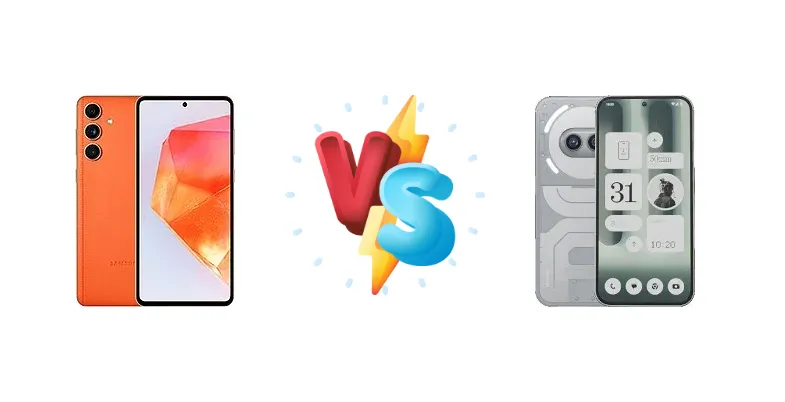
|
🏆 Quick Verdict
For the average user prioritizing sustained performance and a familiar ecosystem, the Nothing Phone (2a) Plus emerges as the stronger contender. Its Dimensity 7350 Pro chipset, coupled with a measured 1097 nits peak brightness, provides a smoother experience and better visibility, despite the Galaxy C55's slightly faster wired charging.
| PHONES | ||
|---|---|---|
| Phone Names | Samsung Galaxy C55 | Nothing Phone (2a) Plus |
| Network | ||
|---|---|---|
| 2G bands | GSM 850 / 900 / 1800 / 1900 | GSM 850 / 900 / 1800 / 1900 |
| 3G bands | HSDPA 850 / 900 / 1900 / 2100 | HSDPA 800 / 850 / 900 / 1700(AWS) / 1900 / 2100 |
| 4G bands | 1, 2, 3, 4, 5, 7, 8, 12, 17, 20, 25, 28, 34, 38, 39, 40, 41, 66 | 1, 3, 4, 5, 7, 8, 18, 19, 20, 26, 28, 38, 39, 40, 41, 42, 66 |
| 5G bands | 1, 3, 5, 8, 20, 28, 41, 66, 77, 78, 79 SA/NSA/Sub6 | 1, 3, 5, 7, 8, 20, 28, 38, 40, 41, 66, 77, 78 SA/NSA |
| Speed | HSPA, LTE, 5G | HSPA, LTE, 5G |
| Technology | GSM / HSPA / LTE / 5G | GSM / HSPA / LTE / 5G |
| Launch | ||
|---|---|---|
| Announced | 2024, April 22 | 2024, July 31 |
| Status | Available. Released 2024, April 22 | Available. Released 2024, August 03 |
| Body | ||
|---|---|---|
| Build | Glass front, silicone polymer (eco leather) back, plastic frame | Glass front (Gorilla Glass 5), plastic frame, plastic back |
| Dimensions | 163.9 x 76.5 x 7.8 mm (6.45 x 3.01 x 0.31 in) | 161.7 x 76.3 x 8.5 mm (6.37 x 3.00 x 0.33 in) |
| SIM | Nano-SIM + Nano-SIM | Nano-SIM + Nano-SIM |
| Weight | 180 g (6.35 oz) | 190 g (6.70 oz) |
| Display | ||
|---|---|---|
| Protection | - | Corning Gorilla Glass 5 |
| Resolution | 1080 x 2400 pixels, 20:9 ratio (~393 ppi density) | 1080 x 2412 pixels, 20:9 ratio (~395 ppi density) |
| Size | 6.7 inches, 108.4 cm2 (~86.4% screen-to-body ratio) | 6.7 inches, 107.5 cm2 (~87.1% screen-to-body ratio) |
| Type | Super AMOLED+, 120Hz, 1000 nits (HBM) | AMOLED, 1B colors, 120Hz, 2160Hz PWM, HDR10+, 700 nits (typ), 1100 nits (HBM), 1300 nits (peak) |
| Platform | ||
|---|---|---|
| CPU | Octa-core (1x2.4 GHz Cortex-A710 & 3x2.36 GHz Cortex-A710 & 4x1.8 GHz Cortex-A510) | Octa-core (2x3.0 GHz Cortex-A715 & 6x 2.0 GHz Cortex-A510) |
| Chipset | Qualcomm SM7450-AB Snapdragon 7 Gen 1 (4 nm) | Mediatek Dimensity 7350 Pro (4 nm) |
| GPU | Adreno 644 | Mali-G610 MC4 |
| OS | Android 14, One UI 6.1 | Android 14, up to 3 major Android upgrades, Nothing OS 3.0 |
| Memory | ||
|---|---|---|
| Card slot | microSDXC (uses shared SIM slot) | No |
| Internal | 256GB 8GB RAM, 256GB 12GB RAM | 256GB 8GB RAM, 256GB 12GB RAM |
| Main Camera | ||
|---|---|---|
| Dual | - | 50 MP, f/1.9, 24mm (wide), 1/1.57", 1.0µm, PDAF, OIS 50 MP, f/2.2, 114˚ (ultrawide), 1/2.76", 0.64µm |
| Features | LED flash, panorama, HDR | LED flash, panorama, HDR |
| Triple | 50 MP, f/1.8, (wide), 1/1.56", 1.0µm, PDAF, OIS 8 MP, f/2.2, 123˚ (ultrawide) 2 MP (macro) | - |
| Video | 4K@30fps, 1080p@30/60fps, gyro-EIS, OIS | 4K@30fps, 1080p@60/120fps, gyro-EIS |
| Selfie camera | ||
|---|---|---|
| Features | - | HDR |
| Single | 50 MP, f/2.4, (wide) | 50 MP, f/2.2, (wide), 1/2.76" |
| Video | 4K@30fps, 1080p@30/60fps | 4K@30fps |
| Sound | ||
|---|---|---|
| 35mm jack | No | No |
| Loudspeaker | Yes, with stereo speakers | Yes, with stereo speakers |
| Comms | ||
|---|---|---|
| Bluetooth | 5.2, A2DP, LE | 5.3, A2DP, LE |
| NFC | Yes | Yes, 360˚ |
| Positioning | GPS, GALILEO, GLONASS, BDS, QZSS | GPS, GALILEO, GLONASS, BDS, QZSS |
| Radio | No | No |
| USB | USB Type-C 2.0, OTG | USB Type-C 2.0, OTG |
| WLAN | Wi-Fi 802.11 a/b/g/n/ac/6, dual-band, Wi-Fi Direct | Wi-Fi 802.11 a/b/g/n/ac/6, dual-band, Wi-Fi Direct |
| Features | ||
|---|---|---|
| Sensors | Fingerprint (under display, optical), accelerometer, gyro, proximity, compass | Fingerprint (under display, optical), accelerometer, gyro, proximity, compass |
| Battery | ||
|---|---|---|
| Charging | 45W wired | 50W wired, 50% in 21 min, 100% in 56 min |
| Type | 5000 mAh | 5000 mAh |
| Misc | ||
|---|---|---|
| Colors | Black, Orange | Black, Grey |
| Models | SM-C5560 | A142P |
| Price | - | € 269.90 / ₹ 22,599 |
Samsung Galaxy C55
- Familiar Samsung One UI experience
- Potentially wider accessory availability
- 45W fast charging
- Unspecified display brightness
- Older Snapdragon 7 Gen 1 chipset
- Missing RAM specification
Nothing Phone (2a) Plus
- Brighter 1097 nits display
- More efficient Dimensity 7350 Pro chipset
- Excellent 16:34h battery life
- Unique design may not appeal to everyone
- Nothing OS may require adjustment for Samsung users
Display Comparison
The Nothing Phone (2a) Plus boasts a significant advantage in display brightness, achieving a measured 1097 nits. This translates to superior visibility under direct sunlight compared to the Galaxy C55, whose brightness remains unspecified. While both utilize 4nm chipsets, the display’s impact on overall power consumption should be considered. The Nothing Phone (2a) Plus’s higher brightness will likely draw more power, but the benefit of readability is substantial. Panel technology details (OLED vs LCD, refresh rate) are missing for the C55, but the 2a Plus’s display is a clear standout.
Camera Comparison
Without detailed camera specs beyond the main sensors, a direct comparison is limited. However, the focus should be on image processing. Samsung typically emphasizes vibrant, saturated colors, while Nothing aims for a more natural look. The absence of OIS information for either device is a concern, particularly for low-light photography. The 2MP macro cameras found on many phones in this price range are generally of limited utility, and should not be a deciding factor. The larger the main sensor (information missing for both), the better the potential for detail and dynamic range.
Performance
The core architecture differs significantly between the two devices. The Nothing Phone (2a) Plus utilizes a MediaTek Dimensity 7350 Pro with 2x 3.0 GHz Cortex-A715 cores and 6x 2.0 GHz Cortex-A510 cores, while the Galaxy C55 features the Qualcomm Snapdragon 7 Gen 1 with 1x 2.4 GHz Cortex-A710, 3x 2.36 GHz Cortex-A710, and 4x 1.8 GHz Cortex-A510 cores. The Dimensity 7350 Pro’s newer Cortex-A715 cores generally offer better single-core performance and efficiency. Both are built on a 4nm process, but the Dimensity’s core configuration suggests a potential edge in multi-threaded tasks and sustained performance. RAM specifications are missing for the C55, but assuming LPDDR5X on both, the CPU architecture is the key differentiator.
Battery Life
The Nothing Phone (2a) Plus demonstrates a clear advantage in battery endurance with an active use score of 16:34h. While the Galaxy C55’s battery capacity is unknown, the Nothing Phone (2a) Plus’s score is a strong indicator of real-world performance. Charging speeds are also different: the C55 supports 45W wired charging, while the 2a Plus offers 50W, reaching 50% in 21 minutes and 100% in 56 minutes. The faster charging on the Nothing Phone (2a) Plus mitigates any concerns about battery capacity, offering quicker top-ups.
Buying Guide
Buy the Samsung Galaxy C55 if you prioritize Samsung’s One UI software experience and a potentially wider availability of accessories. It’s a solid all-rounder for users deeply embedded in the Samsung ecosystem. Buy the Nothing Phone (2a) Plus if you value a cleaner Android experience, a brighter display for outdoor use, and potentially better long-term performance due to the Dimensity 7350 Pro’s more efficient core configuration.