
Samsung Galaxy C55 vs. Google Pixel 8a: A Deep Dive into Mid-Range Champions
| Phones Images | |||||
|---|---|---|---|---|---|
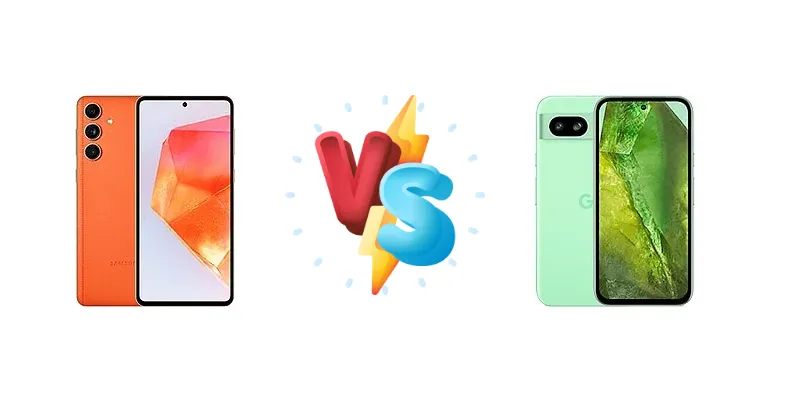
|
🏆 Quick Verdict
For the average user prioritizing a smooth, AI-enhanced experience and exceptional camera capabilities, the Google Pixel 8a emerges as the winner. However, users who demand maximum performance for gaming or demanding applications and value faster charging will find the Samsung Galaxy C55 a more suitable choice.
| PHONES | ||
|---|---|---|
| Phone Names | Samsung Galaxy C55 | Google Pixel 8a |
| Network | ||
|---|---|---|
| 2G bands | GSM 850 / 900 / 1800 / 1900 | GSM 850 / 900 / 1800 / 1900 |
| 3G bands | HSDPA 850 / 900 / 1900 / 2100 | HSDPA 800 / 850 / 900 / 1700(AWS) / 1900 / 2100 |
| 4G bands | 1, 2, 3, 4, 5, 7, 8, 12, 17, 20, 25, 28, 34, 38, 39, 40, 41, 66 | 1, 2, 3, 4, 5, 7, 8, 12, 17, 18, 19, 20, 26, 28, 32, 38, 40, 41, 42, 66 - G6GPR (International) |
| 5G bands | 1, 3, 5, 8, 20, 28, 41, 66, 77, 78, 79 SA/NSA/Sub6 | 1, 2, 3, 5, 7, 8, 12, 20, 26, 28, 38, 40, 41, 66, 75, 76, 77, 78 SA/NSA/Sub6 - G6GPR (International) |
| Speed | HSPA, LTE, 5G | HSPA, LTE, 5G |
| Technology | GSM / HSPA / LTE / 5G | GSM / HSPA / LTE / 5G |
| Launch | ||
|---|---|---|
| Announced | 2024, April 22 | 2024, May 07 |
| Status | Available. Released 2024, April 22 | Available. Released 2024, May 14 |
| Body | ||
|---|---|---|
| Build | Glass front, silicone polymer (eco leather) back, plastic frame | Glass front (Gorilla Glass 3), aluminum frame, plastic back |
| Dimensions | 163.9 x 76.5 x 7.8 mm (6.45 x 3.01 x 0.31 in) | 152.1 x 72.7 x 8.9 mm (5.99 x 2.86 x 0.35 in) |
| SIM | Nano-SIM + Nano-SIM | Nano-SIM + eSIM |
| Weight | 180 g (6.35 oz) | 188 g (6.63 oz) |
| Display | ||
|---|---|---|
| Protection | - | Corning Gorilla Glass 3, Mohs level 5 |
| Resolution | 1080 x 2400 pixels, 20:9 ratio (~393 ppi density) | 1080 x 2400 pixels, 20:9 ratio (~430 ppi density) |
| Size | 6.7 inches, 108.4 cm2 (~86.4% screen-to-body ratio) | 6.1 inches, 90.3 cm2 (~81.6% screen-to-body ratio) |
| Type | Super AMOLED+, 120Hz, 1000 nits (HBM) | OLED, HDR, 120Hz, 2000 nits (peak) |
| Platform | ||
|---|---|---|
| CPU | Octa-core (1x2.4 GHz Cortex-A710 & 3x2.36 GHz Cortex-A710 & 4x1.8 GHz Cortex-A510) | Nona-core (1x3.0 GHz Cortex-X3 & 4x2.45 GHz Cortex-A715 & 4x2.15 GHz Cortex-A510) |
| Chipset | Qualcomm SM7450-AB Snapdragon 7 Gen 1 (4 nm) | Google Tensor G3 (4 nm) |
| GPU | Adreno 644 | Immortalis-G715s MC10 |
| OS | Android 14, One UI 6.1 | Android 14, upgradable to Android 16, up to 7 major Android upgrades |
| Memory | ||
|---|---|---|
| Card slot | microSDXC (uses shared SIM slot) | No |
| Internal | 256GB 8GB RAM, 256GB 12GB RAM | 128GB 8GB RAM, 256GB 8GB RAM |
| Main Camera | ||
|---|---|---|
| Dual | - | 64 MP (16 MP eff.), f/1.9, 26mm (wide), 1/1.73", 0.8µm, dual pixel PDAF, OIS 13 MP, f/2.2, 120˚ (ultrawide), 1.12µm |
| Features | LED flash, panorama, HDR | Dual-LED flash, Pixel Shift, Ultra HDR, panorama, Best Take |
| Triple | 50 MP, f/1.8, (wide), 1/1.56", 1.0µm, PDAF, OIS 8 MP, f/2.2, 123˚ (ultrawide) 2 MP (macro) | - |
| Video | 4K@30fps, 1080p@30/60fps, gyro-EIS, OIS | 4K@30/60fps, 1080p@30/60/120/240fps, OIS |
| Selfie camera | ||
|---|---|---|
| Features | - | HDR, panorama |
| Single | 50 MP, f/2.4, (wide) | 13 MP, f/2.2, 20mm (ultrawide), 1.12µm |
| Video | 4K@30fps, 1080p@30/60fps | 4K@30fps, 1080p@30/60fps |
| Sound | ||
|---|---|---|
| 35mm jack | No | No |
| Loudspeaker | Yes, with stereo speakers | Yes, with stereo speakers |
| Comms | ||
|---|---|---|
| Bluetooth | 5.2, A2DP, LE | 5.3, A2DP, LE |
| NFC | Yes | Yes |
| Positioning | GPS, GALILEO, GLONASS, BDS, QZSS | GPS, GLONASS, GALILEO, BDS, QZSS, NavIC |
| Radio | No | No |
| USB | USB Type-C 2.0, OTG | USB Type-C 3.2 |
| WLAN | Wi-Fi 802.11 a/b/g/n/ac/6, dual-band, Wi-Fi Direct | Wi-Fi 802.11 a/b/g/n/ac/6e, dual/tri-band (market/region dependent) |
| Features | ||
|---|---|---|
| Sensors | Fingerprint (under display, optical), accelerometer, gyro, proximity, compass | Fingerprint (under display, optical), accelerometer, gyro, proximity, compass, barometer |
| Battery | ||
|---|---|---|
| Charging | 45W wired | 18W wired, PD3.0 7.5W wireless Bypass charging |
| Type | 5000 mAh | Li-Po 4492 mAh |
| Misc | ||
|---|---|---|
| Colors | Black, Orange | Obsidian, Porcelain, Bay, Aloe |
| Models | SM-C5560 | GKV4X, G6GPR, G8HHN, G576D |
| Price | - | $ 229.98 / C$ 417.99 / £ 279.00 / € 299.99 / ₹ 33,300 |
| EU LABEL | ||
|---|---|---|
| Battery | - | 40:06h endurance, 1000 cycles |
| Energy | - | Class B |
| Free fall | - | Class A (270 falls) |
| Repairability | - | Class B |
Samsung Galaxy C55
- Faster 45W wired charging
- Potentially better sustained gaming performance
- Snapdragon 7 Gen 1 offers strong CPU performance
- Likely inferior camera processing compared to Pixel 8a
- Battery endurance data unavailable, potentially lower than Pixel 8a
Google Pixel 8a
- Exceptional camera capabilities powered by Tensor G3
- Superior battery endurance and longevity
- AI-powered features and streamlined software experience
- Slower 18W charging
- Tensor G3 may not match Snapdragon 7 Gen 1 in raw gaming power
Display Comparison
The Pixel 8a boasts a significantly brighter display, reaching a measured peak of 1508 nits, making it far more usable in direct sunlight compared to the C55 (brightness data unavailable). While the C55’s panel technology isn’t specified, the Pixel 8a’s OLED panel delivers vibrant colors and deep blacks. The Pixel 8a’s display is likely to offer a superior viewing experience, especially for media consumption, due to its higher brightness and contrast. Bezels are expected to be comparable, given both phones target a similar price bracket.
Camera Comparison
The Pixel 8a is expected to excel in computational photography, leveraging the Tensor G3’s AI capabilities for features like Magic Eraser and Photo Unblur. While specific sensor details are missing for both phones, Google’s image processing pipeline is renowned for its dynamic range and accurate color reproduction. The C55’s camera performance will likely rely more on hardware capabilities, but without detailed sensor information, it’s difficult to assess its strengths. The Pixel 8a’s focus on software optimization gives it a significant advantage in image quality, particularly in challenging lighting conditions.
Performance
The core difference lies in the chipsets. The Google Pixel 8a’s Tensor G3, a nona-core processor with a Cortex-X3 prime core clocked at 3.0 GHz, is architecturally more advanced than the Samsung Galaxy C55’s Snapdragon 7 Gen 1. The Tensor G3’s focus on AI processing translates to faster image processing, improved voice recognition, and enhanced on-device machine learning. The Snapdragon 7 Gen 1, while still a capable performer with its octa-core configuration (1x2.4 GHz Cortex-A710 & 3x2.36 GHz Cortex-A710 & 4x1.8 GHz Cortex-A510), prioritizes sustained CPU and GPU performance. The Pixel 8a benefits from a more modern CPU architecture, but the C55 may hold an edge in graphically demanding tasks. Both are built on a 4nm process, suggesting comparable efficiency.
Battery Life
The Pixel 8a demonstrates superior battery endurance with a measured 40:06h endurance rating and 1000 cycle lifespan, indicating long-term battery health. Its active use score of 11:25h further highlights its efficiency. The Galaxy C55’s battery capacity is not specified, but it compensates with 45W wired charging, significantly faster than the Pixel 8a’s 18W charging with PD3.0 and 7.5W wireless charging. The C55 can top up quickly, while the Pixel 8a prioritizes longevity and efficient power management. The Pixel 8a also features bypass charging, which reduces battery degradation during overnight charging.
Buying Guide
Buy the Samsung Galaxy C55 if you need a phone optimized for sustained performance in mobile games and resource-intensive apps, and if 45W wired charging is a priority. Buy the Google Pixel 8a if you prefer a streamlined Android experience, exceptional computational photography, and long-term battery health thanks to its endurance rating and intelligent charging features.