
Samsung Galaxy C55 vs Google Pixel 7a: Which Mid-Range Champion Reigns Supreme?
| Phones Images | |||||
|---|---|---|---|---|---|
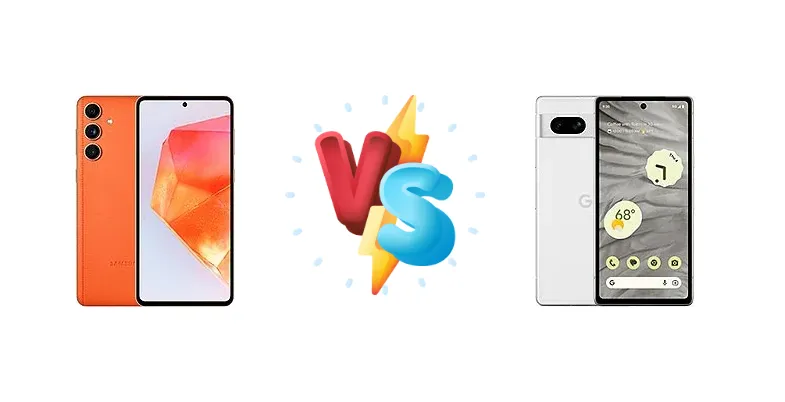
|
🏆 Quick Verdict
For the average user prioritizing camera quality and software experience, the Google Pixel 7a is the better choice. Its Tensor G2 chip, coupled with Google’s image processing algorithms, consistently delivers superior photos and videos. However, the Samsung Galaxy C55 offers significantly faster 45W charging, appealing to those who value convenience.
| PHONES | ||
|---|---|---|
| Phone Names | Samsung Galaxy C55 | Google Pixel 7a |
| Network | ||
|---|---|---|
| 2G bands | GSM 850 / 900 / 1800 / 1900 | GSM 850 / 900 / 1800 / 1900 |
| 3G bands | HSDPA 850 / 900 / 1900 / 2100 | HSDPA 800 / 850 / 900 / 1700(AWS) / 1900 / 2100 |
| 4G bands | 1, 2, 3, 4, 5, 7, 8, 12, 17, 20, 25, 28, 34, 38, 39, 40, 41, 66 | 1, 2, 3, 4, 5, 7, 8, 12, 13, 14, 17, 20, 25, 26, 28, 29, 30, 38, 40, 41, 48, 66, 71 - GWKK3, G0DZQ |
| 5G bands | 1, 3, 5, 8, 20, 28, 41, 66, 77, 78, 79 SA/NSA/Sub6 | 1, 2, 3, 5, 7, 8, 12, 14, 20, 25, 28, 30, 38, 41, 48, 66, 71, 77, 78 SA/NSA/Sub6 - GWKK3 |
| Speed | HSPA, LTE, 5G | HSPA, LTE, 5G |
| Technology | GSM / HSPA / LTE / 5G | GSM / HSPA / LTE / 5G |
| - | 1, 2, 3, 5, 7, 8, 12, 20, 25, 28, 38, 40, 41, 66, 75, 76, 77, 78, 79 SA/NSA/Sub6 - GHL1X, G82U8 | |
| Launch | ||
|---|---|---|
| Announced | 2024, April 22 | 2023, May 10 |
| Status | Available. Released 2024, April 22 | Available. Released 2023, May 10 |
| Body | ||
|---|---|---|
| Build | Glass front, silicone polymer (eco leather) back, plastic frame | Glass front (Gorilla Glass 3), aluminum frame, plastic back |
| Dimensions | 163.9 x 76.5 x 7.8 mm (6.45 x 3.01 x 0.31 in) | 152 x 72.9 x 9 mm (5.98 x 2.87 x 0.35 in) |
| SIM | Nano-SIM + Nano-SIM | Nano-SIM + eSIM |
| Weight | 180 g (6.35 oz) | 193.5 g (6.84 oz) |
| - | IP67 dust/water resistant (up to 1m for 30 min) | |
| Display | ||
|---|---|---|
| Protection | - | Corning Gorilla Glass 3 |
| Resolution | 1080 x 2400 pixels, 20:9 ratio (~393 ppi density) | 1080 x 2400 pixels, 20:9 ratio (~429 ppi density) |
| Size | 6.7 inches, 108.4 cm2 (~86.4% screen-to-body ratio) | 6.1 inches, 90.7 cm2 (~81.8% screen-to-body ratio) |
| Type | Super AMOLED+, 120Hz, 1000 nits (HBM) | OLED, HDR, 90Hz |
| - | Always-on display | |
| Platform | ||
|---|---|---|
| CPU | Octa-core (1x2.4 GHz Cortex-A710 & 3x2.36 GHz Cortex-A710 & 4x1.8 GHz Cortex-A510) | Octa-core (2x2.85 GHz Cortex-X1 & 2x2.35 GHz Cortex-A78 & 4x1.80 GHz Cortex-A55) |
| Chipset | Qualcomm SM7450-AB Snapdragon 7 Gen 1 (4 nm) | Google Tensor G2 (5 nm) |
| GPU | Adreno 644 | Mali-G710 MP7 |
| OS | Android 14, One UI 6.1 | Android 13, upgradable to Android 15, up to 5 major Android upgrades |
| Memory | ||
|---|---|---|
| Card slot | microSDXC (uses shared SIM slot) | No |
| Internal | 256GB 8GB RAM, 256GB 12GB RAM | 128GB 8GB RAM |
| - | UFS 3.1 | |
| Main Camera | ||
|---|---|---|
| Dual | - | 64 MP, f/1.9, 26mm (wide), 1/1.73", 0.8µm, dual pixel PDAF, OIS 13 MP, f/2.2, 120˚ (ultrawide), 1.12µm |
| Features | LED flash, panorama, HDR | Dual-LED flash, Pixel Shift, Auto-HDR, panorama |
| Triple | 50 MP, f/1.8, (wide), 1/1.56", 1.0µm, PDAF, OIS 8 MP, f/2.2, 123˚ (ultrawide) 2 MP (macro) | - |
| Video | 4K@30fps, 1080p@30/60fps, gyro-EIS, OIS | 4K@30/60fps, 1080p@30/60/120/240fps, OIS |
| Selfie camera | ||
|---|---|---|
| Features | - | HDR, panorama |
| Single | 50 MP, f/2.4, (wide) | 13 MP, f/2.2, 20mm (ultrawide), 1.12µm |
| Video | 4K@30fps, 1080p@30/60fps | 4K@30fps, 1080p@30fps |
| Sound | ||
|---|---|---|
| 3.5mm jack | - | No |
| 35mm jack | No | No |
| Loudspeaker | Yes, with stereo speakers | Yes, with stereo speakers |
| Comms | ||
|---|---|---|
| Bluetooth | 5.2, A2DP, LE | 5.3, A2DP, LE |
| NFC | Yes | Yes |
| Positioning | GPS, GALILEO, GLONASS, BDS, QZSS | GPS, GLONASS, GALILEO, BDS, QZSS, NavIC |
| Radio | No | No |
| USB | USB Type-C 2.0, OTG | USB Type-C 3.2 |
| WLAN | Wi-Fi 802.11 a/b/g/n/ac/6, dual-band, Wi-Fi Direct | Wi-Fi 802.11 a/b/g/n/ac/6e, tri-band |
| Features | ||
|---|---|---|
| Sensors | Fingerprint (under display, optical), accelerometer, gyro, proximity, compass | Fingerprint (under display, optical), accelerometer, gyro, proximity, compass, barometer |
| Battery | ||
|---|---|---|
| Charging | 45W wired | 18W wired, PD3.0 7.5W wireless |
| Type | 5000 mAh | Li-Po 4385 mAh |
| Misc | ||
|---|---|---|
| Colors | Black, Orange | Charcoal, Snow, Sea, Coral |
| Models | SM-C5560 | GWKK3, GHL1X, G0DZQ, G82U8 |
| Price | - | € 179.90 / $ 150.00 / £ 170.00 / ₹ 25,980 |
Samsung Galaxy C55
- 45W fast charging for quick top-ups
- Snapdragon 7 Gen 1 offers solid performance
- Potentially more affordable price point
- Camera likely inferior to Pixel 7a
- Software updates may be less frequent
Google Pixel 7a
- Superior camera quality and image processing
- Clean and intuitive software experience
- Guaranteed software updates from Google
- Slower 18W charging
- Potentially higher price
Display Comparison
The Pixel 7a boasts a measured peak brightness of 1070 nits, providing excellent visibility even in direct sunlight. While the Galaxy C55’s display specifications are not provided, Samsung typically employs vibrant AMOLED panels. The Pixel 7a’s display is likely to offer more accurate color reproduction, benefiting content creators. The absence of LTPO technology on either device suggests both will rely on adaptive refresh rate scaling rather than variable refresh rates for power efficiency.
Camera Comparison
The Pixel 7a’s camera system is a significant strength, leveraging Google’s computational photography prowess. While specific sensor details aren’t provided, the Pixel 7a excels in dynamic range and low-light performance. The Galaxy C55’s camera specifications are not detailed, but Samsung often prioritizes high megapixel counts. However, megapixel count isn’t everything; the Tensor G2’s image signal processor (ISP) and software algorithms are crucial to the Pixel 7a’s superior image quality. The Pixel 7a’s video capabilities are also likely to be more refined, offering better stabilization and dynamic range.
Performance
The Google Pixel 7a’s Tensor G2, fabricated on a 5nm process, offers a more complex CPU architecture with 2x Cortex-X1 cores clocked at 2.85 GHz, designed for peak performance. This contrasts with the Galaxy C55’s Snapdragon 7 Gen 1 (4nm), which utilizes 1x Cortex-A710 core at 2.4 GHz. While the Snapdragon 7 Gen 1 is efficient, the Tensor G2’s architecture is geared towards AI and machine learning tasks, enhancing features like voice recognition and image processing. The Pixel 7a’s CPU configuration suggests a performance advantage in demanding applications, though real-world differences may be subtle for typical usage. Both devices utilize 4x Cortex-A5xx cores for efficiency, but the Pixel 7a's A78 cores are a generation ahead of the C55's A510 cores.
Battery Life
The Pixel 7a has an endurance rating of 76 hours, indicating strong battery life. The Galaxy C55 compensates for a potentially smaller battery with its 45W wired charging, significantly faster than the Pixel 7a’s 18W charging with PD3.0. This means the C55 can replenish its battery much quicker, minimizing downtime. The Pixel 7a also supports 7.5W wireless charging, a feature absent on the C55, offering added convenience for users who prefer cable-free charging.
Buying Guide
Buy the Samsung Galaxy C55 if you need rapid charging capabilities and prioritize a smooth, responsive experience for everyday tasks and moderate gaming. It’s ideal for users who frequently find themselves needing to top up their battery quickly. Buy the Google Pixel 7a if you prefer a best-in-class camera experience, a clean and intuitive software interface with guaranteed updates, and don't mind slower charging speeds. It’s the perfect phone for photography enthusiasts and those invested in the Google ecosystem.