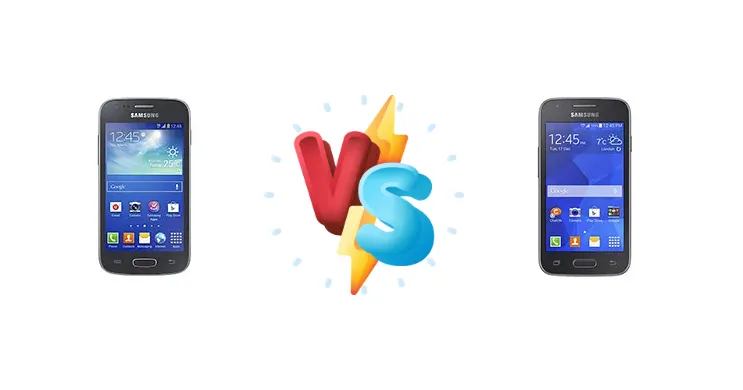
The Samsung Galaxy Ace series was once a staple in the budget smartphone market. Today, we're pitting two of its iterations against each other: the Ace 3 and the Ace 4 LTE. Which of these older devices still holds up, and which offers a slightly better experience?
🏆 Quick Verdict
The Galaxy Ace 4 LTE edges out the Ace 3 thanks to its slightly newer chipset and LTE connectivity. While both are budget options, the Ace 4 LTE provides a marginally faster experience and future-proofed network capabilities, making it the slightly better choice for most users.
| Network |
|---|
| 2G bands | GSM 850 / 900 / 1800 / 1900 - all versions | GSM 850 / 900 / 1800 / 1900 |
| 3G bands | HSDPA 900 / 2100 - S7270, S7272 | HSDPA 850 / 900 / 2100 |
| 4G bands | 3, 7, 8, 20 - S7275 | 3, 7, 8, 20 |
| Speed | HSPA 42.2(14.4 - 3G)/5.76 Mbps, LTE Cat4 150/50 Mbps | HSPA 42.2/5.76 Mbps, LTE Cat4 150/50 Mbps |
| Technology | GSM / HSPA / LTE | GSM / HSPA / LTE |
| | HSDPA 850 / 900 / 2100 - S7275 | - |
| Launch |
|---|
| Announced | 2013, June. Released 2013, July | 2014, June. Released 2014, August |
| Status | Discontinued | Discontinued |
| Body |
|---|
| Build | Glass front, plastic back, plastic frame | - |
| Dimensions | 121.2 x 62.7 x 9.8 mm (3G) / 121.2 x 62.7 x 10 mm (LTE) | 121.4 x 62.9 x 11 mm (4.78 x 2.48 x 0.43 in) |
| SIM | Single SIM (Micro-SIM) or Dual SIM (Micro-SIM, dual stand-by) | Micro-SIM |
| Weight | 115 g (3G) / 119.5 g (LTE) (4.06 oz) | 130.3 g (4.59 oz) |
| Display |
|---|
| Resolution | 480 x 800 pixels, 5:3 ratio (~233 ppi density) | 480 x 800 pixels, 5:3 ratio (~233 ppi density) |
| Size | 4.0 inches, 45.5 cm2 (~59.9% screen-to-body ratio) | 4.0 inches, 45.5 cm2 (~59.6% screen-to-body ratio) |
| Type | TFT | TFT |
| Platform |
|---|
| CPU | Dual-core 1.0 GHz Cortex-A9 (3G) / Dual-core 1.2 GHz Krait (LTE) | Dual-core 1.2 GHz |
| Chipset | Broadcom BCM21664 (3G) / Qualcomm MSM8930 Snapdragon 400 (28 nm) (LTE) | - |
| GPU | Broadcom VideoCore IV (3G) / Adreno 305 (LTE) | - |
| OS | Android 4.2 (Jelly Bean) | Android 4.4.2 (KitKat) |
| Memory |
|---|
| Card slot | microSDXC (dedicated slot) | microSDXC (dedicated slot) |
| Internal | 4GB 1GB RAM (3G), 8GB 1GB RAM (LTE) | 4GB 1GB RAM |
| | eMMC 4.5 | - |
| Main Camera |
|---|
| Features | LED flash, panorama | LED flash, panorama |
| Single | 5 MP, f/2.6, AF | 5 MP, AF |
| Video | 720p@30fps | 720p@30fps |
| Selfie camera |
|---|
| Single | VGA | VGA |
| Sound |
|---|
| 3.5mm jack | Yes | Yes |
| 35mm jack | Yes | Yes |
| Loudspeaker | Yes | Yes |
| Comms |
|---|
| Bluetooth | 4.0, A2DP | 4.0, A2DP |
| NFC | Yes (LTE model only) | Yes |
| Positioning | GPS, GLONASS | GPS, GLONASS |
| Radio | Stereo FM radio, RDS | FM radio |
| USB | microUSB 2.0 | microUSB 2.0 |
| WLAN | Wi-Fi 802.11 b/g/n, Wi-Fi Direct, hotspot | Wi-Fi 802.11 b/g/n, Wi-Fi Direct, hotspot |
| Features |
|---|
| Sensors | Accelerometer, proximity, compass | Accelerometer |
| Battery |
|---|
| Music play | - | Up to 46 h |
| Stand-by | Up to 370 h (3G) | - |
| Talk time | Up to 8 h (3G) | Up to 9 h (3G) |
| Type | Li-Ion 1800/1500 mAh, removable | Li-Ion 1800 mAh, removable |
| Misc |
|---|
| Colors | Black, White, Dark Red | Iris Charcoal, Classic White |
| Models | GT-S7272, GT-S7275, GT-S7275R, GT-S720, GT-S7270, GT-S7278, GT-S7270L | SM-G313F, SM-G313MU, SM-G313HY |
| Price | About 130 EUR | About 250 EUR |
| SAR | 0.67 W/kg (head) 0.45 W/kg (body) | 1.16 W/kg (head) 1.22 W/kg (body) |
| SAR EU | 0.47 W/kg (head) 0.35 W/kg (body) | 0.87 W/kg (head) 0.39 W/kg (body) |
| Tests |
|---|
| Battery life |
Endurance rating 34h
| - |
| Camera |
Photo / Video | - |
| Display |
Contrast ratio: 879:1 (nominal) / 1.622:1 (sunlight) | - |
| Loudspeaker |
Voice 66dB / Noise 62dB / Ring 66dB
| - |
Samsung Galaxy Ace 3
- Impressive battery life (34h endurance)
- Good sunlight display contrast
- Compact and lightweight
- Older chipset
- Limited camera features
- No LTE connectivity
Samsung Galaxy Ace 4 LTE G313
- Slightly faster processor (Krait)
- LTE connectivity
- Potentially better image processing
- Limited camera features
- Display details less available
- Older technology overall
Display Comparison
Both phones feature similar display technology, likely LCD panels. The Ace 3 boasts a contrast ratio of 879:1 (nominal) and an impressive 1.622:1 in sunlight, suggesting good outdoor visibility. The Ace 4 LTE's display details are less readily available, but it's likely comparable. Expect decent, but not exceptional, color accuracy and brightness from either device.
Camera Comparison
Camera specifications are limited in the provided data. Both phones feature Photo/Video capabilities. Given their age and budget positioning, expect basic camera performance with limited features and image quality, particularly in low-light conditions. The Ace 4 LTE *might* have slightly improved image processing due to its newer chipset.
Performance
The Ace 4 LTE has a slight advantage with its 1.2 GHz Dual-core Krait CPU, compared to the Ace 3's 1.0 GHz Dual-core Cortex-A9. While both are dual-core processors, the Krait architecture in the Ace 4 LTE generally offers better performance. Expect smoother multitasking and app loading on the Ace 4 LTE, though neither phone is a powerhouse.
Battery Life
The Ace 3 claims an endurance rating of 34 hours, which is quite impressive for its time. The Ace 4 LTE's battery capacity is likely similar, but the slightly more efficient chipset could result in marginally better real-world battery life. Both should provide a full day of moderate use.
Buying Guide
The Samsung Galaxy Ace 3 is a viable option for users needing a basic smartphone for calls, texts, and light browsing, especially if found at a very low price. The Ace 4 LTE is better suited for those who want a slightly faster experience and the ability to connect to 4G LTE networks, offering a bit more longevity.
Frequently Asked Questions
❓ Are these phones still worth buying in 2024?
Given their age, these phones are best suited for users with very limited budgets or those needing a basic device for essential tasks. Newer smartphones offer significantly better performance, features, and security.
❓ Which phone has better 4G support?
The Samsung Galaxy Ace 4 LTE, as the name suggests, supports 4G LTE networks. The Ace 3 is limited to 3G connectivity.