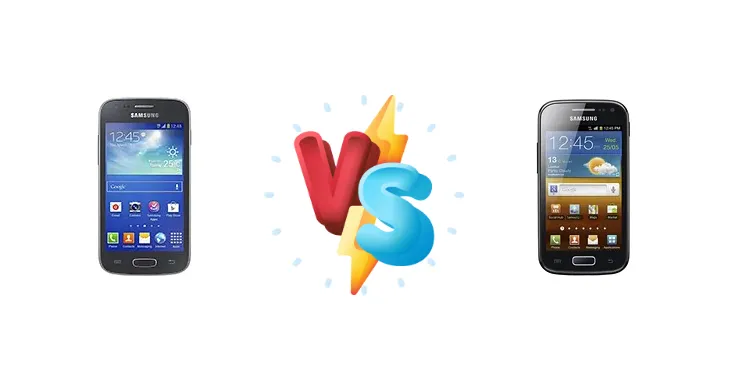
The Samsung Galaxy Ace series offered affordable Android options for years. Today, we're pitting two of them against each other: the Ace 3 and the Ace 2 I8160. Which one holds up best in 2024, considering their age and original specifications?
🏆 Quick Verdict
The Galaxy Ace 3 generally edges out the Ace 2 thanks to its Snapdragon 400 chipset (in LTE versions) offering better performance and a slightly improved display contrast. However, both are aging devices, and modern alternatives are readily available for a similar price.
| Network |
|---|
| 2G bands | GSM 850 / 900 / 1800 / 1900 - all versions | GSM 850 / 900 / 1800 / 1900 |
| 3G bands | HSDPA 900 / 2100 - S7270, S7272 | HSDPA 900 / 2100 |
| 4G bands | 3, 7, 8, 20 - S7275 | - |
| Speed | HSPA 42.2(14.4 - 3G)/5.76 Mbps, LTE Cat4 150/50 Mbps | HSPA 14.4/5.76 Mbps |
| Technology | GSM / HSPA / LTE | GSM / HSPA |
| | HSDPA 850 / 900 / 2100 - S7275 | - |
| Launch |
|---|
| Announced | 2013, June. Released 2013, July | 2012, February. Released 2012, May |
| Status | Discontinued | Discontinued |
| Body |
|---|
| Build | Glass front, plastic back, plastic frame | - |
| Dimensions | 121.2 x 62.7 x 9.8 mm (3G) / 121.2 x 62.7 x 10 mm (LTE) | 118.3 x 62.2 x 10.5 mm (4.66 x 2.45 x 0.41 in) |
| SIM | Single SIM (Micro-SIM) or Dual SIM (Micro-SIM, dual stand-by) | Mini-SIM |
| Weight | 115 g (3G) / 119.5 g (LTE) (4.06 oz) | 122 g (4.30 oz) |
| Display |
|---|
| Resolution | 480 x 800 pixels, 5:3 ratio (~233 ppi density) | 480 x 800 pixels, 5:3 ratio (~246 ppi density) |
| Size | 4.0 inches, 45.5 cm2 (~59.9% screen-to-body ratio) | 3.8 inches, 41.1 cm2 (~55.9% screen-to-body ratio) |
| Type | TFT | PLS LCD |
| Platform |
|---|
| CPU | Dual-core 1.0 GHz Cortex-A9 (3G) / Dual-core 1.2 GHz Krait (LTE) | Dual-core 800 MHz |
| Chipset | Broadcom BCM21664 (3G) / Qualcomm MSM8930 Snapdragon 400 (28 nm) (LTE) | NovaThor U8500 |
| GPU | Broadcom VideoCore IV (3G) / Adreno 305 (LTE) | Mali-400 |
| OS | Android 4.2 (Jelly Bean) | Android 2.3 (Gingerbread), upgradable to 4.1.2 (Jelly Bean), TouchWiz UI 4 |
| Memory |
|---|
| Card slot | microSDXC (dedicated slot) | microSDHC (dedicated slot) |
| Internal | 4GB 1GB RAM (3G), 8GB 1GB RAM (LTE) | 4GB 768MB RAM |
| | eMMC 4.5 | - |
| Main Camera |
|---|
| Features | LED flash, panorama | LED flash |
| Single | 5 MP, f/2.6, AF | 5 MP, f/2.7, AF |
| Video | 720p@30fps | 720p@30fps |
| Selfie camera |
|---|
| Single | VGA | VGA |
| Sound |
|---|
| 3.5mm jack | Yes | Yes |
| 35mm jack | Yes | Yes |
| Loudspeaker | Yes | Yes |
| Comms |
|---|
| Bluetooth | 4.0, A2DP | 3.0, A2DP |
| NFC | Yes (LTE model only) | Optional |
| Positioning | GPS, GLONASS | GPS, A-GPS, GLONASS |
| Radio | Stereo FM radio, RDS | Stereo FM radio, RDS |
| USB | microUSB 2.0 | microUSB 2.0 |
| WLAN | Wi-Fi 802.11 b/g/n, Wi-Fi Direct, hotspot | Wi-Fi 802.11 b/g/n, Wi-Fi Direct, DLNA, hotspot |
| Features |
|---|
| Sensors | Accelerometer, proximity, compass | Accelerometer, proximity, compass |
| Battery |
|---|
| Stand-by | Up to 370 h (3G) | Up to 670 h (2G) / Up to 640 h (3G) |
| Talk time | Up to 8 h (3G) | Up to 16 h 20 min (2G) / Up to 7 h 30 min (3G) |
| Type | Li-Ion 1800/1500 mAh, removable | Removable Li-Ion 1500 mAh battery |
| Misc |
|---|
| Colors | Black, White, Dark Red | Black, White, La Fleur |
| Models | GT-S7272, GT-S7275, GT-S7275R, GT-S720, GT-S7270, GT-S7278, GT-S7270L | GT-I8160, GT-I8160P |
| Price | About 130 EUR | About 130 EUR |
| SAR | 0.67 W/kg (head) 0.45 W/kg (body) | 0.52 W/kg (head) 0.76 W/kg (body) |
| SAR EU | 0.47 W/kg (head) 0.35 W/kg (body) | 0.50 W/kg (head) |
| Tests |
|---|
| Audio quality | - |
Noise -88.7dB / Crosstalk -88.9dB |
| Battery life |
Endurance rating 34h
| - |
| Camera |
Photo / Video |
Photo / Video |
| Display |
Contrast ratio: 879:1 (nominal) / 1.622:1 (sunlight) |
Contrast ratio: 843 (nominal) / 1.566:1 (sunlight) |
| Loudspeaker |
Voice 66dB / Noise 62dB / Ring 66dB
|
Voice 66dB / Noise 66dB / Ring 75dB |
Samsung Galaxy Ace 3
- Slightly better performance (LTE version)
- Better display contrast
- Potentially longer battery life
- More modern chipset (Snapdragon 400)
- Aging device
- Limited camera capabilities
- Potential battery degradation
Samsung Galaxy Ace 2 I8160
- More affordable (potentially)
- Compact size
- Simple Android experience
- Slower performance
- Lower display contrast
- Likely shorter battery life
- Older chipset
Display Comparison
Both phones feature similar display technology, likely Super AMOLED. The Ace 3 boasts a slightly better contrast ratio (879:1 nominal / 1.622:1 sunlight vs. 843:1 nominal / 1.566:1 sunlight), suggesting slightly better outdoor visibility and deeper blacks. However, the difference is marginal and likely not noticeable in everyday use.
Camera Comparison
Camera specifications are not detailed, but both phones likely offer standard photo and video capabilities for their time. Image quality will be limited by the sensors and processing power. Expect decent results in good lighting conditions, but struggles in low light. The Ace 3's slightly more powerful processor *might* result in marginally better image processing.
Performance
This is where the Ace 3 pulls ahead, particularly the LTE variant. The Snapdragon 400 chipset and 1.2 GHz Krait CPU offer a noticeable performance boost over the Ace 2's NovaThor U8500 and 800 MHz dual-core processor. Expect smoother multitasking and faster app loading on the Ace 3.
Battery Life
The Ace 3 claims an endurance rating of 34 hours, which is impressive for its age. The Ace 2's battery life is not explicitly stated, but given its less efficient chipset, it's likely to be shorter. Battery health will be a significant factor for both devices due to their age.
Buying Guide
The Samsung Galaxy Ace 3 is a reasonable choice for users needing a basic smartphone with slightly better performance and a brighter display. The Ace 2 I8160 might appeal to those seeking an even more budget-friendly option, but be prepared for slower performance and a less vibrant screen. Consider newer, more powerful budget phones before committing to either.
Frequently Asked Questions
❓ Are these phones still worth buying in 2024?
Generally, no. While they're affordable, newer budget smartphones offer significantly better performance, cameras, and features. Consider them only if you need a very basic phone and find them at a very low price.
❓ What Android version do these phones run?
Both phones originally shipped with Android 4.1.2 (Jelly Bean). While custom ROMs might exist, official updates are highly unlikely.