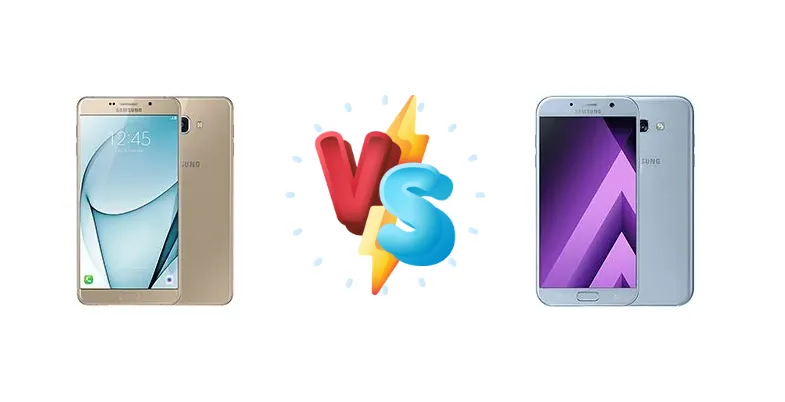
The Samsung Galaxy A series aimed to bridge the gap between budget and flagship devices. The A9 Pro (2016) and A7 (2017) were popular choices, but which one holds up better today? Let's dive into a comprehensive comparison to help you decide.
🏆 Quick Verdict
The Galaxy A7 (2017) edges out the A9 Pro (2016) thanks to its more efficient chipset, slightly better camera performance, and exceptional battery life. While the A9 Pro boasts a larger screen, the A7's overall package is more compelling for most users.
| Network |
|---|
| 2G bands | GSM 850 / 900 / 1800 / 1900 - SIM 1 & SIM 2 (dual-SIM model only) | GSM 850 / 900 / 1800 / 1900 - SIM 1 & SIM 2 (dual-SIM model only) |
| 3G bands | HSDPA 850 / 900 / 1900 / 2100 | HSDPA 850 / 900 / 1700(AWS) / 1900 / 2100 |
| 4G bands | 1, 3, 5, 7, 8, 40 | 1, 2, 3, 4, 5, 7, 8, 17, 20, 28, 38, 40, 41 |
| Speed | HSPA 42.2/5.76 Mbps, LTE (3CA) Cat6 300/50 Mbps | HSPA 42.2/5.76 Mbps, LTE (2CA) Cat6 300/50 Mbps |
| Technology | GSM / HSPA / LTE | GSM / HSPA / LTE |
| | 1, 2, 3, 4, 5, 7, 8, 17, 28, 38, 40 -A910F/DS | - |
| Launch |
|---|
| Announced | 2016, March. Released 2016, May | 2017, January. Released 2017, January |
| Status | Discontinued | Discontinued |
| Body |
|---|
| Build | Glass front (Gorilla Glass 4), glass back (Gorilla Glass 4), aluminum frame | Glass front (Gorilla Glass 4), glass back, aluminum frame |
| Dimensions | 161.7 x 80.9 x 7.9 mm (6.37 x 3.19 x 0.31 in) | 156.8 x 77.6 x 7.9 mm (6.17 x 3.06 x 0.31 in) |
| SIM | · Nano-SIM· Nano-SIM + Nano-SIM | · Nano-SIM· Nano-SIM + Nano-SIM |
| Weight | 210 g (7.41 oz) | 186 g (6.56 oz) |
| | - | IP68 dust/water resistant (up to 1.5m for 30 mins) |
| Display |
|---|
| Protection | Corning Gorilla Glass 4 | Corning Gorilla Glass 4 |
| Resolution | 1080 x 1920 pixels, 16:9 ratio (~367 ppi density) | 1080 x 1920 pixels, 16:9 ratio (~386 ppi density) |
| Size | 6.0 inches, 99.2 cm2 (~75.9% screen-to-body ratio) | 5.7 inches, 89.6 cm2 (~73.6% screen-to-body ratio) |
| Type | Super AMOLED | Super AMOLED |
| | - | Always-on display |
| Platform |
|---|
| CPU | Octa-core (4x1.8 GHz Cortex-A72 & 4x1.4 GHz Cortex-A53) | Octa-core 1.9 GHz Cortex-A53 |
| Chipset | Qualcomm MSM8976 Snapdragon 652 (28 nm) | Exynos 7880 (14 nm) |
| GPU | Adreno 510 | Mali-T830MP3 |
| OS | Android 6.0.1 (Marshmallow), upgradable to Android 8.0 (Oreo), Experience UI 9 | Android 6.0.1 (Marshmallow), upgradable to Android 8.0 (Oreo) |
| Memory |
|---|
| Card slot | microSDXC (dedicated slot) | microSDXC (dedicated slot) |
| Internal | 32GB 4GB RAM | 64GB 3GB RAM, 32GB 3GB RAM |
| | eMMC 5.1 | eMMC 5.1 |
| Main Camera |
|---|
| Features | LED flash, panorama, HDR | LED flash, panorama, HDR |
| Single | 16 MP, f/1.9, 1/2.8", AF, OIS | 16 MP, f/1.9, 27mm (wide), AF |
| Video | 1080p@30fps | 1080p@30fps |
| Selfie camera |
|---|
| Single | 8 MP, f/1.9 | 16 MP, f/1.9, 26mm (wide), 1/3.06", 1.0µm |
| Video | 1080p@30fps | 1080p@30fps |
| Sound |
|---|
| 3.5mm jack | Yes | Yes |
| 35mm jack | Yes | Yes |
| Loudspeaker | Yes | Yes |
| Comms |
|---|
| Bluetooth | 4.2, A2DP, EDR, LE | 4.2, A2DP, EDR, LE |
| NFC | Yes | Yes |
| Positioning | GPS, GLONASS/ BDS (market dependant) | GPS, GLONASS, BDS |
| Radio | FM radio, RDS, recording | FM radio |
| USB | microUSB 2.0 | USB Type-C 2.0 |
| WLAN | Wi-Fi 802.11 a/b/g/n/ac, dual-band, Wi-Fi Direct | Wi-Fi 802.11 a/b/g/n/ac, dual-band, Wi-Fi Direct |
| Features |
|---|
| Sensors | Fingerprint (front-mounted), accelerometer, proximity, compass | Fingerprint (front-mounted), accelerometer, gyro, proximity, compass, barometer |
| | ANT+
Samsung Pay (Visa, MasterCard certified) | ANT+
Samsung Pay |
| Battery |
|---|
| Charging | 18W wired | 18W wired |
| Music play | Up to 109 h | Up to 59 h |
| Talk time | Up to 33 h (3G) | Up to 23 h (3G) |
| Type | Li-Ion 5000 mAh, non-removable | Li-Ion 3600 mAh, non-removable |
| Misc |
|---|
| Colors | White, Black, Gold | Black Sky, Gold Sand, Blue Mist and Peach Cloud |
| Models | SM-A9100, SM-A910F, SM-A910F | SM-A720F, SM-A720S |
| Price | About 300 EUR | About 280 EUR |
| SAR | - | 1.00 W/kg (head) 0.71 W/kg (body) |
| SAR EU | 0.62 W/kg (head) 1.32 W/kg (body) | 0.21 W/kg (head) 1.33 W/kg (body) |
| Tests |
|---|
| Audio quality | - |
Noise-91.9dB / Crosstalk -90.3dB |
| Battery life | - | Endurance rating 115h |
| Camera | - |
Photo / Video |
| Display | - |
Contrast ratio: Infinite (nominal), 4.124(sunlight) |
| Loudspeaker | - |
Voice 66dB / Noise 66dB / Ring 81dB |
| Performance | - |
GFXBench: 5.2fps (ES 3.1 onscreen) |
Samsung Galaxy A9 Pro (2016)
- Larger 6.0-inch display
- Decent performance for everyday tasks
- Expandable storage (microSD card slot)
- Older chipset (Snapdragon 652)
- Shorter battery life
- Less efficient processor
Samsung Galaxy A7 (2017)
- Better performance (Exynos 7880)
- Exceptional battery life (115h endurance)
- Slightly better camera quality
- More modern design
- Smaller display compared to A9 Pro
- No significant upgrade in camera resolution
Display Comparison
Both phones feature Super AMOLED displays, known for vibrant colors and deep blacks. The A9 Pro (2016) has a larger 6.0-inch screen compared to the A7 (2017)'s 5.5-inch display. While both have excellent contrast ratios (reported as 'Infinite' and 4.124 in sunlight), the A7's slightly smaller size might make it more comfortable to hold and use one-handed.
Camera Comparison
Both phones offer decent camera capabilities. The A7 (2017) generally produces slightly better image quality, particularly in low-light conditions, thanks to its more modern image processing. Both have Photo/Video capabilities, but the A7's image processing is superior.
Performance
The A9 Pro (2016) utilizes a Qualcomm Snapdragon 652, while the A7 (2017) is powered by an Exynos 7880. The Exynos 7880 generally offers better performance and efficiency, resulting in smoother multitasking and app loading. The A9 Pro's Snapdragon 652 is still capable, but the A7 has a noticeable edge in responsiveness.
Battery Life
The Galaxy A7 (2017) shines in this category. It boasts an impressive endurance rating of 115 hours, significantly outperforming the A9 Pro (2016). This translates to significantly longer battery life on a single charge.
Buying Guide
Who should buy the Samsung Galaxy A9 Pro (2016)? Users prioritizing a larger display for media consumption and gaming might find it appealing. Who should buy the Samsung Galaxy A7 (2017)? Those seeking long battery life, a more modern chipset, and a generally smoother user experience will prefer the A7.
Frequently Asked Questions
❓ Is the Galaxy A9 Pro (2016) still worth buying?
It can be a budget option if you prioritize a large screen, but the A7 (2017) offers a better overall experience.
❓ Which phone has better software support?
The Galaxy A7 (2017) likely received more software updates due to being newer.