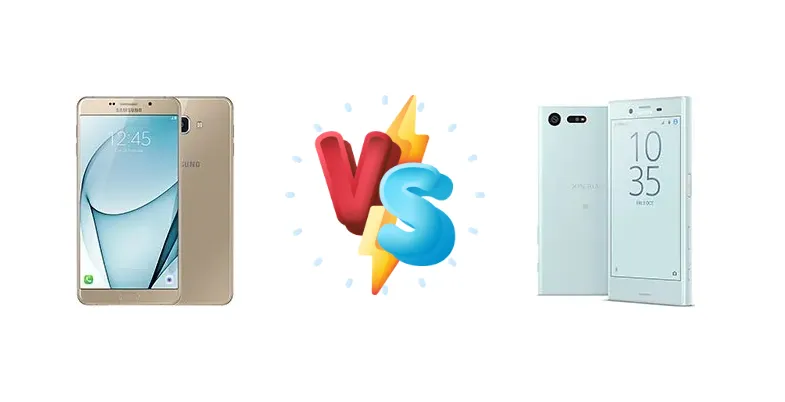
The Samsung Galaxy A9 (2016) and Sony Xperia X Compact were both solid mid-range contenders. The A9 boasted a massive screen and battery, while the X Compact offered a more compact design and Sony's renowned camera expertise. Let's dive into a detailed comparison to see which phone ultimately reigns supreme.
🏆 Quick Verdict
The Samsung Galaxy A9 (2016) edges out the Xperia X Compact thanks to its significantly longer battery life and larger display. However, the X Compact’s more compact size, potentially better camera processing, and Quick Charge 3.0 make it a compelling alternative for users prioritizing portability and faster charging.
| Network |
|---|
| 2G bands | GSM 850 / 900 / 1800 / 1900 - SIM 1 & SIM 2 (dual-SIM model only) | GSM 850 / 900 / 1800 / 1900 |
| 3G bands | HSDPA 850 / 900 / 1900 / 2100 | HSDPA 800 / 850 / 900 / 1700(AWS) / 1900 / 2100 - F5321 |
| 4G bands | 1, 3, 5, 7, 8, 38, 39, 40, 41 | 1, 2, 3, 4, 5, 7, 8, 12, 17, 19, 20, 26, 28, 38, 39, 40, 41 - F5321 |
| Speed | HSPA 42.2/5.76 Mbps, LTE Cat4 150/50 Mbps | HSPA 42.2/5.76 Mbps, LTE Cat6 300/50 Mbps |
| Technology | GSM / HSPA / LTE | GSM / HSPA / LTE |
| Launch |
|---|
| Announced | 2015, December. Released 2016, January | 2016, September 01. Released 2016, September 08 |
| Status | Discontinued | Discontinued |
| Body |
|---|
| Build | Glass front (Gorilla Glass 4), glass back (Gorilla Glass 4), aluminum frame | Glass front (Gorilla Glass 4), plastic back, plastic frame |
| Dimensions | 161.7 x 80.9 x 7.4 mm (6.37 x 3.19 x 0.29 in) | 129 x 65 x 9.5 mm (5.08 x 2.56 x 0.37 in) |
| SIM | · Nano-SIM· Nano-SIM + Nano-SIM | Nano-SIM |
| Weight | 200 g (7.05 oz) | 135 g (4.76 oz) |
| Display |
|---|
| Protection | Corning Gorilla Glass 4 | Corning Gorilla Glass 4 |
| Resolution | 1080 x 1920 pixels, 16:9 ratio (~367 ppi density) | 720 x 1280 pixels, 16:9 ratio (~319 ppi density) |
| Size | 6.0 inches, 99.2 cm2 (~75.9% screen-to-body ratio) | 4.6 inches, 58.3 cm2 (~69.6% screen-to-body ratio) |
| Type | Super AMOLED | IPS LCD |
| | - | Triluminos display
X-Reality Engine |
| Platform |
|---|
| CPU | Octa-core (4x1.8 GHz Cortex-A72 & 4x1.4 GHz Cortex-A53) | Hexa-core (4x1.4 GHz Cortex-A53 & 2x1.8 GHz Cortex-A72) |
| Chipset | Qualcomm MSM8976 Snapdragon 652 (28 nm) | Qualcomm MSM8956 Snapdragon 650 |
| GPU | Adreno 510 | Adreno 510 |
| OS | Android 5.1.1 (Lollipop), upgradable to 6.0.1 (Marshmallow) | Android 6.0.1 (Marshmallow), upgradable to Android 8.0 (Oreo) |
| Memory |
|---|
| Card slot | microSDXC (dedicated slot) | microSDXC (dedicated slot) |
| Internal | 32GB 3GB RAM | 32GB 3GB RAM |
| | eMMC 5.1 | eMMC 4.5 |
| Main Camera |
|---|
| Features | LED flash, panorama, HDR | Color spectrum sensor, LED flash, HDR, panorama |
| Single | 13 MP, f/1.9, 28mm (wide), 1/3.1", 1.12µm, AF, OIS | 23 MP, f/2.0, 24mm (wide), 1/2.3", PDAF |
| Video | 1080p@30fps | 1080p@30fps, 1080p@60fps |
| Selfie camera |
|---|
| Single | 8 MP, f/1.9, 24mm (wide) | 5 MP |
| Video | 1080p@30fps | 1080p@30fps |
| Sound |
|---|
| 3.5mm jack | Yes | Yes |
| 35mm jack | Yes | Yes |
| Loudspeaker | Yes | Yes, with stereo speakers |
| | - | 24-bit/192kHz audio
|
| Comms |
|---|
| Bluetooth | 4.1, A2DP, EDR, LE | 4.2, A2DP, aptX, LE |
| NFC | Yes | Yes |
| Positioning | GPS, GLONASS, BDS | GPS, GLONASS/ BDS (region dependent) |
| Radio | FM radio, RDS, recording | FM radio, RDS |
| USB | microUSB 2.0 | USB Type-C 2.0, OTG |
| WLAN | Wi-Fi 802.11 a/b/g/n/ac, dual-band, Wi-Fi Direct, hotspot | Wi-Fi 802.11 a/b/g/n/ac, dual-band, Wi-Fi Direct, DLNA |
| Features |
|---|
| Sensors | Fingerprint (front-mounted), accelerometer, proximity, compass | Fingerprint (side-mounted), accelerometer, gyro, proximity, barometer, compass |
| | ANT+ | - |
| Battery |
|---|
| Charging | 18W wired | 18W wired, QC3 |
| Stand-by | - | Up to 710 h (2G) / Up to 750 h (3G) |
| Talk time | - | Up to 11 h (2G) / Up to 14 h (3G) |
| Type | Li-Ion 4000 mAh, non-removable | Li-Ion 2700 mAh, non-removable |
| Misc |
|---|
| Colors | Pearl White, Midnight Black, Champagne Gold, Pink | White, Universe black, Mist blue |
| Models | SM-A900F, SM-A9000 | SO-02J, F5321 |
| Price | About 200 EUR | About 220 EUR |
| SAR | 1.19 W/kg (head) 1.33 W/kg (body) | 0.66 W/kg (head) 0.72 W/kg (body) |
| SAR EU | 0.18 W/kg (head) 0.55 W/kg (body) | 1.08 W/kg (head) 1.25 W/kg (body) |
| Tests |
|---|
| Audio quality | - |
Noise -95.1dB / Crosstalk -90.8dB |
| Battery life |
Endurance rating 103h
| Endurance rating 73h |
| Camera |
Photo / Video |
Photo / Video |
| Display |
Contrast ratio: Infinite (nominal), 3.817 (sunlight) |
Contrast ratio: 1225 (nominal), 3.694 (sunlight) |
| Loudspeaker |
Voice 65dB / Noise 72dB / Ring 65dB
|
Voice 64dB / Noise 65dB / Ring 69dB |
| Performance |
Basemark OS II 2.0: 1529Basemark X: 15290 |
Basemark OS II 2.0: 1738Basemark X: 15415 |
Samsung Galaxy A9 (2016)
- Massive 6.0-inch display
- Exceptional battery life (103h endurance)
- Vibrant Super AMOLED screen
- Larger screen for media consumption
- Bulky design
- Potentially less efficient processor
- Camera image processing not as refined as Sony's
Sony Xperia X Compact
- Compact and pocketable design
- Reputable Sony camera
- Quick Charge 3.0 support
- Slightly more efficient processor
- Smaller display
- Shorter battery life (73h endurance)
- Less immersive viewing experience
Display Comparison
The Galaxy A9 (2016) features a massive 6.0-inch Super AMOLED display, offering vibrant colors and deep blacks. Its contrast ratio, while listed as 'infinite' nominally, performs well at 3.817 in sunlight. The Xperia X Compact has a 4.6-inch display with a respectable 1225 contrast ratio and a sunlight readability score of 3.694. While both are adequate, the A9's sheer size provides a more immersive viewing experience.
Camera Comparison
Sony's camera heritage shines in the X Compact. While both offer Photo/Video capabilities, the X Compact's image processing is generally considered superior, producing more natural-looking photos. The A9's camera is decent, but can sometimes over-saturate colors. Low-light performance is also likely better on the X Compact.
Performance
Both phones utilize Snapdragon 600 series chipsets. The A9 uses the Snapdragon 652 with an Octa-core CPU, while the X Compact uses the Snapdragon 650 with a Hexa-core CPU. While the A9 has more cores, the X Compact's Snapdragon 650 is generally considered slightly more efficient. Real-world performance is comparable for everyday tasks, but the X Compact might handle slightly more demanding games a bit better due to its more efficient processor.
Battery Life
This is where the A9 truly dominates. Its endurance rating of 103h is significantly higher than the X Compact's 73h. This translates to significantly longer battery life for the A9, easily lasting a full day or more with moderate usage.
Buying Guide
Who should buy the Samsung Galaxy A9 (2016)? Users who prioritize battery life and a large screen for media consumption. Who should buy the Sony Xperia X Compact? Those seeking a compact, pocketable phone with a reliable camera and faster charging capabilities.
Frequently Asked Questions
❓ Which phone is better for gaming?
The Sony Xperia X Compact might offer slightly better performance in demanding games due to its more efficient processor, but both phones are primarily suited for casual gaming.
❓ Is the Samsung Galaxy A9 (2016) worth buying in 2023?
Given its age, finding a reliable A9 in good condition might be challenging. However, if you prioritize battery life and a large screen and can find one at a very low price, it could still be a viable option.