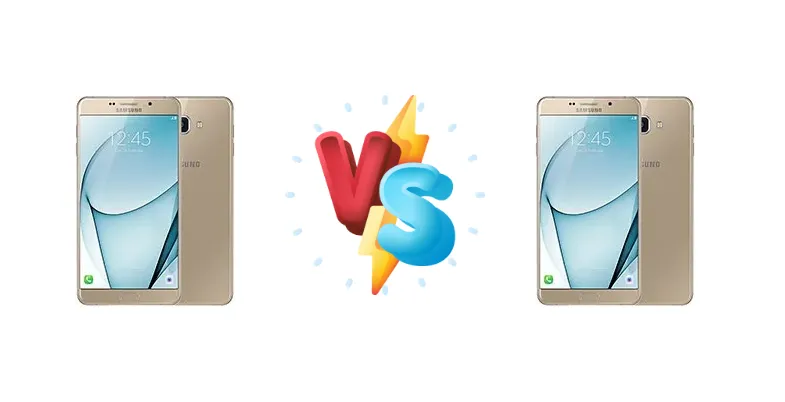
The Samsung Galaxy A9 (2016) and A9 Pro (2016) were intriguing mid-range phones with large displays and premium designs. While sharing many similarities, subtle differences set them apart. This review dives deep into a head-to-head comparison to help you decide which model was the better choice back in 2016.
🏆 Quick Verdict
The Galaxy A9 (2016) edges out the A9 Pro due to its significantly better battery life and superior sunlight visibility on the display. While both share the same processor, the A9's endurance and screen performance make it the more compelling option, especially considering their age.
| Network |
|---|
| 2G bands | GSM 850 / 900 / 1800 / 1900 - SIM 1 & SIM 2 (dual-SIM model only) | GSM 850 / 900 / 1800 / 1900 - SIM 1 & SIM 2 (dual-SIM model only) |
| 3G bands | HSDPA 850 / 900 / 1900 / 2100 | HSDPA 850 / 900 / 1900 / 2100 |
| 4G bands | 1, 3, 5, 7, 8, 38, 39, 40, 41 | 1, 3, 5, 7, 8, 40 |
| Speed | HSPA 42.2/5.76 Mbps, LTE Cat4 150/50 Mbps | HSPA 42.2/5.76 Mbps, LTE (3CA) Cat6 300/50 Mbps |
| Technology | GSM / HSPA / LTE | GSM / HSPA / LTE |
| | - | 1, 2, 3, 4, 5, 7, 8, 17, 28, 38, 40 -A910F/DS |
| Launch |
|---|
| Announced | 2015, December. Released 2016, January | 2016, March. Released 2016, May |
| Status | Discontinued | Discontinued |
| Body |
|---|
| Build | Glass front (Gorilla Glass 4), glass back (Gorilla Glass 4), aluminum frame | Glass front (Gorilla Glass 4), glass back (Gorilla Glass 4), aluminum frame |
| Dimensions | 161.7 x 80.9 x 7.4 mm (6.37 x 3.19 x 0.29 in) | 161.7 x 80.9 x 7.9 mm (6.37 x 3.19 x 0.31 in) |
| SIM | · Nano-SIM· Nano-SIM + Nano-SIM | · Nano-SIM· Nano-SIM + Nano-SIM |
| Weight | 200 g (7.05 oz) | 210 g (7.41 oz) |
| Display |
|---|
| Protection | Corning Gorilla Glass 4 | Corning Gorilla Glass 4 |
| Resolution | 1080 x 1920 pixels, 16:9 ratio (~367 ppi density) | 1080 x 1920 pixels, 16:9 ratio (~367 ppi density) |
| Size | 6.0 inches, 99.2 cm2 (~75.9% screen-to-body ratio) | 6.0 inches, 99.2 cm2 (~75.9% screen-to-body ratio) |
| Type | Super AMOLED | Super AMOLED |
| Platform |
|---|
| CPU | Octa-core (4x1.8 GHz Cortex-A72 & 4x1.4 GHz Cortex-A53) | Octa-core (4x1.8 GHz Cortex-A72 & 4x1.4 GHz Cortex-A53) |
| Chipset | Qualcomm MSM8976 Snapdragon 652 (28 nm) | Qualcomm MSM8976 Snapdragon 652 (28 nm) |
| GPU | Adreno 510 | Adreno 510 |
| OS | Android 5.1.1 (Lollipop), upgradable to 6.0.1 (Marshmallow) | Android 6.0.1 (Marshmallow), upgradable to Android 8.0 (Oreo), Experience UI 9 |
| Memory |
|---|
| Card slot | microSDXC (dedicated slot) | microSDXC (dedicated slot) |
| Internal | 32GB 3GB RAM | 32GB 4GB RAM |
| | eMMC 5.1 | eMMC 5.1 |
| Main Camera |
|---|
| Features | LED flash, panorama, HDR | LED flash, panorama, HDR |
| Single | 13 MP, f/1.9, 28mm (wide), 1/3.1", 1.12µm, AF, OIS | 16 MP, f/1.9, 1/2.8", AF, OIS |
| Video | 1080p@30fps | 1080p@30fps |
| Selfie camera |
|---|
| Single | 8 MP, f/1.9, 24mm (wide) | 8 MP, f/1.9 |
| Video | 1080p@30fps | 1080p@30fps |
| Sound |
|---|
| 3.5mm jack | Yes | Yes |
| 35mm jack | Yes | Yes |
| Loudspeaker | Yes | Yes |
| Comms |
|---|
| Bluetooth | 4.1, A2DP, EDR, LE | 4.2, A2DP, EDR, LE |
| NFC | Yes | Yes |
| Positioning | GPS, GLONASS, BDS | GPS, GLONASS/ BDS (market dependant) |
| Radio | FM radio, RDS, recording | FM radio, RDS, recording |
| USB | microUSB 2.0 | microUSB 2.0 |
| WLAN | Wi-Fi 802.11 a/b/g/n/ac, dual-band, Wi-Fi Direct, hotspot | Wi-Fi 802.11 a/b/g/n/ac, dual-band, Wi-Fi Direct |
| Features |
|---|
| Sensors | Fingerprint (front-mounted), accelerometer, proximity, compass | Fingerprint (front-mounted), accelerometer, proximity, compass |
| | ANT+ | ANT+
Samsung Pay (Visa, MasterCard certified) |
| Battery |
|---|
| Charging | 18W wired | 18W wired |
| Music play | - | Up to 109 h |
| Talk time | - | Up to 33 h (3G) |
| Type | Li-Ion 4000 mAh, non-removable | Li-Ion 5000 mAh, non-removable |
| Misc |
|---|
| Colors | Pearl White, Midnight Black, Champagne Gold, Pink | White, Black, Gold |
| Models | SM-A900F, SM-A9000 | SM-A9100, SM-A910F, SM-A910F |
| Price | About 200 EUR | About 300 EUR |
| SAR | 1.19 W/kg (head) 1.33 W/kg (body) | - |
| SAR EU | 0.18 W/kg (head) 0.55 W/kg (body) | 0.62 W/kg (head) 1.32 W/kg (body) |
| Tests |
|---|
| Battery life |
Endurance rating 103h
| - |
| Camera |
Photo / Video | - |
| Display |
Contrast ratio: Infinite (nominal), 3.817 (sunlight) | - |
| Loudspeaker |
Voice 65dB / Noise 72dB / Ring 65dB
| - |
| Performance |
Basemark OS II 2.0: 1529Basemark X: 15290 | - |
Samsung Galaxy A9 (2016)
- Excellent Battery Life (103h Endurance)
- Vibrant Super AMOLED Display
- Large 6.0-inch Screen
- Decent Performance for Everyday Tasks
- Camera is Average
- Design is a bit dated
- Performance not suitable for demanding games
Samsung Galaxy A9 Pro (2016)
- Similar Performance to A9 (2016)
- Premium Design
- No Battery Data Available
- Likely Inferior Sunlight Visibility
- No significant advantages over A9 (2016)
Display Comparison
Both phones feature a 6.0-inch Super AMOLED display. However, the A9 (2016) boasts a contrast ratio of 'Infinite' (nominal) and a respectable 3.817 in sunlight, suggesting better outdoor visibility compared to the A9 Pro, which lacks sunlight data. The A9 Pro's display, while vibrant, likely suffers more in direct sunlight.
Camera Comparison
Camera specifications are not fully detailed for the A9 Pro. The A9 (2016) features a 13MP main camera and a 5MP front camera. Image quality is decent for the time, but don't expect exceptional results. Low-light performance is average.
Performance
Both devices are powered by the Qualcomm Snapdragon 652 chipset and an Octa-core CPU. Performance will be very similar for everyday tasks and light gaming. Don't expect flagship-level speeds from either phone.
Battery Life
This is where the A9 (2016) truly shines. It boasts an impressive endurance rating of 103 hours, significantly outperforming the A9 Pro, which lacks battery data. This translates to significantly longer usage between charges.
Buying Guide
Who should buy Samsung Galaxy A9 (2016)? Those seeking a large-screen phone with exceptional battery life and decent performance for basic tasks. Who should buy Samsung Galaxy A9 Pro (2016)? Given its limited advantages, it's hard to recommend the A9 Pro over the standard A9 unless it's significantly cheaper and you don't prioritize battery.
Frequently Asked Questions
❓ What's the main difference between the Galaxy A9 and A9 Pro?
The primary difference appears to be battery capacity and potentially display brightness/sunlight visibility. The A9 has a significantly better endurance rating.
❓ Are these phones still worth buying in 2024?
Given their age, these phones are not recommended for primary use. However, they might be suitable for very basic tasks or as a secondary device if found at a very low price.