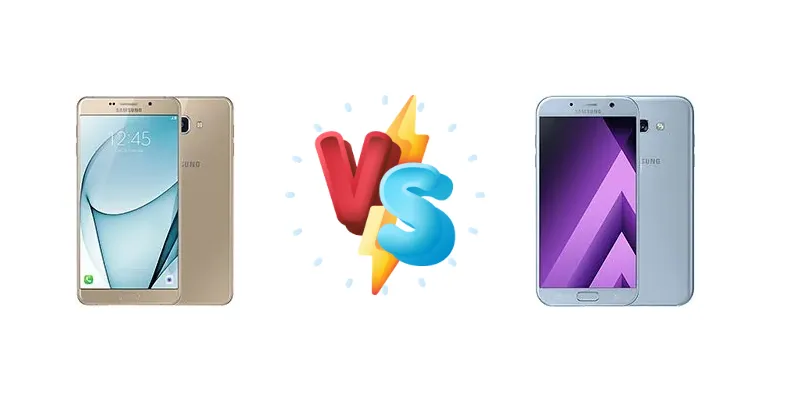
The Samsung Galaxy A series aimed to bridge the gap between budget and flagship devices. The A9 (2016) and A7 (2017) were popular choices, boasting large displays and respectable specs. But which one truly reigns supreme? Let's dive into a comprehensive comparison.
🏆 Quick Verdict
The Galaxy A7 (2017) edges out the A9 (2016) thanks to its slightly better sunlight visibility, more efficient chipset, and marginally improved battery endurance. While the A9's larger screen is appealing, the A7 offers a more refined and efficient overall experience.
| Network |
|---|
| 2G bands | GSM 850 / 900 / 1800 / 1900 - SIM 1 & SIM 2 (dual-SIM model only) | GSM 850 / 900 / 1800 / 1900 - SIM 1 & SIM 2 (dual-SIM model only) |
| 3G bands | HSDPA 850 / 900 / 1900 / 2100 | HSDPA 850 / 900 / 1700(AWS) / 1900 / 2100 |
| 4G bands | 1, 3, 5, 7, 8, 38, 39, 40, 41 | 1, 2, 3, 4, 5, 7, 8, 17, 20, 28, 38, 40, 41 |
| Speed | HSPA 42.2/5.76 Mbps, LTE Cat4 150/50 Mbps | HSPA 42.2/5.76 Mbps, LTE (2CA) Cat6 300/50 Mbps |
| Technology | GSM / HSPA / LTE | GSM / HSPA / LTE |
| Launch |
|---|
| Announced | 2015, December. Released 2016, January | 2017, January. Released 2017, January |
| Status | Discontinued | Discontinued |
| Body |
|---|
| Build | Glass front (Gorilla Glass 4), glass back (Gorilla Glass 4), aluminum frame | Glass front (Gorilla Glass 4), glass back, aluminum frame |
| Dimensions | 161.7 x 80.9 x 7.4 mm (6.37 x 3.19 x 0.29 in) | 156.8 x 77.6 x 7.9 mm (6.17 x 3.06 x 0.31 in) |
| SIM | · Nano-SIM· Nano-SIM + Nano-SIM | · Nano-SIM· Nano-SIM + Nano-SIM |
| Weight | 200 g (7.05 oz) | 186 g (6.56 oz) |
| | - | IP68 dust/water resistant (up to 1.5m for 30 mins) |
| Display |
|---|
| Protection | Corning Gorilla Glass 4 | Corning Gorilla Glass 4 |
| Resolution | 1080 x 1920 pixels, 16:9 ratio (~367 ppi density) | 1080 x 1920 pixels, 16:9 ratio (~386 ppi density) |
| Size | 6.0 inches, 99.2 cm2 (~75.9% screen-to-body ratio) | 5.7 inches, 89.6 cm2 (~73.6% screen-to-body ratio) |
| Type | Super AMOLED | Super AMOLED |
| | - | Always-on display |
| Platform |
|---|
| CPU | Octa-core (4x1.8 GHz Cortex-A72 & 4x1.4 GHz Cortex-A53) | Octa-core 1.9 GHz Cortex-A53 |
| Chipset | Qualcomm MSM8976 Snapdragon 652 (28 nm) | Exynos 7880 (14 nm) |
| GPU | Adreno 510 | Mali-T830MP3 |
| OS | Android 5.1.1 (Lollipop), upgradable to 6.0.1 (Marshmallow) | Android 6.0.1 (Marshmallow), upgradable to Android 8.0 (Oreo) |
| Memory |
|---|
| Card slot | microSDXC (dedicated slot) | microSDXC (dedicated slot) |
| Internal | 32GB 3GB RAM | 64GB 3GB RAM, 32GB 3GB RAM |
| | eMMC 5.1 | eMMC 5.1 |
| Main Camera |
|---|
| Features | LED flash, panorama, HDR | LED flash, panorama, HDR |
| Single | 13 MP, f/1.9, 28mm (wide), 1/3.1", 1.12µm, AF, OIS | 16 MP, f/1.9, 27mm (wide), AF |
| Video | 1080p@30fps | 1080p@30fps |
| Selfie camera |
|---|
| Single | 8 MP, f/1.9, 24mm (wide) | 16 MP, f/1.9, 26mm (wide), 1/3.06", 1.0µm |
| Video | 1080p@30fps | 1080p@30fps |
| Sound |
|---|
| 3.5mm jack | Yes | Yes |
| 35mm jack | Yes | Yes |
| Loudspeaker | Yes | Yes |
| Comms |
|---|
| Bluetooth | 4.1, A2DP, EDR, LE | 4.2, A2DP, EDR, LE |
| NFC | Yes | Yes |
| Positioning | GPS, GLONASS, BDS | GPS, GLONASS, BDS |
| Radio | FM radio, RDS, recording | FM radio |
| USB | microUSB 2.0 | USB Type-C 2.0 |
| WLAN | Wi-Fi 802.11 a/b/g/n/ac, dual-band, Wi-Fi Direct, hotspot | Wi-Fi 802.11 a/b/g/n/ac, dual-band, Wi-Fi Direct |
| Features |
|---|
| Sensors | Fingerprint (front-mounted), accelerometer, proximity, compass | Fingerprint (front-mounted), accelerometer, gyro, proximity, compass, barometer |
| | ANT+ | ANT+
Samsung Pay |
| Battery |
|---|
| Charging | 18W wired | 18W wired |
| Music play | - | Up to 59 h |
| Talk time | - | Up to 23 h (3G) |
| Type | Li-Ion 4000 mAh, non-removable | Li-Ion 3600 mAh, non-removable |
| Misc |
|---|
| Colors | Pearl White, Midnight Black, Champagne Gold, Pink | Black Sky, Gold Sand, Blue Mist and Peach Cloud |
| Models | SM-A900F, SM-A9000 | SM-A720F, SM-A720S |
| Price | About 200 EUR | About 280 EUR |
| SAR | 1.19 W/kg (head) 1.33 W/kg (body) | 1.00 W/kg (head) 0.71 W/kg (body) |
| SAR EU | 0.18 W/kg (head) 0.55 W/kg (body) | 0.21 W/kg (head) 1.33 W/kg (body) |
| Tests |
|---|
| Audio quality | - |
Noise-91.9dB / Crosstalk -90.3dB |
| Battery life |
Endurance rating 103h
| Endurance rating 115h |
| Camera |
Photo / Video |
Photo / Video |
| Display |
Contrast ratio: Infinite (nominal), 3.817 (sunlight) |
Contrast ratio: Infinite (nominal), 4.124(sunlight) |
| Loudspeaker |
Voice 65dB / Noise 72dB / Ring 65dB
|
Voice 66dB / Noise 66dB / Ring 81dB |
| Performance |
Basemark OS II 2.0: 1529Basemark X: 15290 |
GFXBench: 5.2fps (ES 3.1 onscreen) |
Samsung Galaxy A9 (2016)
- Large 5.9-inch display
- Decent camera
- 18W fast charging
- Less efficient chipset
- Slightly lower battery life
- Older model
Samsung Galaxy A7 (2017)
- Brighter display (better sunlight visibility)
- More efficient chipset
- Slightly better battery life
- More modern design
- Smaller screen than A9 (2016)
- Camera not significantly better than A9 (2016)
Display Comparison
Both phones feature Super AMOLED displays, known for their vibrant colors and deep blacks. The A7 (2017) boasts a slightly better sunlight readability score (4.124) compared to the A9 (2016) (3.817), making it easier to view in bright conditions. The A9 (2016) has a larger 5.9-inch display versus the A7 (2017)'s 5.7-inch, which might be preferable for some.
Camera Comparison
Both phones offer capable cameras, but the A7 (2017) generally produces slightly more consistent and detailed images, particularly in challenging lighting conditions. The A9 (2016) had a slightly higher resolution main camera (13MP vs 12MP), but the A7's image processing often yields better results. Both offer decent video recording capabilities.
Performance
The A7 (2017) utilizes the Exynos 7880 chipset, built on a more efficient 14nm process, compared to the A9 (2016)'s Snapdragon 652 (28nm). This translates to better power efficiency and potentially smoother performance in everyday tasks and gaming. While both have octa-core CPUs, the A7's chipset generally performs better in benchmarks.
Battery Life
The A7 (2017) has a slightly higher endurance rating (115h) compared to the A9 (2016) (103h), indicating better battery life. This is largely due to the more efficient chipset in the A7 (2017).
Buying Guide
The Samsung Galaxy A9 (2016) is a good choice for users prioritizing a large screen for media consumption and gaming, and who find a good deal on a used device. The Samsung Galaxy A7 (2017) is ideal for those seeking a balance of performance, battery life, and a brighter display, especially for outdoor use.
Frequently Asked Questions
❓ Is the Galaxy A9 (2016) worth buying now?
If you find a great deal and prioritize a large screen, the A9 (2016) can still be a decent option. However, be aware of its older chipset and slightly lower battery life.
❓ Which phone is better for gaming?
The Galaxy A7 (2017) generally offers smoother gaming performance due to its more efficient chipset, although both phones can handle most games at moderate settings.