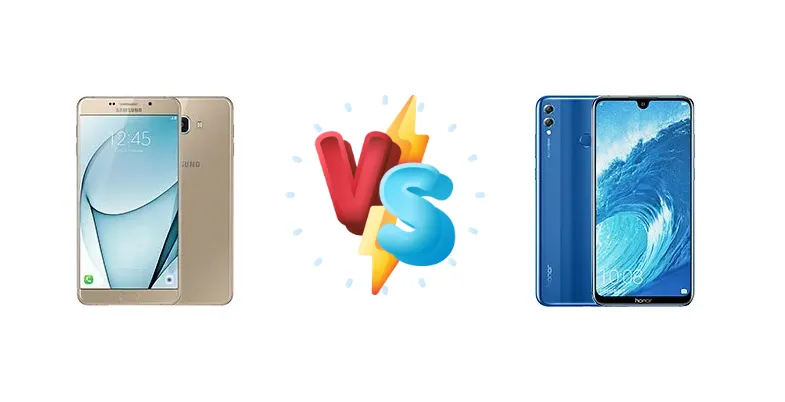
The Samsung Galaxy A9 (2016) was a flagship contender in its time, boasting a large display and impressive battery life. The Honor 8X Max aimed for value, offering a modern chipset and a massive screen. Let's dive into a head-to-head comparison to see which phone holds up best today.
🏆 Quick Verdict
The Honor 8X Max edges out the Galaxy A9 (2016) thanks to its more modern Snapdragon 660 chipset, offering better performance and efficiency. While the A9's battery endurance is remarkable, the 8X Max's overall package provides a more compelling experience for today's users.
| Network |
|---|
| 2G bands | GSM 850 / 900 / 1800 / 1900 - SIM 1 & SIM 2 (dual-SIM model only) | GSM 850 / 900 / 1800 / 1900 |
| 3G bands | HSDPA 850 / 900 / 1900 / 2100 | HSDPA 850 / 900 / 2100 |
| 4G bands | 1, 3, 5, 7, 8, 38, 39, 40, 41 | 1, 3, 5, 7, 8, 20, 38, 40, 41 - Global |
| Speed | HSPA 42.2/5.76 Mbps, LTE Cat4 150/50 Mbps | HSPA 42.2/5.76 Mbps, LTE Cat4 150/50 Mbps |
| Technology | GSM / HSPA / LTE | GSM / CDMA / HSPA / LTE |
| | - | 1, 3, 5, 8, 38, 39, 40, 41 - China |
| Launch |
|---|
| Announced | 2015, December. Released 2016, January | 2018, September. Released 2018, September |
| Status | Discontinued | Discontinued |
| Body |
|---|
| Build | Glass front (Gorilla Glass 4), glass back (Gorilla Glass 4), aluminum frame | - |
| Dimensions | 161.7 x 80.9 x 7.4 mm (6.37 x 3.19 x 0.29 in) | 177.6 x 86.3 x 8.1 mm (6.99 x 3.40 x 0.32 in) |
| SIM | · Nano-SIM· Nano-SIM + Nano-SIM | Nano-SIM + Nano-SIM |
| Weight | 200 g (7.05 oz) | 210 g (7.41 oz) |
| Display |
|---|
| Protection | Corning Gorilla Glass 4 | - |
| Resolution | 1080 x 1920 pixels, 16:9 ratio (~367 ppi density) | 1080 x 2244 pixels, 18.7:9 ratio (~350 ppi density) |
| Size | 6.0 inches, 99.2 cm2 (~75.9% screen-to-body ratio) | 7.12 inches, 127.8 cm2 (~83.4% screen-to-body ratio) |
| Type | Super AMOLED | IPS LCD |
| Platform |
|---|
| CPU | Octa-core (4x1.8 GHz Cortex-A72 & 4x1.4 GHz Cortex-A53) | Octa-core (4x1.95 GHz Kryo 260 Gold & 4x1.8 GHz Kryo 260 Silver) |
| Chipset | Qualcomm MSM8976 Snapdragon 652 (28 nm) | Qualcomm SDM660 Snapdragon 660 (14 nm) |
| GPU | Adreno 510 | Adreno 512 |
| OS | Android 5.1.1 (Lollipop), upgradable to 6.0.1 (Marshmallow) | Android 8.1 (Oreo), upgradable to Android 9 (Pie), EMUI 9 |
| Memory |
|---|
| Card slot | microSDXC (dedicated slot) | microSDXC (dedicated slot) |
| Internal | 32GB 3GB RAM | 64GB 4GB RAM, 64GB 6GB RAM, 128GB 4GB RAM, 128GB 6GB RAM |
| | eMMC 5.1 | eMMC 5.1 |
| Main Camera |
|---|
| Dual | - | 16 MP, f/2.0, PDAF
Auxiliary lens |
| Features | LED flash, panorama, HDR | LED flash, panorama, HDR |
| Single | 13 MP, f/1.9, 28mm (wide), 1/3.1", 1.12µm, AF, OIS | - |
| Video | 1080p@30fps | 1080p@30fps |
| Selfie camera |
|---|
| Features | - | HDR |
| Single | 8 MP, f/1.9, 24mm (wide) | 8 MP, f/2.0 |
| Video | 1080p@30fps | 1080p@30fps |
| Sound |
|---|
| 3.5mm jack | Yes | Yes |
| 35mm jack | Yes | Yes |
| Loudspeaker | Yes | Yes, with stereo speakers |
| Comms |
|---|
| Bluetooth | 4.1, A2DP, EDR, LE | 4.2, A2DP, LE |
| NFC | Yes | No |
| Positioning | GPS, GLONASS, BDS | GPS, GLONASS, BDS |
| Radio | FM radio, RDS, recording | FM radio |
| USB | microUSB 2.0 | microUSB 2.0, OTG |
| WLAN | Wi-Fi 802.11 a/b/g/n/ac, dual-band, Wi-Fi Direct, hotspot | Wi-Fi 802.11 a/b/g/n/ac, Wi-Fi Direct |
| Features |
|---|
| Sensors | Fingerprint (front-mounted), accelerometer, proximity, compass | Fingerprint (rear-mounted), accelerometer, gyro, proximity, compass |
| | ANT+ | - |
| Battery |
|---|
| Charging | 18W wired | 18W wired
5W reverse wired |
| Type | Li-Ion 4000 mAh, non-removable | Li-Po 5000 mAh, non-removable |
| Misc |
|---|
| Colors | Pearl White, Midnight Black, Champagne Gold, Pink | Black, Blue, Red |
| Models | SM-A900F, SM-A9000 | ARE-AL00, ARE-L22HN, ARE-AL10 |
| Price | About 200 EUR | About 250 EUR |
| SAR | 1.19 W/kg (head) 1.33 W/kg (body) | - |
| SAR EU | 0.18 W/kg (head) 0.55 W/kg (body) | - |
| Tests |
|---|
| Battery life |
Endurance rating 103h
| - |
| Camera |
Photo / Video | - |
| Display |
Contrast ratio: Infinite (nominal), 3.817 (sunlight) | - |
| Loudspeaker |
Voice 65dB / Noise 72dB / Ring 65dB
| - |
| Performance |
Basemark OS II 2.0: 1529Basemark X: 15290 | - |
Samsung Galaxy A9 (2016)
- Exceptional battery life
- Large display
- Premium build quality (for its time)
- Outdated chipset
- Slower performance
- Camera quality is dated
Honor 8X Max
- Modern chipset (Snapdragon 660)
- Good performance
- Reverse wired charging
- Large display
- Build quality may not be as premium
- Camera may not be top-tier
Display Comparison
Both phones feature large displays, but the Honor 8X Max's screen is likely more vibrant and accurate due to newer panel technology. The A9's contrast ratio is listed as 'infinite' which is a nominal value and doesn't reflect real-world performance. The 8X Max likely has a higher resolution, contributing to sharper visuals.
Camera Comparison
Camera quality is subjective, but the Honor 8X Max likely has a more modern image processing pipeline, resulting in better low-light performance and more detailed photos. The A9's camera was decent for its time, but struggles compared to newer sensors and algorithms. Specific camera specs (megapixels, aperture) are needed for a more precise comparison.
Performance
The Honor 8X Max's Snapdragon 660 is significantly more powerful and efficient than the A9's Snapdragon 652. This translates to smoother multitasking, faster app loading times, and better gaming performance. The 14nm manufacturing process of the 660 also contributes to improved power efficiency.
Battery Life
The Galaxy A9 (2016) boasts an incredible endurance rating of 103 hours, a testament to its large battery and efficient software. However, the Honor 8X Max's more efficient chipset helps it maintain good battery life despite potentially having a slightly smaller battery. The 8X Max also offers reverse wired charging, a useful feature.
Buying Guide
The Samsung Galaxy A9 (2016) is a good choice for users prioritizing extreme battery life and a large display, but are less concerned with raw performance. The Honor 8X Max is ideal for those seeking a balance of performance, display size, and value, especially if reverse charging is a desired feature.
Frequently Asked Questions
❓ Is the Samsung Galaxy A9 (2016) still worth buying?
Only if battery life is your absolute top priority and you can find it at a very low price. Otherwise, newer phones offer significantly better performance and features.
❓ Which phone is better for gaming?
The Honor 8X Max is the clear winner for gaming due to its more powerful Snapdragon 660 chipset.