
Samsung Galaxy A8+ (2018) vs. Galaxy J8: A Detailed Comparison for Budget-Conscious Buyers
| Phones Images | |||||
|---|---|---|---|---|---|
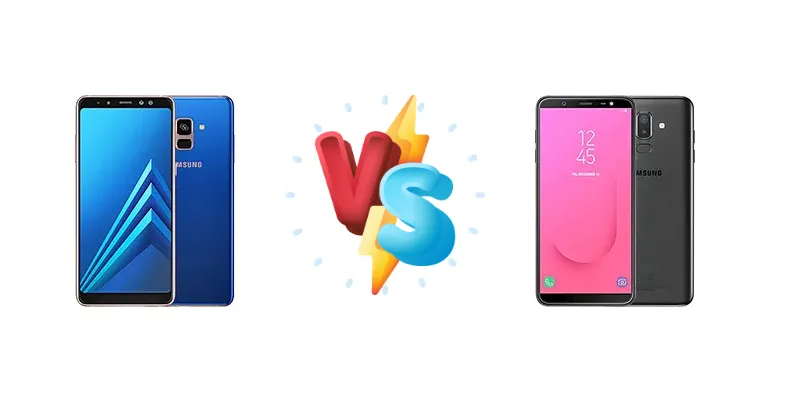
|
🏆 Quick Verdict
For users prioritizing performance and smoother multitasking, the Samsung Galaxy A8+ (2018) is the clear winner. Its Exynos 7885 chipset offers a significant advantage over the Snapdragon 450 in the J8. However, the J8 remains a viable option for basic users on a very tight budget.
| PHONES | ||
|---|---|---|
| Phone Names | Samsung Galaxy A8+ (2018) | Samsung Galaxy J8 |
| Network | ||
|---|---|---|
| 2G bands | GSM 850 / 900 / 1800 / 1900 - SIM 1 & SIM 2 (dual-SIM model only) | GSM 850 / 900 / 1800 / 1900 |
| 3G bands | HSDPA 850 / 900 / 1700(AWS) / 1900 / 2100 | HSDPA 850 / 900 / 1700(AWS) / 1900 / 2100 |
| 4G bands | 1, 2, 3, 4, 5, 7, 8, 12, 13, 17, 18, 19, 20, 26, 28, 38, 40, 41, 66 | 1, 2, 3, 4, 5, 7, 8, 12, 17, 20, 28, 38, 40, 41, 66 - J810Y/DS |
| Speed | HSPA 42.2/5.76 Mbps, LTE (3CA) Cat11 600/75 Mbps | HSPA 42.2/5.76 Mbps, LTE (2CA) Cat6 300/50 Mbps |
| Technology | GSM / HSPA / LTE | GSM / HSPA / LTE |
| Launch | ||
|---|---|---|
| Announced | 2017, December. Released 2018, January | 2018, May. Released 2018, July |
| Status | Discontinued | Discontinued |
| Body | ||
|---|---|---|
| Build | Glass front (Gorilla Glass 4), glass back (Gorilla Glass 5), aluminum frame | Glass front, plastic back, plastic frame |
| Dimensions | 159.9 x 75.7 x 8.3 mm (6.30 x 2.98 x 0.33 in) | 159.2 x 75.7 x 8.2 mm (6.27 x 2.98 x 0.32 in) |
| SIM | · Nano-SIM· Nano-SIM + Nano-SIM | Nano-SIM + Nano-SIM |
| Weight | 191 g (6.74 oz) | 177 g (6.24 oz) |
| Display | ||
|---|---|---|
| Protection | Corning Gorilla Glass 4 | - |
| Resolution | 1080 x 2220 pixels, 18.5:9 ratio (~411 ppi density) | 720 x 1480 pixels, 18.5:9 ratio (~274 ppi density) |
| Size | 6.0 inches, 91.4 cm2 (~75.5% screen-to-body ratio) | 6.0 inches, 91.4 cm2 (~75.8% screen-to-body ratio) |
| Type | Super AMOLED | Super AMOLED |
| Platform | ||
|---|---|---|
| CPU | Octa-core (2x2.2 GHz Cortex-A73 & 6x1.6 GHz Cortex-A53) | Octa-core 1.8 GHz Cortex-A53 |
| Chipset | Exynos 7885 (14 nm) | Qualcomm SDM450 Snapdragon 450 (14 nm) |
| GPU | Mali-G71 | Adreno 506 |
| OS | Android 7.1.1 (Nougat), upgradable to Android 9.0 (Pie) | Android 8.0 (Oreo), upgradable to Android 9.0 (Pie) |
| Memory | ||
|---|---|---|
| Card slot | microSDXC (dedicated slot) | microSDXC (dedicated slot) |
| Internal | 32GB 4GB RAM, 64GB 4GB RAM, 64GB 6GB RAM | 32GB 3GB RAM, 64GB 4GB RAM |
| - | eMMC 5.1 | |
| Main Camera | ||
|---|---|---|
| Dual | - | 16 MP, f/1.7, AF Auxiliary lens |
| Features | LED flash, panorama, HDR | LED flash, panorama, HDR |
| Single | 16 MP, f/1.7, 26mm (wide), 1/2.8”, 1.12µm, PDAF | - |
| Video | 1080p@30fps | 1080p@30fps |
| Selfie camera | ||
|---|---|---|
| Dual | 16 MP, f/1.9, 26mm (wide), 1/3.06", 1.0µm 8 MP, f/1.9, 1/4.0", 1.12µm | - |
| Features | - | LED flash |
| Single | - | 16 MP, f/1.9, 26mm (wide), 1/3.06", 1.0µm |
| Video | 1080p@30fps | 1080p@30fps |
| Sound | ||
|---|---|---|
| 3.5mm jack | - | Yes |
| 35mm jack | Yes | Yes |
| Loudspeaker | Yes | Yes |
| Comms | ||
|---|---|---|
| Bluetooth | 5.0, A2DP, EDR, LE | 4.2, A2DP, LE |
| NFC | Yes | No |
| Positioning | GPS, GLONASS, BDS | GPS, GLONASS, BDS |
| Radio | FM radio | FM radio, recording |
| USB | USB Type-C 2.0 | microUSB 2.0, OTG |
| WLAN | Wi-Fi 802.11 a/b/g/n/ac, dual-band, Wi-Fi Direct | Wi-Fi 802.11 b/g/n, Wi-Fi Direct |
| Features | ||
|---|---|---|
| Sensors | Fingerprint (rear-mounted), accelerometer, gyro, proximity, compass, barometer | Fingerprint (rear-mounted), accelerometer, proximity |
| Battery | ||
|---|---|---|
| Charging | 18W wired | - |
| Music play | Up to 73 h | Up to 112 h |
| Talk time | Up to 23 h (3G) | Up to 23 h (3G) |
| Type | Li-Ion 3500 mAh, non-removable | Li-Ion 3500 mAh, non-removable |
| Misc | ||
|---|---|---|
| Colors | Black, orchid grey, gold, blue | Black, Gold, Blue, Purple |
| Models | SM-A730F | SM-J810G, SM-J810F, J810Y, SM-J810Y, SM-J810GF, SM-J810M |
| Price | About 300 EUR | About 310 EUR |
| SAR EU | 0.32 W/kg (head) 1.30 W/kg (body) | 0.57 W/kg (head) 1.18 W/kg (body) |
Samsung Galaxy A8+ (2018)
- Significantly faster processor (Exynos 7885)
- Faster 18W wired charging
- Better multitasking capabilities
- Likely higher price point (even in 2024)
- May be harder to find new
Samsung Galaxy J8
- More affordable price
- Potentially longer standby time (depending on battery capacity)
- Widely available (likely)
- Slower processor (Snapdragon 450)
- Slower charging speeds
- Struggles with demanding apps
Display Comparison
While both devices likely feature similar LCD panels given their market segments, the focus here isn't display quality but the processing power driving it. Neither phone is known for exceptional display characteristics. The A8+’s stronger chipset will contribute to smoother scrolling and animations, indirectly improving the perceived visual experience. We can assume both have similar resolutions, but the A8+’s processor will handle UI rendering more efficiently.
Camera Comparison
Details on the camera sensors are limited, but the A8+ likely features a more capable primary sensor. Both phones likely include secondary cameras for depth sensing or wide-angle shots, but these are unlikely to be of high quality. The Exynos 7885’s image signal processor (ISP) will also provide better image processing capabilities, resulting in sharper images and improved low-light performance compared to the J8’s Snapdragon 450 ISP. The A8+’s processing power allows for more sophisticated image algorithms.
Performance
The core difference lies in the chipsets. The Samsung Galaxy A8+ (2018) utilizes the Exynos 7885, a 14nm octa-core processor with a heterogeneous architecture – two Cortex-A73 cores clocked at 2.2 GHz for performance and six Cortex-A53 cores at 1.6 GHz for efficiency. This contrasts sharply with the Galaxy J8’s Qualcomm Snapdragon 450, also 14nm, but employing eight Cortex-A53 cores clocked at a lower 1.8 GHz. The A73 cores in the A8+ offer significantly higher single-core performance, translating to faster app launches and a more responsive UI. The Snapdragon 450, while adequate for basic tasks, will struggle with more demanding applications and multitasking. This architectural difference means the A8+ will handle graphically intensive tasks and gaming far better.
Battery Life
Battery capacity is not specified in the provided data. However, the A8+’s 18W wired charging is a significant advantage over the J8, which likely supports slower charging speeds. While a larger battery capacity in the J8 might offer longer standby time, the A8+’s faster charging will reduce downtime. The Exynos 7885’s efficiency gains, despite its higher performance, could also contribute to comparable real-world battery life, especially with moderate usage.
Buying Guide
Buy the Samsung Galaxy A8+ (2018) if you need a phone capable of handling more demanding apps, occasional gaming, and appreciate a more responsive user experience. Buy the Samsung Galaxy J8 if you primarily use your phone for calls, texts, social media, and light browsing, and are looking for the absolute lowest price point.