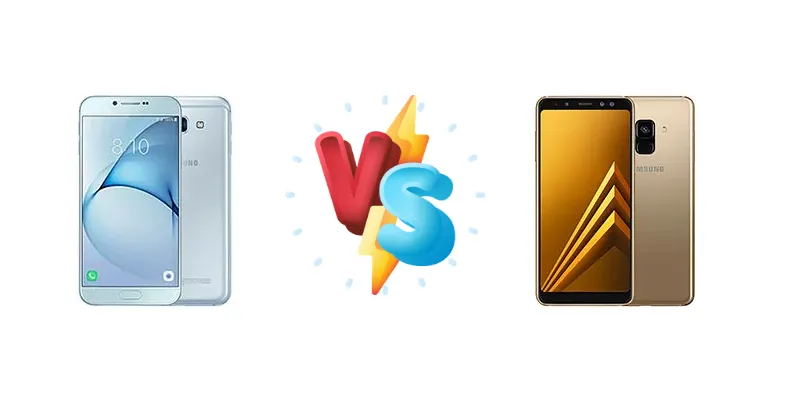
The Samsung Galaxy A8 was once a popular mid-range option, but two generations have passed. This comparison dives deep into the differences between the 2016 and 2018 models, helping you decide which offers the best value today. We'll cover everything from display quality to performance and battery life.
🏆 Quick Verdict
The Galaxy A8 (2018) is the clear winner. While the 2016 model was decent for its time, the 2018 version boasts a more powerful processor, improved camera capabilities, faster charging, and a slightly refined design. It's a worthwhile upgrade if you can find it at a reasonable price.
| Network |
|---|
| 2G bands | GSM 850 / 900 / 1800 / 1900 - SIM 1 & SIM 2 (dual-SIM model only) | GSM 850 / 900 / 1800 / 1900 - SIM 1 & SIM 2 (dual-SIM model only) |
| 3G bands | HSDPA 850 / 900 / 1900 / 2100 | HSDPA 850 / 900 / 1700(AWS) / 1900 / 2100 |
| 4G bands | 1, 3, 5, 7, 8, 28, 38 - Taiwan | 1, 2, 3, 4, 5, 7, 8, 12, 13, 17, 18, 19, 20, 26, 28, 38, 40, 41, 66 |
| Speed | HSPA 42.2/5.76 Mbps, LTE (2CA) Cat6 300/50 Mbps | HSPA 42.2/5.76 Mbps, LTE (3CA) Cat11 600/75 Mbps |
| Technology | GSM / HSPA / LTE | GSM / HSPA / LTE |
| | 1, 3, 5, 7, 8, 20, 40 - UAE | - |
| Launch |
|---|
| Announced | 2016, September. Released 2016, October | 2017, December. Released 2018, January |
| Status | Discontinued | Discontinued |
| Body |
|---|
| Build | Glass front, aluminum back, aluminum frame | Glass front (Gorilla Glass 4), glass back (Gorilla Glass 5), aluminum frame |
| Dimensions | 156.6 x 76.8 x 7.2 mm (6.17 x 3.02 x 0.28 in) | 149.2 x 70.6 x 8.4 mm (5.87 x 2.78 x 0.33 in) |
| SIM | · Nano-SIM· Nano-SIM + Nano-SIM | · Nano-SIM· Nano-SIM + Nano-SIM |
| Weight | 182 g (6.42 oz) | 172 g (6.07 oz) |
| | - | IP68 dust/water resistant (up to 1.5m for 30 min) |
| Display |
|---|
| Protection | - | Corning Gorilla Glass 4 |
| Resolution | 1080 x 1920 pixels, 16:9 ratio (~386 ppi density) | 1080 x 2220 pixels, 18.5:9 ratio (~441 ppi density) |
| Size | 5.7 inches, 89.6 cm2 (~74.5% screen-to-body ratio) | 5.6 inches, 79.6 cm2 (~75.6% screen-to-body ratio) |
| Type | Super AMOLED | Super AMOLED |
| | - | Always-on display |
| Platform |
|---|
| CPU | Octa-core (4x2.1 GHz Cortex-A57 & 4x1.5 GHz Cortex-A53) | Octa-core (2x2.2 GHz Cortex-A73 & 6x1.6 GHz Cortex-A53) |
| Chipset | Exynos 7420 Octa (14 nm) | Exynos 7885 (14 nm) |
| GPU | Mali-T760MP8 | Mali-G71 |
| OS | Android 6.0.1 (Marshmallow) | Android 7.1.1 (Nougat), upgradable to Android 9.0 (Pie), One UI |
| Memory |
|---|
| Card slot | microSDXC (uses shared SIM slot) | microSDXC (dedicated slot) |
| Internal | 32GB 3GB RAM | 32GB 4GB RAM, 64GB 4GB RAM |
| | eMMC 5.1 | eMMC 5.1 |
| Main Camera |
|---|
| Features | LED flash, panorama, HDR | LED flash, panorama, HDR |
| Single | 16 MP, f/1.9, AF | 16 MP, f/1.7, 26mm (wide), 1/2.8”, 1.12µm, PDAF |
| Video | 1080p@30fps | 1080p@30fps |
| Selfie camera |
|---|
| Dual | - | 16 MP, f/1.9, 26mm (wide), 1/3.06", 1.0µm
8 MP, f/1.9, 24mm (wide), 1/4.0", 1.12µm |
| Single | 8 MP, f/1.9 | - |
| Video | 1080p@30fps | 1080p@30fps |
| Sound |
|---|
| 3.5mm jack | Yes | Yes |
| 35mm jack | Yes | Yes |
| Loudspeaker | Yes | Yes |
| | - | 24-bit/192kHz audio
|
| Comms |
|---|
| Bluetooth | 4.1, A2DP, EDR, LE | 5.0, A2DP, EDR, LE |
| NFC | Yes | Yes |
| Positioning | GPS, GLONASS/ BDS (market dependant) | GPS, GLONASS, BDS |
| Radio | FM radio, RDS, recording | FM radio |
| USB | microUSB 2.0 | USB Type-C 2.0 |
| WLAN | Wi-Fi 802.11 a/b/g/n, dual-band, Wi-Fi Direct | Wi-Fi 802.11 a/b/g/n/ac, dual-band, Wi-Fi Direct |
| Features |
|---|
| Sensors | Fingerprint (front-mounted), accelerometer, proximity, compass | Fingerprint (rear-mounted), accelerometer, gyro, proximity, compass, barometer |
| | ANT+ | ANT+
Samsung Pay |
| Battery |
|---|
| Charging | - | 18W wired |
| Music play | Up to 44 h | Up to 66 h |
| Talk time | Up to 22 h (3G) | Up to 24 h (3G) |
| Type | Li-Ion 3300 mAh, non-removable | Li-Ion 3000 mAh, non-removable |
| Misc |
|---|
| Colors | Blue, Pink, Silver, Gold | Black, orchid grey, gold, blue |
| Models | SM-A8100, SM-A810F, SM-A810F, SM-A810YZ, SM-A810S | SM-A530F, SM-A530F, SM-A530K, SM-A530L, SM-A530S, SM-A530N, SM-A530W |
| Price | About 300 EUR | About 250 EUR |
| SAR EU | 0.13 W/kg (head) 1.17 W/kg (body) | 0.24 W/kg (head) 1.25 W/kg (body) |
| Tests |
|---|
| Audio quality | - |
Noise -92.1dB / Crosstalk -90.0dB |
| Battery life | - |
Endurance rating 92h
|
| Camera | - |
Photo / Video |
| Display | - |
Contrast ratio: Infinity (nominal), 3.842 (sunlight) |
| Loudspeaker | - |
Voice 69dB / Noise 70dB / Ring 81dB
|
| Performance | - |
GeekBench: 4418 (v4.4)
GFXBench: 5.2fps (ES 3.1 onscreen) |
Samsung Galaxy A8 (2016)
- Slightly more compact
- Decent display for its time
- Good value if found at a very low price
- Outdated processor
- Slower performance
- Slower charging
- Lower camera quality
Samsung Galaxy A8 (2018)
- Improved performance
- Better camera
- Faster charging (18W)
- Modern design
- Long battery life
- Can be slightly more expensive (depending on availability)
- Still a relatively older phone
Display Comparison
Both phones feature Super AMOLED displays, known for vibrant colors and deep blacks. The 2018 model has a slightly improved contrast ratio (though both are listed as 'Infinity'), and a marginally larger screen size (5.6 inches vs 5.5 inches). The 2018 also benefits from a more modern display technology, offering slightly better viewing angles and color accuracy.
Camera Comparison
The 2018 A8 generally delivers better image quality thanks to its improved processor and potentially updated camera sensors. While both have similar megapixel counts, the 2018 model's image processing is superior, resulting in more detailed photos with better dynamic range and low-light performance. The 2018 also benefits from improved video recording capabilities.
Performance
The Exynos 7885 in the 2018 A8 offers a significant performance boost over the Exynos 7420 in the 2016 model. The Cortex-A73 cores in the 7885 are more efficient and powerful than the A57 cores, resulting in smoother multitasking, faster app loading times, and better gaming performance. The 2016 model can feel sluggish by today's standards.
Battery Life
Both phones boast impressive battery life, with the 2018 model achieving an endurance rating of 92 hours. However, the 2018 model also includes 18W fast charging, significantly reducing charging times compared to the 2016 model's standard charging.
Buying Guide
Who should buy the Samsung Galaxy A8 (2016)? Those on a very tight budget looking for a basic smartphone with a decent screen. Who should buy the Samsung Galaxy A8 (2018)? Anyone seeking a more modern experience with better performance, camera quality, and faster charging, especially if they value battery life.
Frequently Asked Questions
❓ Is the Galaxy A8 (2016) still worth buying?
Only if you're on a very tight budget and primarily need a basic smartphone for calls, texts, and light browsing. Otherwise, the 2018 model offers a much better experience.
❓ What is the main difference between the two models?
The primary difference is the processor. The Galaxy A8 (2018) features the Exynos 7885, which provides significantly better performance and efficiency compared to the Exynos 7420 in the 2016 model.