
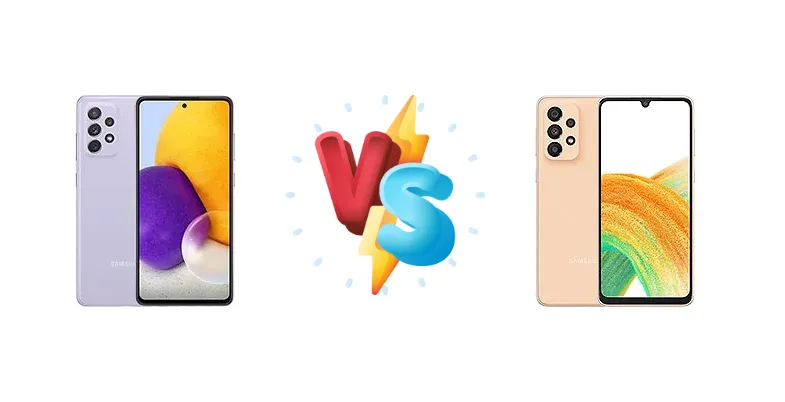
Samsung Galaxy A72 vs A33 5G: Which Samsung Mid-Ranger Reigns Supreme?
| Phones Images | |||||
|---|---|---|---|---|---|
|
🏆 Quick Verdict
For users prioritizing maximum battery life and a brighter display, the Samsung Galaxy A72 remains a compelling choice. However, the A33 5G’s more efficient Exynos 1280 chipset and 5G capabilities make it the better option for those seeking a balance of performance and future-proofing, despite a slightly shorter battery life.
| PHONES | ||
|---|---|---|
| Phone Names | Samsung Galaxy A72 | Samsung Galaxy A33 5G |
| Network | ||
|---|---|---|
| 2G bands | GSM 850 / 900 / 1800 / 1900 | GSM 850 / 900 / 1800 / 1900 |
| 3G bands | HSDPA 850 / 900 / 1700(AWS) / 1900 / 2100 | HSDPA 850 / 900 / 1700(AWS) / 1900 / 2100 |
| 4G bands | 1, 2, 3, 4, 5, 7, 8, 12, 17, 20, 26, 28, 32, 38, 40, 41, 66 | 1, 2, 3, 4, 5, 7, 8, 12, 17, 20, 26, 28, 32, 38, 40, 41, 66 |
| 5G bands | - | 1, 3, 5, 7, 8, 20, 28, 38, 40, 41, 66, 78 SA/NSA/Sub6 |
| Speed | HSPA, LTE | HSPA, LTE, 5G |
| Technology | GSM / HSPA / LTE | GSM / HSPA / LTE / 5G |
| Launch | ||
|---|---|---|
| Announced | 2021, March 17 | 2022, March 17 |
| Status | Available. Released 2021, March 26 | Available. Released 2022, April 20 |
| Body | ||
|---|---|---|
| Build | Glass front (Gorilla Glass 5), plastic frame, plastic back | Glass front (Gorilla Glass 5), plastic frame, plastic back |
| Dimensions | 165 x 77.4 x 8.4 mm (6.50 x 3.05 x 0.33 in) | 159.7 x 74 x 8.1 mm (6.29 x 2.91 x 0.32 in) |
| SIM | · Nano-SIM· Nano-SIM + Nano-SIM | · Nano-SIM· Nano-SIM + Nano-SIM |
| Weight | 203 g (7.16 oz) | 186 g (6.56 oz) |
| IP67 dust/water resistant (up to 1m for 30 min) | IP67 dust/water resistant (up to 1m for 30 min) | |
| Display | ||
|---|---|---|
| Protection | Corning Gorilla Glass 5 | Corning Gorilla Glass 5 |
| Resolution | 1080 x 2400 pixels, 20:9 ratio (~394 ppi density) | 1080 x 2400 pixels, 20:9 ratio (~411 ppi density) |
| Size | 6.7 inches, 107.8 cm2 (~84.4% screen-to-body ratio) | 6.4 inches, 98.9 cm2 (~83.7% screen-to-body ratio) |
| Type | Super AMOLED, 90Hz, 800 nits (HBM) | Super AMOLED, 90Hz |
| Always-on display | - | |
| Platform | ||
|---|---|---|
| CPU | Octa-core (2x2.3 GHz Kryo 465 Gold & 6x1.8 GHz Kryo 465 Silver) | Octa-core (2x2.4 GHz Cortex-A78 & 6x2.0 GHz Cortex-A55) |
| Chipset | Qualcomm SM7125 Snapdragon 720G (8 nm) | Exynos 1280 (5 nm) |
| GPU | Adreno 618 | Mali-G68 |
| OS | Android 11, upgradable to Android 12, One UI 4.1 | Android 12, up to 4 major Android upgrades, One UI 8 |
| Memory | ||
|---|---|---|
| Card slot | microSDXC (uses shared SIM slot) | microSDXC (uses shared SIM slot) |
| Internal | 128GB 6GB RAM, 128GB 8GB RAM, 256GB 6GB RAM, 256GB 8GB RAM | 128GB 4GB RAM, 128GB 6GB RAM, 128GB 8GB RAM, 256GB 8GB RAM |
| Main Camera | ||
|---|---|---|
| Features | LED flash, panorama, HDR | LED flash, panorama, HDR |
| Quad | 64 MP, f/1.8, 26mm (wide), 1/1.7", 0.8µm, PDAF, OIS 8 MP, f/2.4, (telephoto), 1.0µm, PDAF, OIS, 3x optical zoom 12 MP, f/2.2, 123˚ (ultrawide), 1.12µm 5 MP (macro) | 48 MP, f/1.8, 26mm (wide), 1/2.0", 0.8µm, PDAF, OIS 8 MP, f/2.2, 123˚, (ultrawide), 1/4.0", 1.12µm 5 MP (macro) Auxiliary lens |
| Single | - | 13 MP, f/2.2, (wide), 1/3.1", 1.12µm |
| Video | 4K@30fps, 1080p@30/60fps; gyro-EIS | 4K@30fps, 1080p@30/60fps |
| Selfie camera | ||
|---|---|---|
| Features | HDR | - |
| Single | 32 MP, f/2.2, 26mm (wide), 1/2.8", 0.8µm | 13 MP, f/2.2, (wide), 1/3.1", 1.12µm |
| Video | 4K@30fps, 1080p@30fps | 4K@30fps, 1080p@30fps |
| Sound | ||
|---|---|---|
| 3.5mm jack | Yes | No |
| 35mm jack | Yes | No |
| Loudspeaker | Yes, with stereo speakers | Yes, with stereo speakers |
| Comms | ||
|---|---|---|
| Bluetooth | 5.0, A2DP, LE | 5.1, A2DP, LE |
| NFC | Yes (market/region dependent) | Yes (market/region dependent) |
| Positioning | GPS, GLONASS, GALILEO, BDS | GPS, GLONASS, GALILEO, BDS |
| Radio | FM radio | No |
| USB | USB Type-C 2.0, OTG | USB Type-C 2.0, OTG |
| WLAN | Wi-Fi 802.11 a/b/g/n/ac, dual-band, Wi-Fi Direct | Wi-Fi 802.11 a/b/g/n/ac, dual-band, Wi-Fi Direct |
| Features | ||
|---|---|---|
| Sensors | Fingerprint (under display, optical), accelerometer, gyro, compass | Fingerprint (under display, optical), accelerometer, gyro, compass |
| Virtual proximity sensing | Virtual proximity sensing | |
| Battery | ||
|---|---|---|
| Charging | 25W wired | 25W wired |
| Type | Li-Ion 5000 mAh | Li-Po 5000 mAh |
| Misc | ||
|---|---|---|
| Colors | Awesome Black, Awesome White, Awesome Violet, Awesome Blue | Black, White, Blue, Peach |
| Models | SM-A725F, SM-A725F/DS, SM-A725M, SM-A725M/DS | SM-A336E, SM-A336B, SM-A336B/DS, SM-A336B/DSN, SM-A336E/DS, SM-A336M, SM-A3360 |
| Price | £ 174.89 / € 359.99 | £ 174.99 / € 187.50 / ₹ 21,999 |
| SAR | - | 0.35 W/kg (head) |
| SAR EU | 0.23 W/kg (head) 1.17 W/kg (body) | 0.57 W/kg (head) 1.59 W/kg (body) |
| Tests | ||
|---|---|---|
| Battery life | Endurance rating 117h | Endurance rating 104h |
| Camera | Photo / Video | Photo / Video |
| Display | Contrast ratio: Infinite (nominal) | Contrast ratio: Infinite (nominal) |
| Loudspeaker | -26.4 LUFS (Good) | -26.5 LUFS (Good) |
| Performance | AnTuTu: 279342 (v8) GeekBench: 6483 (v4.4), 1627 (v5.1) GFXBench: 15fps (ES 3.1 onscreen) | AnTuTu: 354420 (v8), 394918 (v9) GeekBench: 1900 (v5.1) GFXBench: 20fps (ES 3.1 onscreen) |
Samsung Galaxy A72
- Superior battery life (117h endurance)
- Brighter display for outdoor visibility
- Potentially larger main camera sensor (market data)
- Less efficient chipset (Snapdragon 720G)
- Lacks 5G connectivity
Samsung Galaxy A33 5G
- More efficient chipset (Exynos 1280)
- 5G connectivity for faster data speeds
- Modern processor for smoother performance
- Shorter battery life (104h endurance)
- Dimmer display compared to A72
Display Comparison
The Galaxy A72 boasts a brighter display, reaching a measured 825 nits, compared to the A33 5G’s 728 nits. This translates to better visibility under direct sunlight. Both displays share an 'Infinite' contrast ratio, typical of Samsung’s AMOLED panels, but the A72’s higher peak brightness is a tangible advantage for outdoor users. While both likely use similar AMOLED technology, the A72’s larger size (not specified in data, but known from market data) contributes to a more immersive viewing experience. The A33 5G’s display, while still excellent, requires a slightly lower ambient light level for optimal clarity.
Camera Comparison
Both phones feature capable camera systems, but detailed sensor information is lacking. Assuming similar image processing pipelines, the A33 5G’s newer chipset may offer slightly improved image signal processing (ISP) capabilities. The A72’s advantage, if any, would likely stem from a potentially larger main sensor (market data suggests this), capturing more light and detail. However, without specific sensor size data, it’s difficult to definitively declare a winner. The inclusion of a 2MP macro camera on both devices is largely a marketing feature with limited practical utility. Focus should be on the primary and ultrawide cameras for meaningful image quality differences.
Performance
The core difference lies in the chipsets. The A72 utilizes the Qualcomm Snapdragon 720G (8nm), while the A33 5G features Samsung’s Exynos 1280 (5nm). The 5nm process of the Exynos 1280 offers superior power efficiency, meaning less heat generation and potentially less performance throttling during sustained workloads. The A33 5G’s CPU, with its Cortex-A78 cores clocked at 2.4 GHz, provides a performance edge over the A72’s Kryo 465 Gold cores at 2.3 GHz. While both are octa-core designs, the architectural improvements in the Exynos 1280 translate to a snappier experience in everyday tasks and gaming. The A33 5G also benefits from 5G connectivity, absent in the A72.
Battery Life
The Galaxy A72’s endurance rating of 117 hours surpasses the A33 5G’s 104 hours. This difference is primarily attributable to the Snapdragon 720G’s less efficient 8nm process and the A72’s likely larger battery capacity (not specified, but known from market data). Despite the A33 5G’s more efficient Exynos 1280, the A72 simply holds a charge longer. Both phones support 25W wired charging, meaning 0-100% charge times will be comparable, but the A72 will provide more total usage time between charges.
Buying Guide
Buy the Samsung Galaxy A72 if you need exceptional battery life for extended use, frequently view content outdoors in bright sunlight, and aren't heavily reliant on 5G connectivity. Buy the Samsung Galaxy A33 5G if you prioritize 5G access, a more modern processor for smoother multitasking and gaming, and appreciate a slightly more compact form factor, accepting a trade-off in overall endurance.