
Samsung Galaxy A71 5G vs Google Pixel 5a 5G: A Detailed Comparison
| Phones Images | |||||
|---|---|---|---|---|---|
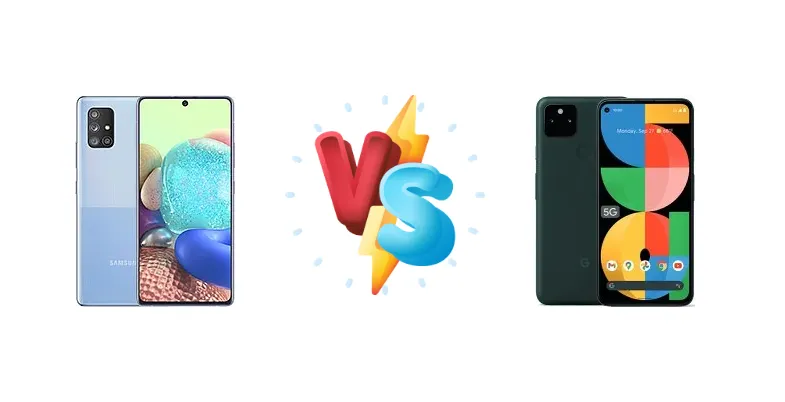
|
🏆 Quick Verdict
For the average user prioritizing consistent camera performance and software support, the Google Pixel 5a 5G emerges as the better choice. While the Samsung Galaxy A71 5G offers faster 25W charging, the Pixel 5a’s Snapdragon 765G and Google’s image processing provide a more refined and reliable experience.
| PHONES | ||
|---|---|---|
| Phone Names | Samsung Galaxy A71 5G | Google Pixel 5a 5G |
| Network | ||
|---|---|---|
| 2G bands | GSM 850 / 900 / 1800 / 1900 | GSM 850 / 900 / 1800 / 1900 |
| 3G bands | HSDPA 850 / 900 / 1900 / 2100 - SM-A716B | HSDPA 850 / 900 / 1700(AWS) / 1900 / 2100 |
| 4G bands | 1, 3, 4, 5, 7, 8, 12, 20, 28, 34, 38, 39, 40, 41 - SM-A716B | 1, 2, 3, 4, 5, 7, 8, 12, 13, 14, 17, 18, 19, 20, 25, 26, 28, 29, 30, 32, 38, 39, 40, 41, 42, 46, 48, 66, 71 |
| 5G bands | 41, 78 SA/NSA/Sub6 - SM-A716B | 1, 2, 5, 12, 25, 28, 41, 66, 71, 77, 78 SA/NSA/Sub6 |
| Speed | HSPA, LTE, 5G | HSPA, LTE, 5G |
| Technology | GSM / CDMA / HSPA / EVDO / LTE / 5G | GSM / HSPA / EVDO / LTE / 5G |
| 2, 5, 41, 66, 71 mmWave/Sub6 - SM-A716U | CDMA2000 1xEV-DO | |
| Launch | ||
|---|---|---|
| Announced | 2020, April 08 | 2021, August 17 |
| Status | Available. Released 2020, June 15 | Available. Released 2021, August 26 |
| Body | ||
|---|---|---|
| Build | Glass front (Gorilla Glass 3), plastic back, aluminum frame | Glass front (Gorilla Glass 3), aluminum frame, aluminum back |
| Dimensions | 162.5 x 75.5 x 8.1 mm (6.40 x 2.97 x 0.32 in) | 156.2 x 73.2 x 8.8 mm (6.15 x 2.88 x 0.35 in) |
| SIM | · Nano-SIM· Nano-SIM + Nano-SIM | Nano-SIM + eSIM |
| Weight | 185 g (6.53 oz) | 183 g (6.46 oz) |
| - | IP67 dust/water resistant (up to 1m for 30 min) | |
| Display | ||
|---|---|---|
| Protection | Corning Gorilla Glass 3 | Corning Gorilla Glass 3 |
| Resolution | 1080 x 2400 pixels, 20:9 ratio (~393 ppi density) | 1080 x 2400 pixels, 20:9 ratio (~415 ppi density) |
| Size | 6.7 inches, 108.4 cm2 (~88.3% screen-to-body ratio) | 6.34 inches, 97.0 cm2 (~84.9% screen-to-body ratio) |
| Type | Super AMOLED Plus | OLED, HDR |
| - | Always-on display | |
| Platform | ||
|---|---|---|
| CPU | Octa-core (2x2.2 GHz Cortex-A77 & 6x1.8 GHz Cortex A55) | Octa-core (1x2.4 GHz Kryo 475 Prime & 1x2.2 GHz Kryo 475 Gold & 6x1.8 GHz Kryo 475 Silver) |
| Chipset | Exynos 980 (8 nm) | Qualcomm SM7250 Snapdragon 765G 5G (7 nm) |
| GPU | Mali-G76 MP5 | Adreno 620 |
| OS | Android 10, upgradable to Android 13, One UI 5 | Android 11, upgradable to Android 14 |
| Memory | ||
|---|---|---|
| Card slot | microSDXC (uses shared SIM slot) | No |
| Internal | 128GB 6GB RAM, 128GB 8GB RAM | 128GB 6GB RAM |
| UFS 2.1 | - | |
| Main Camera | ||
|---|---|---|
| Dual | - | 12.2 MP, f/1.7, 27mm, (wide), 1/2.55", 1.4µm, dual pixel PDAF, OIS 16 MP, f/2.2, 119˚ (ultrawide), 1.0µm |
| Features | LED flash, panorama, HDR | LED flash, Pixel Shift, Auto-HDR, panorama |
| Quad | 64 MP, f/1.8, 26mm (wide), 1/1.72", 0.8µm, PDAF 12 MP, f/2.2, 123˚ (ultrawide) 5 MP (macro) Auxiliary lens | - |
| Single | - | 8 MP, f/2.0, 24mm (wide), 1.12µm |
| Video | 4K@30fps, 1080p@30/240fps, 1080p@960fps; gyro-EIS | 4K@30/60fps, 1080p@30/60/120/240fps; gyro-EIS |
| Selfie camera | ||
|---|---|---|
| Features | HDR | HDR |
| Single | 32 MP, f/2.2, 26mm (wide), 1/2.8", 0.8µm | 8 MP, f/2.0, 24mm (wide), 1.12µm |
| Video | 4K@30fps, 1080p@30fps | 1080p@30fps |
| Sound | ||
|---|---|---|
| 3.5mm jack | Yes | Yes |
| 35mm jack | Yes | Yes |
| Loudspeaker | Yes | Yes, with stereo speakers |
| Comms | ||
|---|---|---|
| Bluetooth | 5.0, A2DP, LE | 5.0, A2DP, LE, aptX HD |
| NFC | Yes (market dependent) | Yes |
| Positioning | GPS, GLONASS, GALILEO, BDS | GPS, GLONASS, GALILEO, QZSS, BDS |
| Radio | FM radio | No |
| USB | USB Type-C 2.0, OTG | USB Type-C 3.1 |
| WLAN | Wi-Fi 802.11 a/b/g/n/ac, dual-band, Wi-Fi Direct | Wi-Fi 802.11 a/b/g/n/ac, dual-band, Wi-Fi Direct |
| Features | ||
|---|---|---|
| Sensors | Fingerprint (under display, optical), accelerometer, gyro, proximity, compass | Fingerprint (rear-mounted), accelerometer, gyro, proximity, compass, barometer |
| ANT+ | - | |
| Battery | ||
|---|---|---|
| Charging | 25W wired | 18W wired, PD2.0 |
| Type | Li-Po 4500 mAh | Li-Po 4680 mAh |
| Misc | ||
|---|---|---|
| Colors | Prism Cube Black, Prism Cube Sliver, Prism Cube Blue | Mostly Black |
| Models | SM-A716F, SM-A716F/DS, SM-A716F/DSN, SM-A7160, SM-A716B/DS, SM-A716U, SM-A716B, SM-A716U1 | G1F8F, G4S1M |
| Price | About 120 EUR | $ 189.00 / C$ 249.99 |
| SAR | 0.69 W/kg (head) 1.11 W/kg (body) | - |
| SAR EU | 1.24 W/kg (head) 1.53 W/kg (body) | - |
| Tests | ||
|---|---|---|
| Battery life | - | Endurance rating 122h |
| Display | - | Contrast ratio: Infinite (nominal) |
| Performance | - | AnTuTu: 291303 (v8) GeekBench: 1337 (v5.1) GFXBench: 19fps (ES 3.1 onscreen) |
Samsung Galaxy A71 5G
- Faster 25W wired charging
- Larger display size for media consumption
- Potentially lower price point (depending on retailer)
- Exynos 980 may exhibit more thermal throttling
- Image processing not as refined as Pixel 5a
- Software update support may be less consistent
Google Pixel 5a 5G
- Superior camera performance, especially in low light
- Clean Android software with guaranteed updates
- More efficient Snapdragon 765G chipset
- Slower 18W charging
- Smaller display size
- May be slightly more expensive
Display Comparison
The Google Pixel 5a 5G boasts a notably brighter display, reaching a measured peak brightness of 861 nits, compared to an unspecified value for the A71 5G. This translates to better visibility in direct sunlight. While both displays have an 'infinite' contrast ratio (nominal), the Pixel 5a’s superior brightness is a tangible advantage. The A71 5G’s larger screen size may appeal to some, but the Pixel 5a’s color accuracy and outdoor visibility are key differentiators.
Camera Comparison
While both phones feature multiple rear cameras, the Pixel 5a 5G distinguishes itself through Google’s renowned computational photography. The Pixel 5a’s image processing excels in dynamic range and low-light performance, leveraging software algorithms to compensate for potentially smaller sensor sizes. The A71 5G likely relies more heavily on hardware, and while capable, won’t match the Pixel’s consistently excellent results. The A71 5G’s inclusion of a dedicated macro camera is offset by its typically limited utility compared to the Pixel’s overall image quality.
Performance
The Samsung Galaxy A71 5G utilizes the Exynos 980, built on an 8nm process, while the Pixel 5a 5G features the Qualcomm Snapdragon 765G, fabricated on a more efficient 7nm node. This process difference suggests the Snapdragon 765G will exhibit better thermal efficiency, potentially leading to less throttling during sustained workloads. The Snapdragon 765G’s CPU configuration – a 2.4 GHz Kryo 475 Prime core – offers a slight clock speed advantage over the A71 5G’s 2.2 GHz Cortex-A77 cores, hinting at snappier single-core performance. Both devices employ an octa-core configuration with similar mid-tier Cortex-A55/Kryo 475 Silver cores for efficiency.
Battery Life
Both the Samsung Galaxy A71 5G and Google Pixel 5a 5G achieve an endurance rating of 122 hours, indicating comparable overall battery life. However, the charging speeds differ significantly. The A71 5G supports 25W wired charging, allowing for faster top-ups, while the Pixel 5a 5G is limited to 18W with PD2.0. This means the A71 5G will likely achieve a full charge in less time, despite the similar endurance ratings. The efficiency of the Snapdragon 765G may partially offset the slower charging speed in real-world usage.
Buying Guide
Buy the Samsung Galaxy A71 5G if you need faster wired charging and a larger display for media consumption. Its 25W charging capability significantly reduces downtime. Buy the Google Pixel 5a 5G if you prioritize camera quality, clean software, and guaranteed updates. The Pixel’s computational photography and streamlined Android experience offer a superior user experience for those who value simplicity and image fidelity.