
Samsung Galaxy A56 vs. Google Pixel 8a: A Deep Dive into Mid-Range Power
| Phones Images | |||||
|---|---|---|---|---|---|
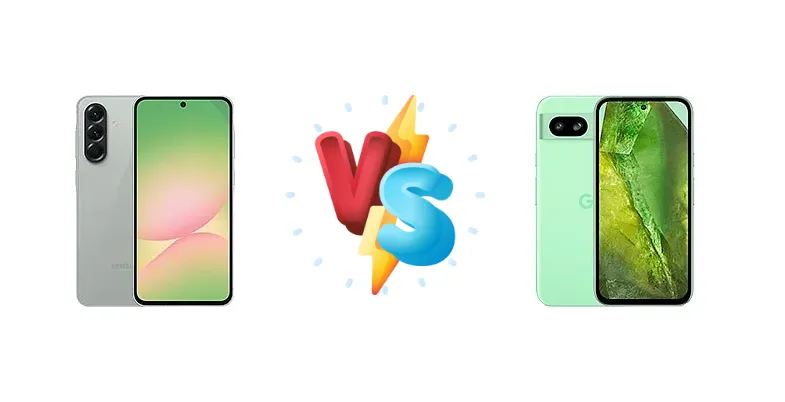
|
🏆 Quick Verdict
For the average user prioritizing longevity and rapid replenishment, the Samsung Galaxy A56 emerges as the winner. Its significantly longer 44:34h battery endurance and 45W charging capability outweigh the Pixel 8a’s processing advantages. However, Pixel purists will favor the 8a’s software experience.
| PHONES | ||
|---|---|---|
| Phone Names | Samsung Galaxy A56 | Google Pixel 8a |
| Network | ||
|---|---|---|
| 2G bands | GSM 850 / 900 / 1800 / 1900 | GSM 850 / 900 / 1800 / 1900 |
| 3G bands | HSDPA 850 / 900 / 1700(AWS) / 1900 / 2100 | HSDPA 800 / 850 / 900 / 1700(AWS) / 1900 / 2100 |
| 4G bands | 1, 2, 3, 4, 5, 7, 8, 12, 17, 20, 25, 26, 28, 32, 38, 40, 41, 66 | 1, 2, 3, 4, 5, 7, 8, 12, 17, 18, 19, 20, 26, 28, 32, 38, 40, 41, 42, 66 - G6GPR (International) |
| 5G bands | 1, 3, 5, 7, 8, 20, 28, 38, 40, 41, 66, 77, 78 SA/NSA/Sub6 | 1, 2, 3, 5, 7, 8, 12, 20, 26, 28, 38, 40, 41, 66, 75, 76, 77, 78 SA/NSA/Sub6 - G6GPR (International) |
| Speed | HSPA, LTE, 5G | HSPA, LTE, 5G |
| Technology | GSM / HSPA / LTE / 5G | GSM / HSPA / LTE / 5G |
| Launch | ||
|---|---|---|
| Announced | 2025, March 02 | 2024, May 07 |
| Status | Available. Released 2025, March 10 | Available. Released 2024, May 14 |
| Body | ||
|---|---|---|
| Build | Glass front (Gorilla Glass Victus+), glass back (Gorilla Glass Victus+), aluminum frame | Glass front (Gorilla Glass 3), aluminum frame, plastic back |
| Dimensions | 162.2 x 77.5 x 7.4 mm (6.39 x 3.05 x 0.29 in) | 152.1 x 72.7 x 8.9 mm (5.99 x 2.86 x 0.35 in) |
| SIM | Nano-SIM + Nano-SIM + eSIM + eSIM (max 2 at a time) | Nano-SIM + eSIM |
| Weight | 198 g (6.98 oz) | 188 g (6.63 oz) |
| Display | ||
|---|---|---|
| Protection | Corning Gorilla Glass Victus+, Mohs level 5 | Corning Gorilla Glass 3, Mohs level 5 |
| Resolution | 1080 x 2340 pixels, 19.5:9 ratio (~385 ppi density) | 1080 x 2400 pixels, 20:9 ratio (~430 ppi density) |
| Size | 6.7 inches, 110.2 cm2 (~87.7% screen-to-body ratio) | 6.1 inches, 90.3 cm2 (~81.6% screen-to-body ratio) |
| Type | Super AMOLED, 120Hz, HDR10+, 1200 nits (HBM), 1900 nits (peak) | OLED, HDR, 120Hz, 2000 nits (peak) |
| Platform | ||
|---|---|---|
| CPU | Octa-core (1x2.9 GHz Cortex-A720 & 3x2.6 GHz Cortex-A720 & 4x1.9 GHz Cortex-A520) | Nona-core (1x3.0 GHz Cortex-X3 & 4x2.45 GHz Cortex-A715 & 4x2.15 GHz Cortex-A510) |
| Chipset | Exynos 1580 (4 nm) | Google Tensor G3 (4 nm) |
| GPU | Xclipse 540 | Immortalis-G715s MC10 |
| OS | Android 15, up to 6 major Android upgrades, One UI 7 | Android 14, upgradable to Android 16, up to 7 major Android upgrades |
| Memory | ||
|---|---|---|
| Card slot | No | No |
| Internal | 128GB 6GB RAM, 128GB 8GB RAM, 256GB 6GB RAM, 256GB 8GB RAM, 256GB 12GB RAM | 128GB 8GB RAM, 256GB 8GB RAM |
| Main Camera | ||
|---|---|---|
| Dual | - | 64 MP (16 MP eff.), f/1.9, 26mm (wide), 1/1.73", 0.8µm, dual pixel PDAF, OIS 13 MP, f/2.2, 120˚ (ultrawide), 1.12µm |
| Features | Best Face, LED flash, panorama, HDR | Dual-LED flash, Pixel Shift, Ultra HDR, panorama, Best Take |
| Triple | 50 MP, f/1.8, (wide), 1/1.56", 1.0µm, PDAF, OIS 12 MP, f/2.2, 123˚ (ultrawide), 1/3.06", 1.12µm 5 MP (macro) | - |
| Video | 4K@30fps, 1080p@30/60fps, gyro-EIS | 4K@30/60fps, 1080p@30/60/120/240fps, OIS |
| Selfie camera | ||
|---|---|---|
| Features | - | HDR, panorama |
| Single | 12 MP, f/2.2, (wide) | 13 MP, f/2.2, 20mm (ultrawide), 1.12µm |
| Video | 4K@30fps, 1080p@30fps, 1080p@60fps (regional availability), 10-bit HDR | 4K@30fps, 1080p@30/60fps |
| Sound | ||
|---|---|---|
| 35mm jack | No | No |
| Loudspeaker | Yes, with stereo speakers | Yes, with stereo speakers |
| Comms | ||
|---|---|---|
| Bluetooth | 5.3, A2DP, LE | 5.3, A2DP, LE |
| NFC | Yes (market/region dependent) | Yes |
| Positioning | GPS, GALILEO, GLONASS, BDS, QZSS | GPS, GLONASS, GALILEO, BDS, QZSS, NavIC |
| Radio | No | No |
| USB | USB Type-C 2.0, OTG | USB Type-C 3.2 |
| WLAN | Wi-Fi 802.11 a/b/g/n/ac/6, dual-band, Wi-Fi Direct | Wi-Fi 802.11 a/b/g/n/ac/6e, dual/tri-band (market/region dependent) |
| Features | ||
|---|---|---|
| Sensors | Fingerprint (under display, optical), accelerometer, gyro, compass | Fingerprint (under display, optical), accelerometer, gyro, proximity, compass, barometer |
| Battery | ||
|---|---|---|
| Charging | 45W wired, 65% in 30 min, 100% in 68 min | 18W wired, PD3.0 7.5W wireless Bypass charging |
| Type | 5000 mAh | Li-Po 4492 mAh |
| Misc | ||
|---|---|---|
| Colors | Pink, Olive, Graphite, Lightgray | Obsidian, Porcelain, Bay, Aloe |
| Models | SM-A566V, SM-A566B, SM-A566B/DS, SM-A566E, SM-A566E/DS, SM-A5660, SM-A566U, SM-A566U1, SM-A566W, SM-A566S | GKV4X, G6GPR, G8HHN, G576D |
| Price | € 286.99 / $ 308.29 / £ 249.00 / ₹ 38,999 | $ 229.98 / C$ 417.99 / £ 279.00 / € 299.99 / ₹ 33,300 |
| SAR | 1.32 W/kg (head) | - |
| SAR EU | 0.61 W/kg (head) 1.05 W/kg (body) | - |
| EU LABEL | ||
|---|---|---|
| Battery | 44:34h endurance, 2000 cycles | 40:06h endurance, 1000 cycles |
| Energy | Class B | Class B |
| Free fall | Class A (270 falls) | Class A (270 falls) |
| Repairability | Class C | Class B |
Samsung Galaxy A56
- Exceptional battery endurance (44:34h)
- Ultra-fast 45W charging
- Brighter display for outdoor use
- Less powerful processor than Pixel 8a
- Camera likely lags behind Pixel 8a’s computational photography
Google Pixel 8a
- Powerful Google Tensor G3 chip
- Superior image processing and camera quality
- Clean Android experience with guaranteed updates
- Shorter battery life (40:06h)
- Slower 18W charging
Display Comparison
The Google Pixel 8a boasts a brighter display, reaching 1508 nits compared to the Samsung Galaxy A56’s 1213 nits. This translates to superior visibility in direct sunlight. While both utilize 4nm chipsets, the display difference is immediately noticeable. Samsung doesn’t specify panel technology, but the A56’s brightness is still respectable. The Pixel 8a’s higher peak brightness is a clear advantage for outdoor users, and likely contributes to a more vibrant viewing experience overall.
Camera Comparison
While detailed camera specs are missing, the Pixel 8a’s strength lies in Google’s computational photography. The Tensor G3 chip is specifically designed to accelerate image processing, resulting in superior dynamic range and low-light performance. The A56 likely relies more on hardware, and while it may produce good results, it won’t match the Pixel’s software-driven enhancements. The absence of detailed sensor information makes a direct comparison difficult, but Google’s track record suggests a significant advantage in image quality.
Performance
The Google Pixel 8a’s Tensor G3, with its nona-core configuration including a Cortex-X3 prime core clocked at 3.0 GHz, offers a more complex and potentially faster processing experience than the Samsung Galaxy A56’s Exynos 1580. The Exynos 1580’s octa-core setup, while utilizing Cortex-A720 cores, lacks the high-performance X3 core. This difference will be most apparent in demanding tasks like video editing or graphically intensive games. However, the A56’s thermal management, given the Exynos’ 4nm process, should be efficient enough for everyday use. The Pixel 8a’s Tensor G3 is also optimized for Google’s AI features.
Battery Life
Battery life is where the Samsung Galaxy A56 truly shines. Its 44:34h endurance rating significantly surpasses the Pixel 8a’s 40:06h. This difference is further amplified by the A56’s 45W wired charging, capable of reaching 65% in 30 minutes and 100% in 68 minutes, compared to the Pixel 8a’s slower 18W charging. The Pixel 8a does offer 7.5W wireless charging and bypass charging, but the A56’s faster wired charging is a more practical benefit for most users. The A56 also boasts 2000 charge cycles, suggesting greater long-term battery health compared to the Pixel 8a’s 1000 cycles.
Buying Guide
Buy the Samsung Galaxy A56 if you need exceptional battery life, fast charging, and a brighter display for outdoor visibility. It’s ideal for users who frequently travel or rely heavily on their phone throughout the day. Buy the Google Pixel 8a if you prioritize a clean Android experience, Google’s computational photography prowess, and a more powerful processor for demanding tasks like video editing or gaming.