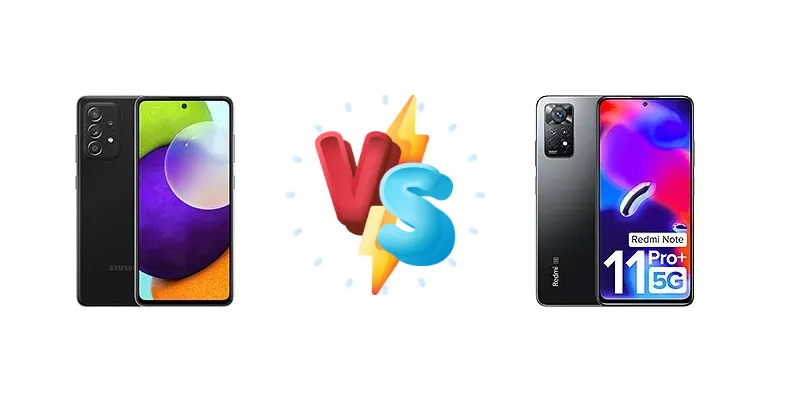
The Samsung Galaxy A52, while an older model, remains a popular choice due to its established brand reputation and solid all-around performance. The Xiaomi Redmi Note 11 Pro+ 5G (India) aims to disrupt this with significantly faster charging and a newer chipset, but at what cost? This comparison dives deep into the key differences to help you choose the right phone for your needs.
🏆 Quick Verdict
For most users, the Xiaomi Redmi Note 11 Pro+ 5G (India) offers a compelling upgrade with its 67W charging, replenishing 50% of the battery in just 15 minutes. While the Galaxy A52 boasts a slightly higher endurance rating, the Redmi’s charging speed and newer Snapdragon 695 chipset make it the better overall value.
| Network |
|---|
| 2G bands | GSM 850 / 900 / 1800 / 1900 | GSM 850 / 900 / 1800 / 1900 - SIM 1 & SIM 2 |
| 3G bands | HSDPA 850 / 900 / 1700(AWS) / 1900 / 2100 | HSDPA 850 / 900 / 1900 / 2100 |
| 4G bands | 1, 2, 3, 4, 5, 7, 8, 12, 17, 20, 26, 28, 32, 38, 40, 41, 66 | 1, 3, 5, 8, 40, 41 |
| 5G bands | - | 1, 3, 5, 8, 28, 40, 78 SA/NSA |
| Speed | HSPA, LTE | HSPA, LTE-A (CA), 5G |
| Technology | GSM / HSPA / LTE | GSM / HSPA / LTE / 5G |
| Launch |
|---|
| Announced | 2021, March 17 | 2022, March 09 |
| Status | Available. Released 2021, March 26 | Available. Released 2022, March 15 |
| Body |
|---|
| Build | Glass front (Gorilla Glass 5), plastic frame, plastic back | Glass front (Gorilla Glass 5), glass back |
| Dimensions | 159.9 x 75.1 x 8.4 mm (6.30 x 2.96 x 0.33 in) | 164.2 x 76.1 x 8.1 mm (6.46 x 3.00 x 0.32 in) |
| SIM | · Nano-SIM· Nano-SIM + Nano-SIM | Hybrid Dual SIM (Nano-SIM, dual stand-by) |
| Weight | 189 g (6.67 oz) | 202 g (7.13 oz) |
| | - | IP53, dust and splash resistant |
| Display |
|---|
| Protection | Corning Gorilla Glass 5 | Corning Gorilla Glass 5 |
| Resolution | 1080 x 2400 pixels, 20:9 ratio (~407 ppi density) | 1080 x 2400 pixels, 20:9 ratio (~395 ppi density) |
| Size | 6.5 inches, 101.0 cm2 (~84.1% screen-to-body ratio) | 6.67 inches, 107.4 cm2 (~86.0% screen-to-body ratio) |
| Type | Super AMOLED, 90Hz, 800 nits (HBM) | Super AMOLED, 120Hz, 700 nits, 1200 nits (peak) |
| Platform |
|---|
| CPU | Octa-core (2x2.3 GHz Kryo 465 Gold & 6x1.8 GHz Kryo 465 Silver) | Octa-core (2x2.2 GHz Kryo 660 Gold & 6x1.7 GHz Kryo 660 Silver) |
| Chipset | Qualcomm SM7125 Snapdragon 720G (8 nm) | Qualcomm SM6375 Snapdragon 695 5G (6 nm) |
| GPU | Adreno 618 | Adreno 619 |
| OS | Android 11, upgradable to Android 14, One UI 6.1 | Android 11, MIUI 13 |
| Memory |
|---|
| Card slot | microSDXC (uses shared SIM slot) | microSDXC (uses shared SIM slot) |
| Internal | 128GB 4GB RAM, 128GB 6GB RAM, 128GB 8GB RAM, 256GB 6GB RAM, 256GB 8GB RAM | 64GB 6GB RAM, 128GB 6GB RAM, 128GB 8GB RAM, 256GB 8GB RAM |
| | - | UFS 2.2 |
| Main Camera |
|---|
| Features | LED flash, panorama, HDR | LED flash, HDR, panorama |
| Quad | 64 MP, f/1.8, 26mm (wide), 1/1.7", 0.8µm, PDAF, OIS
12 MP, f/2.2, 123˚ (ultrawide), 1.12µm
5 MP (macro)
Auxiliary lens | - |
| Triple | - | 108 MP, f/1.9, 26mm (wide), 1/1.52", 0.7µm, PDAF
8 MP, f/2.2, 118˚ (ultrawide)
2 MP, f/2.4, (macro) |
| Video | 4K@30fps, 1080p@30/60fps; gyro-EIS | 1080p@30fps |
| Selfie camera |
|---|
| Features | HDR | - |
| Single | 32 MP, f/2.2, 26mm (wide), 1/2.8", 0.8µm | 16 MP, f/2.5, (wide), 1/3.06" 1.0µm |
| Video | 4K@30fps, 1080p@30fps | 1080p@30fps |
| Sound |
|---|
| 3.5mm jack | Yes | Yes |
| 35mm jack | Yes | - |
| Loudspeaker | Yes, with stereo speakers | Yes, with stereo speakers |
| | - | 24-bit/192kHz audio |
| Comms |
|---|
| Bluetooth | 5.0, A2DP, LE | 5.1, A2DP, LE |
| Infrared port | - | Yes |
| NFC | Yes (market/region dependent) | No |
| Positioning | GPS, GLONASS, GALILEO, BDS | GPS, GLONASS, BDS, GALILEO |
| Radio | FM radio | Unspecified |
| USB | USB Type-C 2.0, OTG | USB Type-C 2.0, OTG |
| WLAN | Wi-Fi 802.11 a/b/g/n/ac, dual-band, Wi-Fi Direct | Wi-Fi 802.11 a/b/g/n/ac, dual-band, Wi-Fi Direct |
| Features |
|---|
| Sensors | Fingerprint (under display, optical), accelerometer, gyro, compass | Fingerprint (side-mounted), accelerometer, gyro, proximity, compass |
| Battery |
|---|
| Charging | 25W wired, 50% in 30 min | 67W wired, PD3.0, QC3, 50% in 15 min, 100% in 42 min (advertised) |
| Type | Li-Po 4500 mAh | Li-Po 5000 mAh, non-removable |
| Misc |
|---|
| Colors | Awesome Black, Awesome White, Awesome Violet, Awesome Blue | Mirage Blue, Phantom White, Stealth Black |
| Models | SM-A525F, SM-A525F/DS, SM-A525M, SM-A525M/DS | 2201116SI |
| Price | C$ 699.00 / £ 129.99 / € 169.89 | About 250 EUR |
| SAR EU | 0.35 W/kg (head) 0.84 W/kg (body) | - |
| Tests |
|---|
| Battery life |
Endurance rating 105h
| - |
| Camera |
Photo / Video | - |
| Display |
Contrast ratio: Infinite (nominal) | - |
| Loudspeaker |
-27.0 LUFS (Good)
| - |
| Performance |
AnTuTu: 261282 (v8)
GeekBench: 5865 (v4.4), 1577 (v5.1)
GFXBench: 15fps (ES 3.1 onscreen) | - |
Samsung Galaxy A52
- Proven reliability and software support from Samsung
- Good display brightness for outdoor visibility (794 nits)
- Solid battery endurance (105h rating)
- Slower 25W charging
- Older Snapdragon 720G chipset (8nm process)
Xiaomi Redmi Note 11 Pro+ 5G (India)
- Ultra-fast 67W charging (50% in 15 min)
- More efficient Snapdragon 695 5G chipset (6nm process)
- Likely more modern camera system
- MIUI software may not appeal to all users
- Long-term software support is less certain than Samsung
Display Comparison
The Samsung Galaxy A52 features a display capable of reaching 794 nits of peak brightness, ensuring good visibility outdoors. While the Redmi Note 11 Pro+ 5G’s display brightness isn’t specified, it’s likely comparable. Both devices lack LTPO technology, meaning refresh rate scaling isn’t as efficient as on higher-end phones. The A52’s ‘Infinite’ contrast ratio is a marketing term, but generally indicates a good quality AMOLED panel. The Redmi Note 11 Pro+ 5G’s display technology isn’t specified, but is likely AMOLED given the brand’s recent trends.
Camera Comparison
Both devices are listed as having Photo/Video capabilities, but detailed camera specs are missing. Given the Redmi Note 11 Pro+ 5G’s positioning, it likely features a higher resolution main sensor than the A52. The absence of details on Optical Image Stabilization (OIS) for either device makes it difficult to assess low-light performance. The A52’s image processing is known for its vibrant colors, while Xiaomi typically aims for a more natural look. Without further information, it’s difficult to definitively declare a camera winner.
Performance
The Redmi Note 11 Pro+ 5G (India) utilizes the Qualcomm Snapdragon 695 5G (6nm), while the Galaxy A52 is powered by the Snapdragon 720G (8nm). The 6nm process of the 695 should offer improved power efficiency and potentially better sustained performance under load. Although the 720G has a slightly higher clock speed on its prime cores (2.3 GHz vs 2.2 GHz), the architectural improvements and process node of the 695 likely translate to a more responsive user experience, especially in tasks leveraging 5G connectivity. Both phones feature an octa-core CPU configuration with a similar Kryo core arrangement.
Battery Life
The Samsung Galaxy A52 achieves an endurance rating of 105 hours, indicating solid battery life. However, the Xiaomi Redmi Note 11 Pro+ 5G (India) compensates for any potential capacity difference with its blazing-fast 67W wired charging, achieving 50% charge in just 15 minutes and a full charge in 42 minutes (advertised). The A52’s 25W charging takes 30 minutes to reach 50%, highlighting a significant difference in charging convenience. The 6nm process of the Snapdragon 695 in the Redmi may also contribute to improved power efficiency, partially offsetting any capacity disadvantage.
Buying Guide
Buy the Samsung Galaxy A52 if you prioritize a proven track record, a well-established software ecosystem, and a slightly longer overall battery endurance rating. Buy the Xiaomi Redmi Note 11 Pro+ 5G (India) if you value incredibly fast charging, a more modern chipset fabricated on a smaller 6nm process, and are comfortable with Xiaomi’s MIUI software.
Frequently Asked Questions
❓ Does the Snapdragon 695 in the Redmi Note 11 Pro+ 5G handle demanding games like PUBG or Call of Duty?
The Snapdragon 695 is a capable mid-range chipset. While it won't deliver flagship-level performance, it should handle PUBG and Call of Duty at medium settings with reasonable frame rates. Expect some frame drops during intense action, but it's generally playable. The 6nm process helps with thermal throttling, allowing for sustained performance.
❓ Is the 67W charging on the Redmi Note 11 Pro+ 5G safe for the battery's long-term health?
Xiaomi incorporates several safety mechanisms into its 67W charging system to protect the battery. While fast charging *can* theoretically degrade battery health faster over the long term, the Redmi Note 11 Pro+ 5G utilizes intelligent charging algorithms that slow down the charging rate as the battery approaches full capacity, minimizing heat and stress.
❓ How does the software experience differ between Samsung's One UI and Xiaomi's MIUI on these devices?
Samsung's One UI is generally considered cleaner and more intuitive, with a focus on ease of use. Xiaomi's MIUI is highly customizable but can be more cluttered with pre-installed apps and features. MIUI also has a reputation for more aggressive battery management, which can sometimes impact background app performance.