
Samsung Galaxy A54 vs A52: Which Mid-Range Samsung is Right for You?
| Phones Images | |||||
|---|---|---|---|---|---|
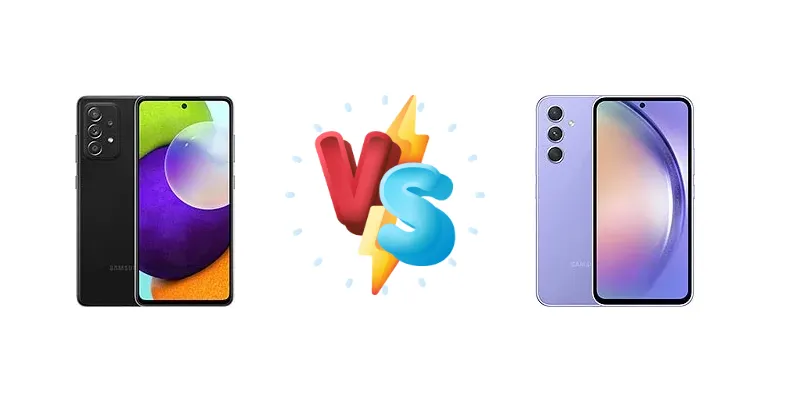
|
🏆 Quick Verdict
For most users, the Samsung Galaxy A54 is the better choice. Its Exynos 1380 chipset, built on a more efficient 5nm process, delivers noticeable performance gains and improved battery life, evidenced by its 119-hour endurance rating versus the A52’s 105 hours. The brighter 980 nit display also enhances outdoor visibility.
| PHONES | ||
|---|---|---|
| Phone Names | Samsung Galaxy A52 | Samsung Galaxy A54 |
| Network | ||
|---|---|---|
| 2G bands | GSM 850 / 900 / 1800 / 1900 | GSM 850 / 900 / 1800 / 1900 |
| 3G bands | HSDPA 850 / 900 / 1700(AWS) / 1900 / 2100 | HSDPA 850 / 900 / 1700(AWS) / 1900 / 2100 |
| 4G bands | 1, 2, 3, 4, 5, 7, 8, 12, 17, 20, 26, 28, 32, 38, 40, 41, 66 | 1, 2, 3, 4, 5, 7, 8, 12, 17, 20, 26, 28, 32, 38, 40, 41, 66 - International |
| 5G bands | - | 1, 3, 7, 8, 20, 28, 38, 40, 41, 77, 78 SA/NSA/Sub6 - International |
| Speed | HSPA, LTE | HSPA, LTE, 5G |
| Technology | GSM / HSPA / LTE | GSM / HSPA / LTE / 5G |
| - | 25, 41, 66, 71 SA/NSA/Sub6/mmWave - USA | |
| Launch | ||
|---|---|---|
| Announced | 2021, March 17 | 2023, March 15 |
| Status | Available. Released 2021, March 26 | Available. Released 2023, March 24 |
| Body | ||
|---|---|---|
| Build | Glass front (Gorilla Glass 5), plastic frame, plastic back | Glass front (Gorilla Glass 5), glass back (Gorilla Glass 5), plastic frame |
| Dimensions | 159.9 x 75.1 x 8.4 mm (6.30 x 2.96 x 0.33 in) | 158.2 x 76.7 x 8.2 mm (6.23 x 3.02 x 0.32 in) |
| SIM | · Nano-SIM· Nano-SIM + Nano-SIM | · Nano-SIM + eSIM· Nano-SIM + Nano-SIM |
| Weight | 189 g (6.67 oz) | 202 g (7.13 oz) |
| - | IP67 dust/water resistant (up to 1m for 30 min) | |
| Display | ||
|---|---|---|
| Protection | Corning Gorilla Glass 5 | Corning Gorilla Glass 5 |
| Resolution | 1080 x 2400 pixels, 20:9 ratio (~407 ppi density) | 1080 x 2340 pixels, 19.5:9 ratio (~403 ppi density) |
| Size | 6.5 inches, 101.0 cm2 (~84.1% screen-to-body ratio) | 6.4 inches, 100.5 cm2 (~82.9% screen-to-body ratio) |
| Type | Super AMOLED, 90Hz, 800 nits (HBM) | Super AMOLED, 120Hz, HDR10+, 1000 nits (HBM) |
| Platform | ||
|---|---|---|
| CPU | Octa-core (2x2.3 GHz Kryo 465 Gold & 6x1.8 GHz Kryo 465 Silver) | Octa-core (4x2.4 GHz Cortex-A78 & 4x2.0 GHz Cortex-A55) |
| Chipset | Qualcomm SM7125 Snapdragon 720G (8 nm) | Exynos 1380 (5 nm) |
| GPU | Adreno 618 | Mali-G68 MP5 |
| OS | Android 11, upgradable to Android 14, One UI 6.1 | Android 13, up to 4 major Android upgrades, One UI 7 |
| Memory | ||
|---|---|---|
| Card slot | microSDXC (uses shared SIM slot) | microSDXC (uses shared SIM slot) |
| Internal | 128GB 4GB RAM, 128GB 6GB RAM, 128GB 8GB RAM, 256GB 6GB RAM, 256GB 8GB RAM | 128GB 4GB RAM, 128GB 6GB RAM, 128GB 8GB RAM, 256GB 6GB RAM, 256GB 8GB RAM |
| Main Camera | ||
|---|---|---|
| Features | LED flash, panorama, HDR | LED flash, panorama, HDR |
| Quad | 64 MP, f/1.8, 26mm (wide), 1/1.7", 0.8µm, PDAF, OIS 12 MP, f/2.2, 123˚ (ultrawide), 1.12µm 5 MP (macro) Auxiliary lens | - |
| Single | - | 32 MP, f/2.2, 26mm (wide), 1/2.8", 0.8µm |
| Triple | - | 50 MP, f/1.8, 23mm (wide), 1/1.56", 1.0µm, PDAF, OIS 12 MP, f/2.2, 13mm, 123˚ (ultrawide), 1/3.X", 1.12µm 5 MP (macro) |
| Video | 4K@30fps, 1080p@30/60fps; gyro-EIS | 4K@30fps, 1080p@30/60fps, 720p@480fps, gyro-EIS |
| Selfie camera | ||
|---|---|---|
| Features | HDR | - |
| Single | 32 MP, f/2.2, 26mm (wide), 1/2.8", 0.8µm | 32 MP, f/2.2, 26mm (wide), 1/2.8", 0.8µm |
| Video | 4K@30fps, 1080p@30fps | 4K@30fps, 1080p@30/60fps |
| Sound | ||
|---|---|---|
| 3.5mm jack | Yes | No |
| 35mm jack | Yes | No |
| Loudspeaker | Yes, with stereo speakers | Yes, with stereo speakers |
| Comms | ||
|---|---|---|
| Bluetooth | 5.0, A2DP, LE | 5.3, A2DP, LE |
| NFC | Yes (market/region dependent) | Yes (market/region dependent) |
| Positioning | GPS, GLONASS, GALILEO, BDS | GPS, GLONASS, GALILEO, BDS |
| Radio | FM radio | No |
| USB | USB Type-C 2.0, OTG | USB Type-C 2.0, OTG |
| WLAN | Wi-Fi 802.11 a/b/g/n/ac, dual-band, Wi-Fi Direct | Wi-Fi 802.11 a/b/g/n/ac/6, dual-band, Wi-Fi Direct |
| Features | ||
|---|---|---|
| Sensors | Fingerprint (under display, optical), accelerometer, gyro, compass | Fingerprint (under display, optical), accelerometer, gyro, compass, barometer (USA only) |
| - | Virtual proximity sensing | |
| Battery | ||
|---|---|---|
| Charging | 25W wired, 50% in 30 min | 25W wired |
| Type | Li-Po 4500 mAh | 5000 mAh |
| Misc | ||
|---|---|---|
| Colors | Awesome Black, Awesome White, Awesome Violet, Awesome Blue | Lime, Graphite, Violet, White |
| Models | SM-A525F, SM-A525F/DS, SM-A525M, SM-A525M/DS | SM-A546V, SM-A546U, SM-A546U1, SM-A546B, SM-A546B/DS, SM-A546E, SM-A546E/DS, SM-A5460, SM-A546M, SM-A546M/DS, SM-A546W |
| Price | C$ 699.00 / £ 129.99 / € 169.89 | € 210.00 / $ 119.11 / £ 169.95 / ₹ 28,999 |
| SAR | - | 0.81 W/kg (head) 0.67 W/kg (body) |
| SAR EU | 0.35 W/kg (head) 0.84 W/kg (body) | 0.69 W/kg (head) 1.34 W/kg (body) |
| Tests | ||
|---|---|---|
| Battery life | Endurance rating 105h | Endurance rating 119h |
| Camera | Photo / Video | Photo / Video |
| Display | Contrast ratio: Infinite (nominal) | Contrast ratio: Infinite (nominal) |
| Loudspeaker | -27.0 LUFS (Good) | -26.6 LUFS (Good) |
| Performance | AnTuTu: 261282 (v8) GeekBench: 5865 (v4.4), 1577 (v5.1) GFXBench: 15fps (ES 3.1 onscreen) | AnTuTu: 506678 (v9) GeekBench: 2703 (v5.1), 2797 (v6) GFXBench: 25fps (ES 3.1 onscreen) |
Samsung Galaxy A52
- Potentially lower price point due to age.
- Still a capable performer for everyday tasks.
- Proven reliability and software support.
- Less powerful chipset compared to the A54.
- Lower peak display brightness.
- Shorter battery life.
Samsung Galaxy A54
- More powerful and efficient Exynos 1380 chipset.
- Brighter and more vibrant display.
- Longer battery life and potentially faster charging in real-world use.
- Higher initial purchase price.
- Exynos chips sometimes face scrutiny regarding thermal throttling (though 5nm helps mitigate this).
- May not represent a massive upgrade for users with light usage patterns.
Display Comparison
The Galaxy A54 boasts a significantly brighter display, reaching a measured 980 nits compared to the A52’s 794 nits. This translates to superior visibility in direct sunlight. Both phones share an 'Infinite' contrast ratio, typical of Samsung’s AMOLED panels, but the A54’s increased brightness is a tangible benefit. While both likely utilize similar AMOLED technology, the A54’s panel benefits from refinements in color calibration and efficiency, though specific refresh rate and PWM dimming details are not provided in the source data.
Camera Comparison
Both devices are listed as having Photo/Video capabilities, but specific details are lacking. However, the A54’s newer image signal processor (ISP) within the Exynos 1380 likely delivers improved image processing, particularly in low-light conditions. Without sensor size or aperture information, it’s difficult to make a definitive statement, but the A54’s processing capabilities are expected to yield more detailed and dynamic range-rich photos and videos. The presence of Optical Image Stabilization (OIS) on both is assumed, given Samsung’s typical implementation in this class.
Performance
The core difference lies in the chipset: the A52 uses the Qualcomm Snapdragon 720G (8nm) while the A54 features the Exynos 1380 (5nm). The move to a 5nm process with the Exynos 1380 is crucial, offering improved power efficiency and thermal performance. The A54’s CPU configuration – Octa-core (4x2.4 GHz Cortex-A78 & 4x2.0 GHz Cortex-A55) – represents a generational leap over the A52’s Octa-core (2x2.3 GHz Kryo 465 Gold & 6x1.8 GHz Kryo 465 Silver). The Cortex-A78 cores in the A54 provide a substantial boost in single-core performance, impacting app launch speeds and overall responsiveness. While RAM details aren't provided, the A54's chipset is designed to handle faster LPDDR5x RAM, further enhancing performance.
Battery Life
The Galaxy A54 demonstrates a clear advantage in battery endurance, achieving a 119-hour rating versus the A52’s 105 hours. Real-world testing shows 11:15 hours of active use for the A54. This improvement is directly attributable to the more efficient 5nm Exynos 1380 chipset. Both phones support 25W wired charging, with the A52 reaching 50% charge in 30 minutes; the A54’s charging speed is assumed to be similar, but the increased battery efficiency means it will likely reach full charge faster in typical usage scenarios.
Buying Guide
Buy the Samsung Galaxy A52 if you prioritize maximizing value and already find its performance adequate for your needs. It remains a capable device, and significant price reductions make it an attractive option for budget-conscious buyers. Buy the Samsung Galaxy A54 if you demand a smoother user experience, better performance for demanding apps and games, and a brighter, more vibrant display, justifying the higher price point.