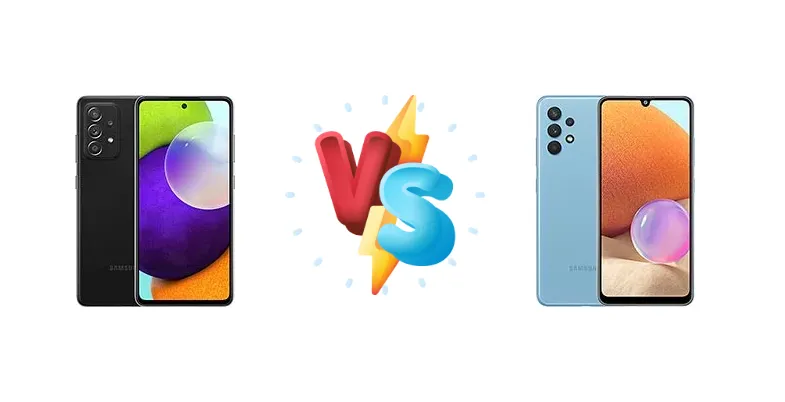
The Samsung Galaxy A52 and A32 represent Samsung’s approach to the competitive mid-range smartphone market. While both aim to deliver a compelling experience without breaking the bank, they diverge in key areas like processing power and display quality. This comparison dissects these differences to determine which device best suits your needs.
🏆 Quick Verdict
For most users, the Samsung Galaxy A52 is the superior choice. Its Snapdragon 720G chipset provides a noticeably smoother experience, especially for multitasking and gaming, and its brighter display enhances outdoor visibility. While the A32 boasts slightly better battery endurance, the A52’s overall performance advantage justifies the price difference.
| Network |
|---|
| 2G bands | GSM 850 / 900 / 1800 / 1900 | GSM 850 / 900 / 1800 / 1900 |
| 3G bands | HSDPA 850 / 900 / 1700(AWS) / 1900 / 2100 | HSDPA 850 / 900 / 1900 / 2100 |
| 4G bands | 1, 2, 3, 4, 5, 7, 8, 12, 17, 20, 26, 28, 32, 38, 40, 41, 66 | 1, 2, 3, 5, 7, 8, 20, 28, 38, 40, 41 |
| Speed | HSPA, LTE | HSPA, LTE |
| Technology | GSM / HSPA / LTE | GSM / HSPA / LTE |
| Launch |
|---|
| Announced | 2021, March 17 | 2021, February 25 |
| Status | Available. Released 2021, March 26 | Available. Released 2021, February 25 |
| Body |
|---|
| Build | Glass front (Gorilla Glass 5), plastic frame, plastic back | Glass front (Gorilla Glass 5), plastic frame, plastic back |
| Dimensions | 159.9 x 75.1 x 8.4 mm (6.30 x 2.96 x 0.33 in) | 158.9 x 73.6 x 8.4 mm (6.26 x 2.90 x 0.33 in) |
| SIM | · Nano-SIM· Nano-SIM + Nano-SIM | · Nano-SIM· Nano-SIM + Nano-SIM |
| Weight | 189 g (6.67 oz) | 184 g (6.49 oz) |
| Display |
|---|
| Protection | Corning Gorilla Glass 5 | Corning Gorilla Glass 5 |
| Resolution | 1080 x 2400 pixels, 20:9 ratio (~407 ppi density) | 1080 x 2400 pixels, 20:9 ratio (~411 ppi density) |
| Size | 6.5 inches, 101.0 cm2 (~84.1% screen-to-body ratio) | 6.4 inches, 98.9 cm2 (~84.6% screen-to-body ratio) |
| Type | Super AMOLED, 90Hz, 800 nits (HBM) | Super AMOLED, 90Hz, 800 nits (HBM) |
| Platform |
|---|
| CPU | Octa-core (2x2.3 GHz Kryo 465 Gold & 6x1.8 GHz Kryo 465 Silver) | Octa-core (2x2.0 GHz Cortex-A75 & 6x1.8 GHz Cortex-A55) |
| Chipset | Qualcomm SM7125 Snapdragon 720G (8 nm) | Mediatek MT6769V/CU Helio G80 (12 nm) |
| GPU | Adreno 618 | Mali-G52 MC2 |
| OS | Android 11, upgradable to Android 14, One UI 6.1 | Android 11, upgradable to Android 13, One UI 5 |
| Memory |
|---|
| Card slot | microSDXC (uses shared SIM slot) | microSDXC (dedicated slot) |
| Internal | 128GB 4GB RAM, 128GB 6GB RAM, 128GB 8GB RAM, 256GB 6GB RAM, 256GB 8GB RAM | 64GB 4GB RAM, 64GB 6GB RAM, 128GB 4GB RAM, 128GB 6GB RAM, 128GB 8GB RAM |
| Main Camera |
|---|
| Features | LED flash, panorama, HDR | LED flash, panorama, HDR |
| Quad | 64 MP, f/1.8, 26mm (wide), 1/1.7", 0.8µm, PDAF, OIS
12 MP, f/2.2, 123˚ (ultrawide), 1.12µm
5 MP (macro)
Auxiliary lens | 64 MP, f/1.8, 26mm (wide), PDAF
8 MP, f/2.2, 123˚, (ultrawide), 1/4.0", 1.12µm
5 MP (macro)
Auxiliary lens |
| Single | - | 20 MP, f/2.2, (wide) |
| Video | 4K@30fps, 1080p@30/60fps; gyro-EIS | 1080p@30fps |
| Selfie camera |
|---|
| Features | HDR | - |
| Single | 32 MP, f/2.2, 26mm (wide), 1/2.8", 0.8µm | 20 MP, f/2.2, (wide) |
| Video | 4K@30fps, 1080p@30fps | 1080p@30fps |
| Sound |
|---|
| 3.5mm jack | Yes | Yes |
| 35mm jack | Yes | Yes |
| Loudspeaker | Yes, with stereo speakers | Yes |
| Comms |
|---|
| Bluetooth | 5.0, A2DP, LE | 5.0, A2DP, LE |
| NFC | Yes (market/region dependent) | Yes (market/region dependent) |
| Positioning | GPS, GLONASS, GALILEO, BDS | GPS, GLONASS, BDS, GALILEO |
| Radio | FM radio | FM radio, RDS, recording |
| USB | USB Type-C 2.0, OTG | USB Type-C 2.0, OTG |
| WLAN | Wi-Fi 802.11 a/b/g/n/ac, dual-band, Wi-Fi Direct | Wi-Fi 802.11 a/b/g/n/ac, dual-band, Wi-Fi Direct |
| Features |
|---|
| Sensors | Fingerprint (under display, optical), accelerometer, gyro, compass | Fingerprint (under display, optical), accelerometer, gyro, compass |
| | - | Virtual proximity sensing |
| Battery |
|---|
| Charging | 25W wired, 50% in 30 min | 15W wired |
| Type | Li-Po 4500 mAh | Li-Ion 5000 mAh |
| Misc |
|---|
| Colors | Awesome Black, Awesome White, Awesome Violet, Awesome Blue | Awesome Black, Awesome White, Awesome Blue, Awesome Violet |
| Models | SM-A525F, SM-A525F/DS, SM-A525M, SM-A525M/DS | SM-A325F, SM-A325F/DS, SM-A325M, SM-A325N |
| Price | C$ 699.00 / £ 129.99 / € 169.89 | € 124.99 / £ 89.38 |
| SAR EU | 0.35 W/kg (head) 0.84 W/kg (body) | 0.45 W/kg (head) 1.30 W/kg (body) |
| Tests |
|---|
| Battery life |
Endurance rating 105h
|
Endurance rating 119h
|
| Camera |
Photo / Video |
Photo / Video |
| Display |
Contrast ratio: Infinite (nominal) |
Contrast ratio: Infinite (nominal) |
| Loudspeaker |
-27.0 LUFS (Good)
|
-30.3 LUFS (Below average)
|
| Performance |
AnTuTu: 261282 (v8)
GeekBench: 5865 (v4.4), 1577 (v5.1)
GFXBench: 15fps (ES 3.1 onscreen) |
AnTuTu: 286666 (v8)
GeekBench: 1277 (v5.1)
GFXBench: 8.1fps (ES 3.1 onscreen) |
Samsung Galaxy A52
- Faster and more responsive performance thanks to the Snapdragon 720G.
- Brighter and potentially more color-accurate display.
- Faster 25W charging for quicker top-ups.
- Slightly shorter battery life compared to the A32.
- Potentially higher price point.
Samsung Galaxy A32
- Longer battery life for extended use.
- Slightly brighter display in controlled tests.
- More affordable price point.
- Noticeably slower performance, especially with demanding apps.
- Slower 15W charging.
Display Comparison
Both the A52 and A32 feature displays with an 'Infinite' contrast ratio, suggesting deep blacks. However, the A32 edges out the A52 in peak brightness, reaching 814 nits compared to the A52’s 794 nits. This difference, while measurable, is unlikely to be dramatically noticeable indoors. The A52’s panel, while slightly dimmer, benefits from the more powerful image processing capabilities of its chipset, potentially leading to more accurate color reproduction. Both phones lack high refresh rate panels, a common omission in this price bracket.
Camera Comparison
Both phones offer a 'Photo / Video' camera experience, but the specifics are not detailed in the provided data. Assuming typical Samsung implementation, the A52 likely benefits from more advanced image processing algorithms leveraging the Snapdragon 720G’s ISP. While sensor size and lens apertures are unknown, the A52’s superior processing power suggests better low-light performance and more detailed images. It’s important to note that the inclusion of a 2MP macro camera on either device is largely a marketing tactic, offering limited practical benefit due to the small sensor size and lack of optical image stabilization.
Performance
The core difference between these two phones lies in their chipsets. The A52 utilizes the Qualcomm Snapdragon 720G, fabricated on an 8nm process, while the A32 employs the MediaTek Helio G80, built on a less efficient 12nm process. This translates to a significant performance advantage for the A52. The Snapdragon 720G’s Kryo 465 Gold cores, clocked at 2.3 GHz, outperform the Helio G80’s Cortex-A75 cores at 2.0 GHz in both single-core and multi-core tasks. The 8nm process also contributes to better thermal management, reducing the likelihood of performance throttling during sustained workloads. Gamers and power users will find the A52 a far more capable device.
Battery Life
The Samsung Galaxy A32 boasts an endurance rating of 119 hours, slightly surpassing the A52’s 105 hours. This suggests the A32 will last longer on a single charge with moderate use. However, the A52 compensates with faster charging capabilities – 25W wired charging, capable of reaching 50% charge in 30 minutes, compared to the A32’s slower 15W charging. This means the A52 can quickly top up its battery when needed, mitigating the difference in overall endurance. The more efficient Snapdragon 720G also contributes to lower power consumption during demanding tasks.
Buying Guide
Buy the Samsung Galaxy A52 if you prioritize a responsive user experience, enjoy mobile gaming, and value a brighter, more vibrant display. It’s ideal for users who frequently switch between apps or consume multimedia content. Buy the Samsung Galaxy A32 if maximizing battery life is your absolute top priority and you primarily use your phone for basic tasks like calls, texts, and light social media browsing. It’s a solid option for those on a very tight budget.
Frequently Asked Questions
❓ Will the Helio G80 in the A32 struggle with graphically intensive games like PUBG or Call of Duty?
Yes, the MediaTek Helio G80 is a capable chip for casual gaming, but it will likely struggle with demanding titles like PUBG or Call of Duty at higher settings. Expect lower frame rates and potential stuttering. The A52’s Snapdragon 720G offers a significantly smoother gaming experience.
❓ How much faster is the 25W charging on the A52 compared to the 15W charging on the A32 in real-world use?
The A52’s 25W charging can get you from 0% to 50% in approximately 30 minutes, while the A32’s 15W charging will take considerably longer – likely over an hour to reach the same level. This difference is particularly noticeable when you need a quick power boost before heading out.
❓ Does either phone support 5G connectivity?
Neither the Samsung Galaxy A52 nor the A32 support 5G connectivity. Both are 4G LTE devices, which is typical for phones in this price range. If 5G is a priority, you'll need to consider more expensive models.
❓ Is the difference in battery life between the A32 and A52 significant for average users?
While the A32 has a higher endurance rating, the difference in real-world usage is often minimal for average users. The A52’s faster charging and more efficient processor can offset the slightly smaller battery capacity. Heavy users who frequently game or stream video will notice the difference more.