
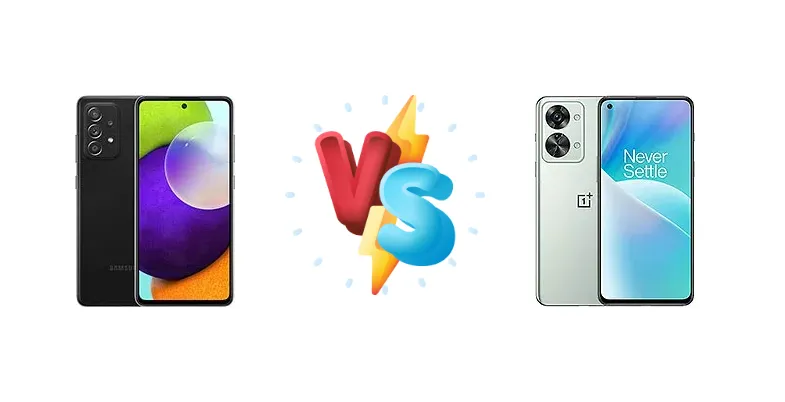
OnePlus Nord 2T vs Samsung Galaxy A52: Which Mid-Range Phone Reigns Supreme?
| Phones Images | |||||
|---|---|---|---|---|---|
|
🏆 Quick Verdict
For most users, the OnePlus Nord 2T emerges as the stronger contender. Its Mediatek Dimensity 1300 chipset delivers a noticeable performance boost over the Snapdragon 720G in the A52, and the blazing-fast 80W charging significantly reduces downtime. While the A52 retains a slight edge in display brightness, the Nord 2T’s overall package is more compelling.
| PHONES | ||
|---|---|---|
| Phone Names | Samsung Galaxy A52 | OnePlus Nord 2T |
| Network | ||
|---|---|---|
| 2G bands | GSM 850 / 900 / 1800 / 1900 | GSM 850 / 900 / 1800 / 1900 |
| 3G bands | HSDPA 850 / 900 / 1700(AWS) / 1900 / 2100 | HSDPA 800 / 850 / 900 / 1700(AWS) / 1800 / 1900 / 2100 |
| 4G bands | 1, 2, 3, 4, 5, 7, 8, 12, 17, 20, 26, 28, 32, 38, 40, 41, 66 | 1, 2, 3, 4, 5, 7, 8, 12, 17, 18, 19, 20, 26, 28, 32, 34, 38, 39, 40, 41, 66 |
| 5G bands | - | 1, 3, 7, 8, 20, 28, 38, 41, 78 SA/NSA |
| Speed | HSPA, LTE | HSPA 42.2/5.76 Mbps, LTE Cat18 1200/150 Mbps, 5G |
| Technology | GSM / HSPA / LTE | GSM / HSPA / LTE / 5G |
| Launch | ||
|---|---|---|
| Announced | 2021, March 17 | 2022, May 19 |
| Status | Available. Released 2021, March 26 | Available. Released 2022, May 21 |
| Body | ||
|---|---|---|
| Build | Glass front (Gorilla Glass 5), plastic frame, plastic back | Glass front (Gorilla Glass 5), plastic frame |
| Dimensions | 159.9 x 75.1 x 8.4 mm (6.30 x 2.96 x 0.33 in) | 159.1 x 73.2 x 8.2 mm (6.26 x 2.88 x 0.32 in) |
| SIM | · Nano-SIM· Nano-SIM + Nano-SIM | Nano-SIM + Nano-SIM |
| Weight | 189 g (6.67 oz) | 190 g (6.70 oz) |
| Display | ||
|---|---|---|
| Protection | Corning Gorilla Glass 5 | Corning Gorilla Glass 5 |
| Resolution | 1080 x 2400 pixels, 20:9 ratio (~407 ppi density) | 1080 x 2400 pixels, 20:9 ratio (~409 ppi density) |
| Size | 6.5 inches, 101.0 cm2 (~84.1% screen-to-body ratio) | 6.43 inches, 99.8 cm2 (~85.7% screen-to-body ratio) |
| Type | Super AMOLED, 90Hz, 800 nits (HBM) | AMOLED, 90Hz, HDR10+ |
| Platform | ||
|---|---|---|
| CPU | Octa-core (2x2.3 GHz Kryo 465 Gold & 6x1.8 GHz Kryo 465 Silver) | Octa-core (1x3.0 GHz Cortex-A78 & 3x2.6 GHz Cortex-A78 & 4x2.0 GHz Cortex-A55) |
| Chipset | Qualcomm SM7125 Snapdragon 720G (8 nm) | Mediatek Dimensity 1300 (6 nm) |
| GPU | Adreno 618 | Mali-G77 MC9 |
| OS | Android 11, upgradable to Android 14, One UI 6.1 | Android 12, upgradable to Android 14, OxygenOS 14 |
| Memory | ||
|---|---|---|
| Card slot | microSDXC (uses shared SIM slot) | No |
| Internal | 128GB 4GB RAM, 128GB 6GB RAM, 128GB 8GB RAM, 256GB 6GB RAM, 256GB 8GB RAM | 128GB 8GB RAM, 256GB 12GB RAM |
| - | UFS 3.1 | |
| Main Camera | ||
|---|---|---|
| Features | LED flash, panorama, HDR | Dual-LED flash, HDR, panorama |
| Quad | 64 MP, f/1.8, 26mm (wide), 1/1.7", 0.8µm, PDAF, OIS 12 MP, f/2.2, 123˚ (ultrawide), 1.12µm 5 MP (macro) Auxiliary lens | - |
| Single | - | 32 MP, f/2.4, (wide), 1/2.8", 0.8µm |
| Triple | - | 50 MP, f/1.9, 24mm (wide), 1/1.56", 1.0µm, PDAF, OIS 8 MP, f/2.2, 120˚ (ultrawide) Auxiliary lens |
| Video | 4K@30fps, 1080p@30/60fps; gyro-EIS | 4K@30fps, 1080p@30/60/120/480fps, gyro-EIS |
| Selfie camera | ||
|---|---|---|
| Features | HDR | Auto HDR |
| Single | 32 MP, f/2.2, 26mm (wide), 1/2.8", 0.8µm | 32 MP, f/2.4, (wide), 1/2.8", 0.8µm |
| Video | 4K@30fps, 1080p@30fps | 1080p@30fps, gyro-EIS |
| Sound | ||
|---|---|---|
| 3.5mm jack | Yes | No |
| 35mm jack | Yes | No |
| Loudspeaker | Yes, with stereo speakers | Yes, with stereo speakers |
| Comms | ||
|---|---|---|
| Bluetooth | 5.0, A2DP, LE | 5.2, A2DP, LE, aptX HD |
| NFC | Yes (market/region dependent) | Yes |
| Positioning | GPS, GLONASS, GALILEO, BDS | GPS, GLONASS, GALILEO, BDS, NavIC |
| Radio | FM radio | No |
| USB | USB Type-C 2.0, OTG | USB Type-C 2.0, OTG |
| WLAN | Wi-Fi 802.11 a/b/g/n/ac, dual-band, Wi-Fi Direct | Wi-Fi 802.11 a/b/g/n/ac/6, dual-band, Wi-Fi Direct |
| Features | ||
|---|---|---|
| Sensors | Fingerprint (under display, optical), accelerometer, gyro, compass | Fingerprint (under display, optical), accelerometer, gyro, proximity, compass |
| Battery | ||
|---|---|---|
| Charging | 25W wired, 50% in 30 min | 80W wired, PD |
| Type | Li-Po 4500 mAh | Li-Po 4500 mAh |
| Misc | ||
|---|---|---|
| Colors | Awesome Black, Awesome White, Awesome Violet, Awesome Blue | Gray Shadow, Jade Fog |
| Models | SM-A525F, SM-A525F/DS, SM-A525M, SM-A525M/DS | CPH2399, CPH2401 |
| Price | C$ 699.00 / £ 129.99 / € 169.89 | € 144.39 / $ 169.99 / ₹ 31,490 |
| SAR EU | 0.35 W/kg (head) 0.84 W/kg (body) | - |
| Tests | ||
|---|---|---|
| Battery life | Endurance rating 105h | Endurance rating 100h |
| Camera | Photo / Video | Photo / Video |
| Display | Contrast ratio: Infinite (nominal) | Contrast ratio: Infinite (nominal) |
| Loudspeaker | -27.0 LUFS (Good) | -25.6 LUFS (Very good) |
| Performance | AnTuTu: 261282 (v8) GeekBench: 5865 (v4.4), 1577 (v5.1) GFXBench: 15fps (ES 3.1 onscreen) | AnTuTu: 490545 (v8) | 604467 (v9) GeekBench: 2790 (v5.1) GFXBench: 40fps (ES 3.1 onscreen) |
Samsung Galaxy A52
- Slightly longer battery endurance (105h)
- Brighter display for outdoor use (794 nits)
- Proven reliability and software support
- Older, less powerful Snapdragon 720G chipset
- Slower 25W charging
OnePlus Nord 2T
- Faster and more efficient Dimensity 1300 chipset
- Blazing-fast 80W wired charging
- More modern processor architecture
- Slightly lower battery endurance (100h)
- Dimmer display (636 nits)
Display Comparison
The Samsung Galaxy A52 boasts a measured peak brightness of 794 nits, offering excellent visibility in bright conditions. However, the OnePlus Nord 2T, while dimmer at 636 nits, still provides a perfectly usable experience. Both displays share an 'Infinite' (nominal) contrast ratio, suggesting deep blacks. The A52’s Super AMOLED panel is known for its vibrant colors, but the Nord 2T’s display is no slouch. The difference in brightness is the most significant distinction, favoring the A52 for users frequently exposed to direct sunlight.
Camera Comparison
Both devices offer capable camera systems, but details are limited to 'Photo / Video' in the provided data. However, considering OnePlus’s recent focus on camera improvements and the Dimensity 1300’s image signal processor (ISP), the Nord 2T likely benefits from more advanced image processing algorithms. The A52’s camera is known for its consistent performance, but the Nord 2T’s newer chipset could offer advantages in low-light photography and dynamic range. Without specific sensor details, it’s difficult to declare a clear winner, but the Nord 2T’s processing power suggests a slight edge.
Performance
The core difference lies in the chipsets. The OnePlus Nord 2T’s Mediatek Dimensity 1300, built on a 6nm process, represents a significant leap over the Samsung Galaxy A52’s 8nm Qualcomm Snapdragon 720G. The Dimensity 1300’s octa-core configuration, featuring a high-clocked Cortex-A78 prime core, translates to faster app loading times and smoother multitasking. While both phones are capable of handling everyday tasks, the Nord 2T will exhibit less strain during demanding games and resource-intensive applications. The 6nm node also contributes to improved thermal efficiency, potentially reducing throttling under sustained load.
Battery Life
The Samsung Galaxy A52’s endurance rating of 105 hours is slightly better than the OnePlus Nord 2T’s 100 hours, indicating marginally longer battery life under typical usage. However, this advantage is offset by the Nord 2T’s dramatically faster 80W wired charging, which can replenish the battery from 0-100% in a fraction of the time compared to the A52’s 25W charging (50% in 30 minutes). This difference in charging speed is a game-changer for users who prioritize convenience and minimal downtime.
Buying Guide
Buy the Samsung Galaxy A52 if you prioritize proven reliability, a slightly brighter display for outdoor visibility, and a longer track record of software support. Buy the OnePlus Nord 2T if you value faster performance for gaming and multitasking, incredibly rapid charging, and a more modern processor architecture for future-proofing.