
Samsung Galaxy A52 vs. Motorola Moto G Stylus 5G (2022): A Detailed Comparison
| Phones Images | |||||
|---|---|---|---|---|---|
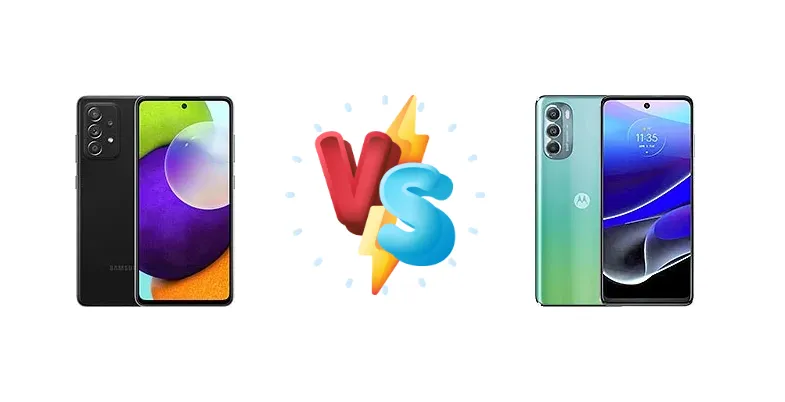
|
🏆 Quick Verdict
For most users, the Samsung Galaxy A52 emerges as the better overall choice. Its significantly brighter display (794 nits) and proven endurance rating (105h) outweigh the Moto G Stylus 5G’s newer chipset, especially considering the Motorola’s slow 10W charging.
| PHONES | ||
|---|---|---|
| Phone Names | Samsung Galaxy A52 | Motorola Moto G Stylus 5G (2022) |
| Network | ||
|---|---|---|
| 2G bands | GSM 850 / 900 / 1800 / 1900 | GSM 850 / 900 / 1800 / 1900 |
| 3G bands | HSDPA 850 / 900 / 1700(AWS) / 1900 / 2100 | HSDPA 850 / 900 / 1700(AWS) / 1900 / 2100 |
| 4G bands | 1, 2, 3, 4, 5, 7, 8, 12, 17, 20, 26, 28, 32, 38, 40, 41, 66 | 1, 2, 3, 4, 5, 7, 8, 12, 13, 17, 18, 19, 20, 25, 26, 28, 29, 30, 38, 39, 40, 41, 48, 66, 71 - USA |
| 5G bands | - | 1, 2, 5, 12, 14, 24, 26, 29, 30, 41, 48, 66, 70, 71, 77, 78 SA/NSA - USA |
| Speed | HSPA, LTE | HSPA, LTE, 5G |
| Technology | GSM / HSPA / LTE | GSM / HSPA / LTE / 5G |
| Launch | ||
|---|---|---|
| Announced | 2021, March 17 | 2022, April 22 |
| Status | Available. Released 2021, March 26 | Available. Released 2022, April 27 |
| Body | ||
|---|---|---|
| Build | Glass front (Gorilla Glass 5), plastic frame, plastic back | Glass front, plastic frame, plastic back |
| Dimensions | 159.9 x 75.1 x 8.4 mm (6.30 x 2.96 x 0.33 in) | 168.9 x 75.8 x 9.3 mm (6.65 x 2.98 x 0.37 in) |
| SIM | · Nano-SIM· Nano-SIM + Nano-SIM | Nano-SIM |
| Weight | 189 g (6.67 oz) | 215 g (7.58 oz) |
| - | Stylus Water-repellent design | |
| Display | ||
|---|---|---|
| Protection | Corning Gorilla Glass 5 | - |
| Resolution | 1080 x 2400 pixels, 20:9 ratio (~407 ppi density) | 1080 x 2460 pixels (~395 ppi density) |
| Size | 6.5 inches, 101.0 cm2 (~84.1% screen-to-body ratio) | 6.8 inches, 109.8 cm2 (~85.8% screen-to-body ratio) |
| Type | Super AMOLED, 90Hz, 800 nits (HBM) | IPS LCD, 120Hz |
| Platform | ||
|---|---|---|
| CPU | Octa-core (2x2.3 GHz Kryo 465 Gold & 6x1.8 GHz Kryo 465 Silver) | Octa-core (2x2.2 GHz Kryo 660 Gold & 6x1.7 GHz Kryo 660 Silver) |
| Chipset | Qualcomm SM7125 Snapdragon 720G (8 nm) | Qualcomm SM6375 Snapdragon 695 5G (6 nm) |
| GPU | Adreno 618 | Adreno 619 |
| OS | Android 11, upgradable to Android 14, One UI 6.1 | Android 12, planned upgrade to Android 13 |
| Memory | ||
|---|---|---|
| Card slot | microSDXC (uses shared SIM slot) | microSDXC (dedicated slot) |
| Internal | 128GB 4GB RAM, 128GB 6GB RAM, 128GB 8GB RAM, 256GB 6GB RAM, 256GB 8GB RAM | 128GB 4GB RAM, 128GB 6GB RAM, 128GB 8GB RAM, 256GB 8GB RAM |
| Main Camera | ||
|---|---|---|
| Features | LED flash, panorama, HDR | LED flash, HDR, panorama |
| Quad | 64 MP, f/1.8, 26mm (wide), 1/1.7", 0.8µm, PDAF, OIS 12 MP, f/2.2, 123˚ (ultrawide), 1.12µm 5 MP (macro) Auxiliary lens | - |
| Triple | - | 50 MP, f/1.9, 26mm (wide), 0.64µm, PDAF, OIS 8 MP, f/2.2, 118˚ (ultrawide), 1/4.0, 1.12µm Auxiliary lens |
| Video | 4K@30fps, 1080p@30/60fps; gyro-EIS | 1080p@30/60fps; gyro-EIS |
| Selfie camera | ||
|---|---|---|
| Features | HDR | HDR |
| Single | 32 MP, f/2.2, 26mm (wide), 1/2.8", 0.8µm | 16 MP, f/2.2, (wide), 1/3.06", 1.0µm |
| Video | 4K@30fps, 1080p@30fps | 1080p@30fps |
| Sound | ||
|---|---|---|
| 3.5mm jack | Yes | Yes |
| 35mm jack | Yes | Yes |
| Loudspeaker | Yes, with stereo speakers | Yes |
| Comms | ||
|---|---|---|
| Bluetooth | 5.0, A2DP, LE | 5.1, A2DP, LE |
| NFC | Yes (market/region dependent) | Yes |
| Positioning | GPS, GLONASS, GALILEO, BDS | GPS, GLONASS, BDS, GALILEO |
| Radio | FM radio | FM radio |
| USB | USB Type-C 2.0, OTG | USB Type-C 2.0 |
| WLAN | Wi-Fi 802.11 a/b/g/n/ac, dual-band, Wi-Fi Direct | Wi-Fi 802.11 a/b/g/n/ac, dual-band, Wi-Fi Direct |
| Features | ||
|---|---|---|
| Sensors | Fingerprint (under display, optical), accelerometer, gyro, compass | Fingerprint (side-mounted), accelerometer, gyro, proximity |
| Battery | ||
|---|---|---|
| Charging | 25W wired, 50% in 30 min | 10W wired, QC3 |
| Type | Li-Po 4500 mAh | Li-Po 5000 mAh |
| Misc | ||
|---|---|---|
| Colors | Awesome Black, Awesome White, Awesome Violet, Awesome Blue | Steel Blue, Seafoam Green |
| Models | SM-A525F, SM-A525F/DS, SM-A525M, SM-A525M/DS | XT2215, XT2215-1, XT2215-2, XT2215-3, XT2215-4 |
| Price | C$ 699.00 / £ 129.99 / € 169.89 | $ 66.60 |
| SAR EU | 0.35 W/kg (head) 0.84 W/kg (body) | - |
| Tests | ||
|---|---|---|
| Battery life | Endurance rating 105h | - |
| Camera | Photo / Video | - |
| Display | Contrast ratio: Infinite (nominal) | - |
| Loudspeaker | -27.0 LUFS (Good) | - |
| Performance | AnTuTu: 261282 (v8) GeekBench: 5865 (v4.4), 1577 (v5.1) GFXBench: 15fps (ES 3.1 onscreen) | - |
Samsung Galaxy A52
- Significantly brighter display for outdoor visibility
- Faster 25W charging
- Proven 105-hour battery endurance
- Older chipset (Snapdragon 720G)
- May receive fewer software updates
Motorola Moto G Stylus 5G (2022)
- Newer 5G chipset (Snapdragon 695)
- Integrated stylus for note-taking
- Potentially better power efficiency with 6nm process
- Slow 10W charging
- Likely dimmer display
- Uncertain camera performance
Display Comparison
The Samsung Galaxy A52 boasts a substantial advantage in display quality, achieving a measured peak brightness of 794 nits. This makes it far more usable outdoors under direct sunlight compared to the Moto G Stylus 5G, which lacks published brightness data and is expected to be dimmer. While both likely utilize OLED panels, the A52’s higher brightness and 'Infinite' contrast ratio suggest superior viewing angles and color reproduction. The A52’s display is geared towards immersive media consumption, while the Moto G Stylus 5G’s display is likely more functional than impressive.
Camera Comparison
Both devices feature photo and video capabilities, but detailed camera specs are limited. The A52’s camera system likely benefits from Samsung’s established image processing algorithms. Without specific sensor size or aperture information for either phone, it’s difficult to make a definitive judgment. The Moto G Stylus 5G’s camera is likely focused on providing adequate performance for social media sharing, while the A52 may offer more refined image quality and potentially better low-light performance. The inclusion of OIS on the A52 would be a significant advantage, but is unconfirmed.
Performance
The Motorola Moto G Stylus 5G (2022) features the Qualcomm Snapdragon 695 5G (6nm), a newer chipset than the Galaxy A52’s Snapdragon 720G (8nm). The 6nm process node generally offers improved power efficiency. However, the Snapdragon 720G’s Kryo 465 Gold cores, clocked at 2.3 GHz, are slightly faster than the 695’s 2.2 GHz Kryo 660 Gold cores. In real-world usage, the performance difference will be noticeable in demanding tasks, but both phones are geared towards mid-range performance, not flagship-level gaming. The 695’s 5G modem is a key advantage for future-proofing.
Battery Life
The Samsung Galaxy A52’s endurance rating of 105 hours indicates excellent battery life. This is coupled with 25W wired charging, capable of reaching 50% charge in 30 minutes. The Motorola Moto G Stylus 5G (2022) suffers from a significant disadvantage in this area, with only 10W wired charging and QC3 support. This slower charging speed will require considerably more time to fully replenish the battery, making the A52 the clear winner for users who prioritize quick top-ups and overall battery longevity.
Buying Guide
Buy the Samsung Galaxy A52 if you prioritize a vibrant, easily viewable display, and long-lasting battery life. It’s ideal for media consumption and users who value a polished software experience. Buy the Motorola Moto G Stylus 5G (2022) if you specifically need a built-in stylus for note-taking or creative tasks, and are willing to compromise on display quality and charging speed for a newer 5G chipset.